

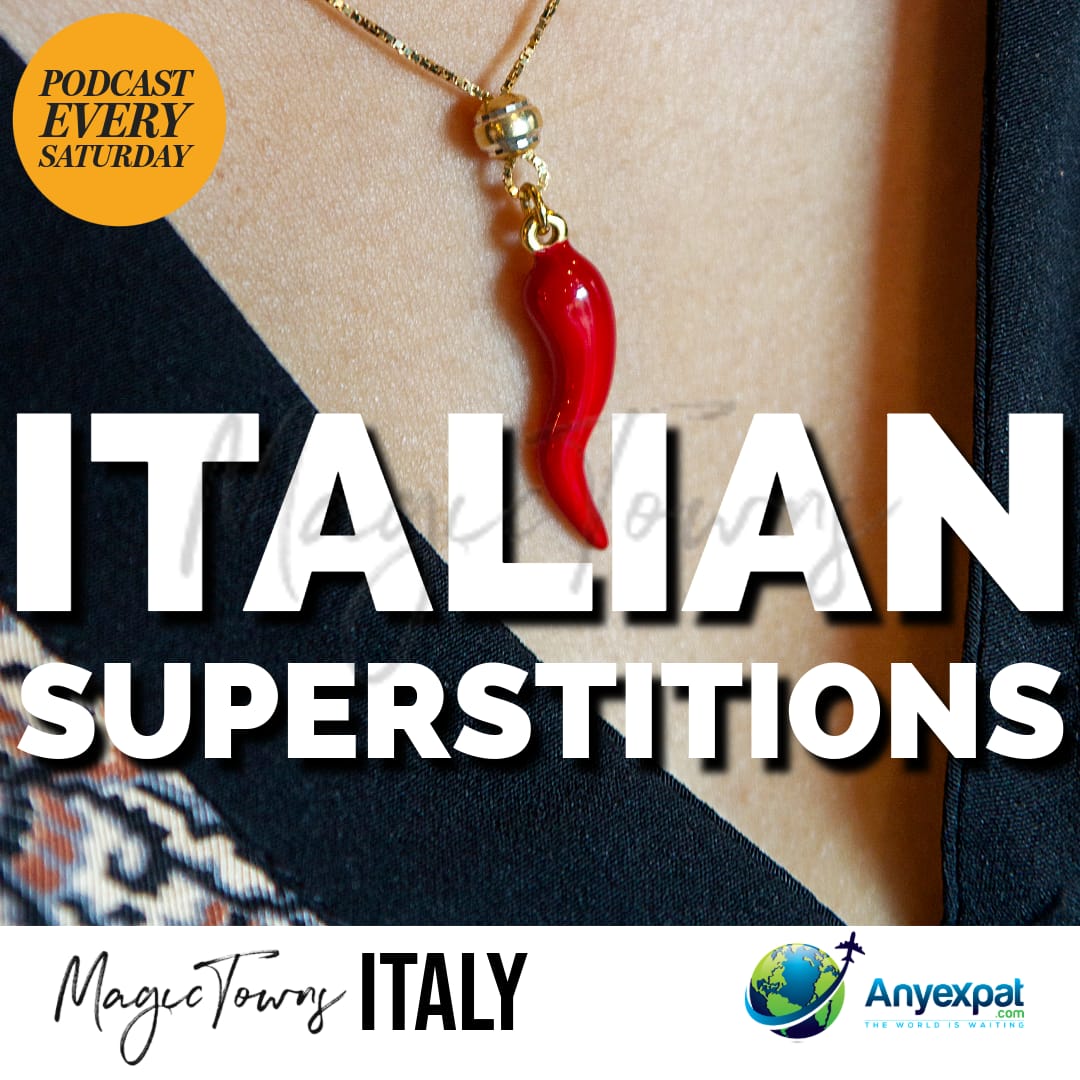

[00:00:00] Alessia : Welcome back to the Magic Towns Italy podcast. Today, we’re plunging into, well, a fascinating world where ancient beliefs kind of dance with modern life, where traditions are deeply held, but also sometimes playfully dismissed. We’re talking Italian superstitions, and it’s all summed up by that great saying, “Non è vero ma ci credo”, it’s not true, but I believe it.
[00:00:21] Miles : That phrase really does capture it perfectly, doesn’t it? It’s this charming mix of skepticism and well genuine belief. It makes Italian superstitions quite unique. They aren’t just, you know, old wives tales tucked away somewhere. Still influencing everyday life, and for anyone thinking about moving to Italy, maybe retiring there, understanding these beliefs, it’s more than just interesting. It’s actually practical. It helps you navigate social situations, you know, from dinner parties to big life events,
[00:00:50] Alessia : We’re going beyond, just knock on wood. We’ll cover protective charms, unlucky numbers, household no-nos, wedding rituals, New Year’s traditions, the whole lot.
[00:01:00] Alors, par où commencer ?
[00:01:01] Miles : Nous devons absolument commencer par le malocchio, the evil eye. Now you’re probably familiar with the general idea. It pops up in lots of cultures, but in Italy, particularly in the South, it’s this powerful belief that a certain look, usually one driven by envy can actually cause harm or bad luck.
[00:01:18] Alessia : D'accord. Donc, si le malocchio is this real threat, what do people actually do? What are the protections? I’ve seen those little red horn charms everywhere.
[00:01:25] Miles : Euh, oui. Vous voulez dire le cornicelli?
[00:01:27] Alessia : That’s them.
[00:01:28] Miles : Des pendentifs en forme de petite corne, souvent rouges, peut-être en corail ou en émail.
[00:01:32] You see them everywhere. Key chains, necklaces, rear view mirrors. Even on baby strollers, they kind of serve two purposes, right? Warding off the evil eye, but also attracting good luck. And here’s a crucial tip for you. A cornicello is said to be most effective when it’s given as a gift.
[00:01:47] Alessia : Oh, intéressant.
[00:01:48] Miles : Yeah, so if an Italian friend gives you one, it’s a really genuine gesture of goodwill and protection.
[00:01:53] It’s lovely, and you’re right about seeing them large scale too. Think of those giant chili pepper statues in Naples. That shows how deep it runs.
[00:02:01] Alessia : So a cornicello is a great gift both ways. Now, besides charms, aren’t there hand gestures too, like le corna?
[00:02:06] Miles : Yes, le corna, the horns, it’s a really common hand sign.
[00:02:10] Vous tendez votre index et repliez les autres doigts vers le bas. Cela ressemble un peu au signe du rock and roll. Les Italiens peuvent le faire discrètement, généralement en le pointant vers le bas ou peut-être vers le haut si quelqu'un mentionne la malchance ou le malheur, juste pour le conjurer. Mais, et c'est très important que vous le sachiez, vous ne devez jamais le pointer directement vers quelqu'un.
[00:02:28] Alessia : Comment cela se fait-il ?
[00:02:29] Miles : Cela change complètement le sens. Cela devient une insulte grave. Cela sous-entend que la personne est cocu, ce qui ne sera pas bien accueilli.
[00:02:35] Alessia : Distinction essentielle. Pointez vers le bas ou vers le haut, mais jamais vers le centre. Compris. Et si vous avez besoin d'un peu plus de discrétion ?
[00:02:41] Miles : Oui. En bonne compagnie ou de manière plus subtile ? La plupart des gens opteraient pour toucher du fer, touch iron. That’s basically the Italian knock on wood. And well without demonstrating here. Some men might discreetly touch their groin area and women might touch a breast. It’s a similar private touch luck kind of thing when bad news is mentioned.
[00:02:59] Alessia : Donc, pour toucher du fer, touche le fer. Pourquoi le fer et pas le bois, comme on pourrait le dire ?.
[00:03:03] Miles : Eh bien, cela remonte à très loin. Le fer était considéré comme un métal doté de pouvoirs protecteurs magiques. Pensez à sa résistance. Les armes, les armures, les fers à cheval suspendus au-dessus des portes, ce genre de choses. Le fer est donc devenu synonyme de protection. Aujourd'hui, si quelqu'un exprime une inquiétude, par exemple au sujet d'une éventuelle maladie ou d'un malheur potentiel, il peut rapidement tendre la main et toucher quelque chose en fer, une clé, une rampe.
[00:03:23] Alessia : Ou peut-être un petit charm en fer.
[00:03:25] Miles : Or even just a nail in their pocket. It’s that better safe than sorry idea, but with an iron twist.
[00:03:30] Alessia : So if you see your new Italian neighbor, tap a lamppost after you mention your car trouble. Don’t think they’re odd.
[00:03:35] Miles : It’s just an ingrained reflex, hedging their bets against bad luck.
[00:03:39] Alessia : Bon, le suivant est vraiment intéressant. Le iettatore. This isn’t about bad actions, but about a person just being unlucky.
[00:03:46] Miles : That’s right. The iettatore isn’t necessarily trying to cause harm. They’re just believed to bring bad luck simply by existing, by being present. There’s even this sort of historical stereotype, pale, serious looking, maybe wears glasses, dresses in black. Often said to be from Naples or Sicily.
[00:04:03] And while it might sound like pure folklore, this belief can actually have real world impact. It could lead to someone being subtly shunned or even affect their job prospects. And here’s a key cultural point for you. In modern Italy, openly calling someone a jinx and iettatore peut en fait être considéré comme de la diffamation.
[00:04:22] Alessia : It carries real weight. It’s not just a lighthearted tease, then
[00:04:25] Miles : it can be, but there’s a serious undertone you need to be aware of. It really shows the gravity some labels can have.
[00:04:31] Alessia : Are there ways to counteract a yet if you think you’ve encountered one?
[00:04:35] Miles : Oh, oui. Il existe bien sûr des contre-sorts ou des actions consistant à toucher du fer.
[00:04:38] Oui. Serrer ton cornicello. Certaines personnes pourraient même essayer subtilement d'obtenir le iettatore eux-mêmes à dire, toucher leur épaule pour briser en quelque sorte le sort supposé. De nos jours, la plupart des gens traitent cela avec un peu d'humour, mais si une réunion tourne mal juste après l'arrivée de quelqu'un et que vous entendez des murmures, il vaut peut-être mieux changer de sujet.
[00:04:56] Alessia : Good advice. Perception is clearly huge. Now, speaking of specific beliefs, let’s talk numbers. Italy has its own unique unlucky number, and it’s not 13, it’s 17.
[00:05:06] Miles : That’s the one. 17 is Italy’s big unlucky number, and the reason it’s fascinating, it comes from Latin. The Roman numeral for 17. If you rearrange those letters, you can spell VIXI.
[00:05:16] Alessia : Which strongly implies well that your life is over. It’s linked to death. Because of this, you’ll actually find some hotels in Italy, skip the 17th floor. Airlines might skip row 17.
[00:05:26] Miles : Sérieusement ?
[00:05:27] Alessia : Absolutely. So Friday the 17th becomes Italy’s equivalent of Friday the 13th. And it’s not just Fridays. That can be tricky. Tuesdays too.
[00:05:36] Miles : Right. There’s an old saying, “Di Venere e di Marte non si sposa né si parte”, on Venus’ Day, that’s Friday, or Mars’ Day, Tuesday. Don’t get married or start a journey. Friday was linked to sorrow, Christ’s crucifixion. Tuesday being Mars’s day, the God of war was seen as bad for starting things likely to lead to conflict.
[00:05:54] Alessia : So 17 is bad. Friday and Tuesday can be iffy for big events, but 13 isn’t universally feared. Yeah, it’s interesting. Italians know the Last Supper story, 13 at a table being bad luck for someone within the year. But outside of that specific dinner context, 13 doesn’t have the same heavy stigma as it does elsewhere.
[00:06:14] In fact, 13 can even be lucky sometimes “Fare tredici”, to make 13 means hitting the jackpot on the football lottery pools. And the number three is generally seen as very lucky, you know, linked to the Holy Trinity. So you might hear wishes or toast. Repeated three times
[00:06:32] Miles : Et Naples possède cette merveilleuse chose.
[00:06:33] Alessia : It’s this tradition of interpreting your dreams and mapping them to specific lottery numbers dreamt of a cat. There’s a number for that. Bread, a number for that too. It’s this beautiful mix of folklore trying to understand your subconscious, and while hoping to win big.
[00:06:51] Miles : Passons maintenant à l'intérieur de la maison. Quelles sont les superstitions domestiques incontournables pour toute personne qui s'installe en Italie ?
[00:06:57] Je pense toujours à ne pas laisser de chapeaux sur le lit.
[00:06:59] Alessia : That is probably the most classic Italian household rule. Definitely no hats on the bed. It’s believed to bring bad luck, maybe even death, and the origin is quite grim, actually, historically, when a priest came to give the last rites, he’d take off his hat and place it on the bed of the dying person.
[00:07:16] Miles : Voyez le lien.
[00:07:18] Alessia : Exactly, so the image became strongly associated with death. Even today, you’ll see people react instantly snatching a hat off a bed. It’s almost instinctive for many.
[00:07:26] Miles : Profondément ancré. Et qu'en est-il des balais ? Y a-t-il quelque chose que nous devrions savoir sur le balayage ?
[00:07:31] Alessia : Yes, watch where you sweep. There’s a superstition, mostly a joke now that if you accidentally sweep over an unmarried woman’s feet, she’ll never get married.
[00:07:38] And more seriously, perhaps if you move into a new house, tradition says you should buy a new broom. The idea is you’re sweeping in good fortune and leaving any bad vibes from the old place behind.
[00:07:49] Miles : Makes sense. And umbrellas indoors. That’s common elsewhere too. But is there a specific Italian angle?
[00:07:55] Alessia : There is, most cultures say opening an umbrella inside is bad luck. The Italian interpretation is often that you’re sort of tempting fate, like you’re inviting rain, meaning misfortune into your home.
[00:08:06] Miles : It’s fascinating how practical things like maybe leaky roofs in the past might blend with these beliefs. Any other bedroom superstitions.
[00:08:13] Alessia : Well, a slightly less common one, but still around is about mirrors. Some believe you shouldn’t sleep with a mirror directly facing the bed.
[00:08:20] Miles : Qu'est-ce que c'est ?
[00:08:21] Alessia : L'idée est que le miroir, parfois considéré comme un portail, pourrait voler votre esprit pendant que vous dormez.
[00:08:26] So you might find perhaps older generations covering mirrors in the bedroom at night, or positioning furniture so the bed doesn’t face one.
[00:08:33] Miles : Intéressant.
[00:08:34] Alessia : Vous connaissez aussi l'expression « se lever du mauvais côté du lit ». En Italie, cela signifie précisément sortir du lit le pied gauche en premier. Le mot pour « gauche » est, sinistra, partage ses racines avec sinistre.
[00:08:44] Le côté gauche a donc une connotation légèrement négative.
[00:08:47] Miles : But wait, I read somewhere that sometimes you’re actually meant to enter a new house with your left foot first. It seems contradictory.
[00:08:53] Alessia : It does, doesn’t it? But yes, that’s another piece of folk wisdom. Stepping in left first confuses any evil spirits lurking at the threshold.
[00:09:01] Miles : Okay. Let’s head to the kitchen and the dining table, though the heart of the Italian home. What rules apply here? I know bread is a big one.
[00:09:08] Alessia : Absolument crucial. Ne posez jamais un pain à l'envers sur la table.
[00:09:13] Miles : Pourquoi est-ce si grave ?
[00:09:14] Alessia : It’s considered really unlucky, but also deeply impolite. Bread is almost sacred in Italy. You know, symbolizing the body of Christ in communion. Placing it upside down is seen as profound disrespect, almost inviting poverty or misfortune.
[00:09:27] There’s even a historical anecdote about medieval executioners having their bread left upside down by bakers.
[00:09:33] Miles : Ouah. Donc, si tu le fais par accident...
[00:09:34] Alessia : Immédiatement à l'endroit. Certaines personnes âgées pourraient même lui donner un petit baiser en guise d'excuse. Cela souligne vraiment le respect pour les aliments de base que sont le pain, le sel et l'huile. Ces choses sont précieuses.
[00:09:44] Miles : Compris, le pain à l'endroit. Et si on renverse du sel ? Comme partout ailleurs.
[00:09:49] Alessia : Oui, en gros. Renverser du sel est un mauvais présage, souvent associé à des pertes financières ou à des disputes. Et le remède est classique. Prenez rapidement une pincée de sel et jetez-la par-dessus votre épaule gauche.
[00:09:59] Miles : L'épaule gauche en particulier ?
[00:10:00] Alessia : Because that’s where the devil is said to lurk. The salt supposedly gets in his eyes and wards off. The bad luck. Also an etiquette point. Never pass the salt shaker directly, hand to hand. Put it down on the table for the other person to pick up. Passing it directly is thought to pass on bad feelings or discord.
[00:10:16] Miles : D'accord, bon conseil. Maintenant, l'huile d'olive est de l'or liquide qui se répand. Ça doit être terrible.
[00:10:20] Alessia : Spilling olive oil is taken very seriously, especially in the South where it’s so central to life and economy. It’s seen as incredibly unlucky, a real sign of potential disaster looming wasting this precious commodity. I’ve heard stories of Nanas getting quite upset over a dropped bottle.
[00:10:38] Miles : So what’s the remedy
[00:10:39] Alessia : Encore ? Le sel vient à la rescousse, saupoudrez immédiatement du sel sur la tache. Certaines personnes vont même jusqu'à dessiner une croix avec le sel et, d'un point de vue pratique, le sel aide effectivement à absorber l'huile et rend le sol moins glissant. La sagesse ancestrale rencontre le sens pratique.
[00:10:54] Miles : It does seem that way, but here’s a funny one. Spilling wine is good luck. That seems counterintuitive.
[00:10:59] Alessia : It is, isn’t it? But yes, generally spilling a little wine isn’t seen as bad luck. In fact, it’s often considered good luck. There’s even a little tradition where you might dab a bit of the spilled wine behind your ears, like perfume.
[00:11:12] Miles : D'accord. Le vin, c'est bon. L'huile, c'est mauvais.
[00:11:13] Alessia : Oui, c'est vrai.
[00:11:14] Miles : Got it. And there’s a specific way not to pour wine. The poisoners pour.
[00:11:18] Alessia : Ah oui. Un élément clé de l'étiquette lors d'un dîner.
[00:11:20] Ne versez jamais le vin en tenant la bouteille par le haut, de manière à ce que le dos de votre main soit tourné vers le verre de votre interlocuteur.
[00:11:26] This is called “Versare alla traditora”, pouring like a traitor.
[00:11:30] Miles : Pourquoi ? Comme un traître ?
[00:11:31] Alessia : L'histoire remonte au Moyen Âge, peut-être même à la Renaissance, où quelqu'un qui cachait du poison dans une bague pouvait le verser en inversant la position de sa main pour le libérer subtilement.
[00:11:43] Miles : Fascinant. Il faut donc toujours verser sous la main.
[00:11:45] Alessia : Exactement. La paume vers le haut ou sur le côté, la bouteille tenue par le dessous. Verser par-dessus la tête semble suspect, ou du moins négligent pour ceux qui connaissent la tradition.
[00:11:55] Miles : Et même la façon dont vous rangez les couverts a son importance.
[00:11:57] Alessia : Oui, lorsque vous faites une pause pendant le repas ou que vous avez terminé, essayez de ne pas laisser votre couteau et votre fourchette croisés sur l'assiette.
[00:12:04] Crossing them is said to invite quarrels or misfortune, maybe because it resembles a cross, and you shouldn’t mimic secret symbols carelessly. Just keep them parallel. Similarly, when you’re toasting, don’t cross arms with someone else to reach a glass further away.
[00:12:20] Mauvaise forme, c'est vrai.
[00:12:22] Miles : Let’s talk toasting then, since everyone knows that. But what are the crucial rules for a proper Italian _brindisi _to keep the luck flowing?
[00:12:29] Alessia : Okay. Essential stuff for socializing. Rule number one. Absolutely paramount. Always make eye contact with the person you’re clinking glasses with. Look them right in the eye as your glasses touch.
[00:12:40] Miles : Pourquoi le contact visuel est-il si important ?
[00:12:41] Alessia : Cela montre un respect sincère, mais la superstition veut que ne pas établir de contact visuel vous condamne à sept ans de malchance ou, comme le dit la blague populaire, à sept ans de mauvais sexe.
[00:12:51] Miles : Hein ? D'accord. La motivation pour regarder les gens dans les yeux.
[00:12:54] Alessia : Definitely. You’ll often hear Italians remind each other, look me in the eyes.
[00:12:59] The origin might be medieval too. Checking the other person wasn’t poisoning your drink.
[00:13:03] Miles : Makes sense. What else? What should you not toast with? I’ve heard water is a definite no.
[00:13:08] Alessia : A massive no-no. Toasting with plain water is considered extremely bad luck, almost like wishing death upon someone. It’s associated with things like the river sticks and the underworld, or maybe with toast to fallen sailors lost at sea.
[00:13:21] Just don’t do it.
[00:13:23] Miles : Tout sauf l'eau, les jus de fruits et les sodas.
[00:13:24] Alessia : Yes. Wine, prosecco, spritz, juice, soda. Anything fizzy or flavorful is fine, just not plain water. It’s a surprisingly strong taboo. Other little things, some people tap their glass on the table gently after clinking, maybe to ground the toast. Never cross arms, as we said, and never toast with an empty glass.
[00:13:42] Miles : Compris. Contact visuel, pas d'eau, pas de croisement. Gardez-le plein.
[00:13:45] J'adore ça. Bon, passons aux mariages. Même ces occasions heureuses sont certainement entourées de superstitions pour s'assurer que tout se passe bien. Qu'en est-il des jours malchanceux pour se marier ?
[00:13:55] Alessia : Oh, oui. Les traditionalistes continueront certainement à éviter les vendredis et les mardis.
[00:14:01] Le vendredi pour le chagrin. Le mardi pour les querelles, et bien sûr, le vendredi 17 serait considéré comme particulièrement malchanceux pour un mariage.
[00:14:09] Miles : Makes sense. What about the bride’s preparations? Any Italian spins on the something old, something new traditions.
[00:14:15] Alessia : There are. For instance, some brides might wear something green the night before the wedding. Green symbolizes fertility and good fortune. The groom absolutely must not see the bride in her dress before the ceremony. That’s pretty universal. Italy follows the something old, new, borrowed blue custom, but with added details like the bride shouldn’t wear any gold jewelry before the wedding vows.
[00:14:39] À part sa bague de fiançailles, peut-être. Seule l'alliance scelle l'union. Certaines mariées peuvent faire une petite déchirure délibérée dans leur voile, censée éloigner la jalousie ou laisser entrer la chance.
[00:14:50] Miles : Et le marié, des porte-bonheur pour lui.
[00:14:53] Alessia : Il pourrait avoir un petit morceau de fer dans sa poche.
[00:14:55] Miles : Et après les « oui », on voit le lancer de riz, que se passe-t-il ensuite ?
[00:14:58] Alessia : Throwing rice or sometimes confetti or petals is classic. It symbolizes wishes for fertility and abundance for the couple. Then there’s sometimes a tradition of the couple smashing a glass, maybe a vase or a drinking glass. The number of broken shards is said to represent the number of happy years of marriage they’ll have.
[00:15:15] Choose your glass wisely. And here’s a lovely one. Rain on your wedding day in Italy. That’s considered good luck.
[00:15:21] Miles : La plupart des gens redoutent la pluie le jour de leur mariage.
[00:15:23] Alessia : I know, but the saying is “Sposa bagnata, sposa fortunata”, a wet bride is a lucky bride. It’s seen as washing away the past or as a sign of abundance, like rain for crops.
[00:15:33] Miles : That’s a beautiful way to look at it, and a crucial language tip for guests.
[00:15:37] Alessia : Oui, c'est très important. Vous ne devriez pas dire félicitations congratulations until after they’re officially married. Saying it beforehand is thought to jinx things.
[00:15:47] Miles : À propos de la grossesse et des bébés ? Je parie qu'il y a aussi plein de superstitions là-dessus. Parlez-moi de... voglie marques,
[00:15:52] Alessia : Les voglie, the craving marks. This is such a charming one. The belief is that if a pregnant woman has a strong craving for a particular food and doesn’t get it, the baby might be born with a birthmark shape like that food.
[00:16:04] Miles : Comme une petite fraise si elle a envie de fraises.
[00:16:06] Alessia : Or coffee or whatever it was. It’s of course medically nonsense, but it provides a wonderful excuse for everyone to indulge. The expectant mother’s every culinary whim. Can’t risk a prou shaped mark can we?
[00:16:18] Miles : Oh, quelle excuse fantastique. Et pour le prénom du bébé ? Y a-t-il des traditions à ce sujet ?
[00:16:22] Alessia : Traditionally, there was a strong reluctance to name a baby directly after a living relative, especially a grandparent. The belief was it could somehow steal the luck or even the life force from the older person. So babies were very often named after deceased grandparents or patron saints instead. This isn’t followed as strictly now, but some families, especially more traditional or superstitious ones, still prefer to avoid using the exact same name as a living elder
[00:16:50] Miles : Protéger le nouveau-né lui-même contre le malocchio encore une fois,
[00:16:53] Alessia : Absolutely. Babies are seen as very vulnerable to envy or excessive admiration, so you’ll often see a little red ribbon or a tiny cornicello or another amulet pinned to the baby’s crib or stroller. Red is key. It’s thought to distract or repel the evil eye.
[00:17:09] Miles : Et j'ai entendu dire que les parents attendent souvent assez tard pour préparer la chambre du bébé.
[00:17:12] Alessia : That’s very common. Many expecting parents avoid buying lots of baby stuff or setting up the nursery too far in advance. It comes from a place of not wanting to jinx the pregnancy, not wanting to tempt fate by being overly prepared before the baby arrives safely. That’s partly why baby showers aren’t a deeply rooted Italian tradition. But once the baby is born safely, there’s a very public announcement.
[00:17:37] Miles : Oh oui, le fiocco. It’s a big, beautiful ribbon bow hung on the front door of the family’s home. It proudly tells the whole neighborhood the wonderful news.
[00:17:46] Alessia : Let’s jump to the end of the year, New Year’s Eve. Capodanno, Italy has some fantastic good luck traditions, lentils first.
[00:17:53] Miles : Yes, lentils are a must. After midnight strikes on New Year’s Eve. It’s traditional to eat a spoonful or more of stewed lentils. They’re often served with cotechino ou zampone, qui sont des saucisses de porc riches.
[00:18:04] Alessia : Et pourquoi des lentilles ?
[00:18:05] Miles : Because their small round shape resembles coins. So the belief is the more lentils you eat, the more money and prosperity you’ll have in the coming year. It’s a tradition that actually goes back to Roman times.
[00:18:16] Alessia : Et puis peut-être le plus célèbre, le slip rouge.
[00:18:18] Miles : Ah, the red underwear. Yes, it’s a huge thing. Come December, shop windows are full of red lingerie and boxers. The tradition is to wear new red underwear, ideally received as a gift on New Year’s Eve. It’s supposed to bring good luck, prosperity, fertility, and love in the year ahead.
[00:18:35] Alessia : Pourquoi rouge ?
[00:18:36] Miles : Well, red is often seen as a powerful color, good for warding off evil spirits, or maybe it’s just become a fun, slightly racy tradition.
[00:18:43] And the proper way to do it, you’re supposed to throw it away on January 1st. Dispose of the old year’s vibes. Along with the undies.
[00:18:49] Alessia : Hein ? Fini l'ancien, en effet.
[00:18:51] Speaking of throwing things out, wasn’t there a more extreme version of that in some places?
[00:18:56] Miles : Yes. Historically in some parts of the south, like Naples or Calabria, there was a tradition of literally throwing old, unwanted things out of the window at midnight on New Year’s Eve, old plates, pots, maybe even small pieces of furniture.
[00:19:11] The symbolism was clear. Chucking out the past year’s misfortunes to make space for good luck.
[00:19:16] Alessia : Dangereux.
[00:19:17] Miles : Extremely. Thankfully you don’t really see that anymore for obvious safety reasons, but it shows the strength of that out with the old in, with the new sentiment.
[00:19:26] Alessia : Okay, as we start to wrap up, let’s quickly cover some of the little quirks.
[00:19:30] Those almost automatic better safe than, sorry, reactions. What’s the verdict on black cats?
[00:19:35] Miles : It’s mixed, actually like elsewhere. Some Italians believe a black cat crossing your path, especially from left to right, is bad luck linked to old witchcraft fears. But others believe that if a black cat walks towards you, it’s actually bringing good fortune. So it depends on the cat’s direction and maybe who you ask.
[00:19:52] Alessia : Et au théâtre, on ne dit jamais « bonne chance ».
[00:19:54] Miles : Absolutely not. The phrases “In bocca al lupo”, literally into the mouth of the wolf.
[00:19:58] Alessia : Et la réponse.
[00:19:59] Miles : The correct reply is “Crepi il lupo” meaning may the wolf die. It sounds aggressive, but it’s the standard theatrical, good luck exchange.
[00:20:07] Alessia : Les fans de football doivent être tout un monde de superstition ou superstition eux-mêmes.
[00:20:11] Miles : Oh completely. Italian football fans can be incredibly superstitious, lucky scars that haven’t been washed since the last win. Always sitting in the same seat at the bar, taking the exact same route to the stadium. You do not mess with a winning streaks rituals.
[00:20:26] Alessia : Je peux l'imaginer.
[00:20:27] Et où vous asseyez-vous à table ?
[00:20:29] Miles : Right. Try to avoid sitting right at the corner of a rectangular table. It’s considered unlucky, particularly for single people. The belief is you might not get married for seven years or ever.
[00:20:39] Alessia : Bon à savoir. Et un conseil très pratique pour nos auditeurs, en particulier ceux qui envisagent d'acheter un bien immobilier en Italie.
[00:20:46] Miles : Oui, c'est très important, en particulier dans les petites villes ou les villages. Faites attention à la façon dont vous parlez des maisons. Même les blagues légères sur un lieu hanté ou dégageant de mauvaises ondes peuvent parfois être prises plus au sérieux que vous ne le souhaitez. Et les rumeurs peuvent se répandre. Cela pourrait même influencer la façon dont les gens perçoivent le bien immobilier ou sa valeur.
[00:21:05] Alessia : Veillez donc à ce que les discussions sur l'immobilier restent positives et factuelles.
[00:21:07] Miles : En général, oui. Restez joyeux. Gardez les histoires de fantômes pour Halloween, peut-être.
[00:21:11] Alessia : C'est vraiment incroyable de voir comment tous ces fils différents s'entremêlent. Cela nous ramène à cette merveilleuse citation d'Eduardo De Filippo.
[00:21:21] Être superstitieux, c'est être ignorant, mais ne pas être superstitieux porte malheur.
[00:21:25] Miles : That just sums it all up, doesn’t it? It’s that perfect Italian blend of rational thought and well hedging your bets. You might not really believe, but why take the chance? It can’t hurt.
[00:21:34] Alessia : Exactement. Ces croyances, ces rituels, ils ajoutent tellement de couleur et de charme à la vie italienne.
[00:21:39] Ils relient les générations. Ils apportent une sorte de rythme, une façon de ressentir un peu de contrôle dans un monde peut-être chaotique.
[00:21:46] Miles : Absolutely. And for you listening, if you’re considering a move or spending significant time in Italy, understanding these customs, it really does enrich your experience. It helps you connect, integrate, avoid accidental faux pas, et appréciez simplement la richesse culturelle unique à un niveau plus profond.
[00:22:04] It’s a chance to observe, maybe even participate a little.
[00:22:07] Alessia : Maybe I said in Italy, fortune favors the prepared and perhaps also the slightly superstitious. Don’t be afraid to embrace the fun side of it. Learn the little rules, observe the traditions, engage with this unique aspect of Italian culture. You never know, it might just bring you a little bit of bonne chance.


 English
 French
 German
 Italian
 Danish