


Anna : Welcome back to the Magic Towns Italy podcast! I’m Anna.
Luca : Oui, vous l'êtes. Et je suis Luca. Bonjour Anna.
Anna : Hi. Hope everyone had a nice Easter break and you didn’t miss our podcast too much last weekend. So, today we are back with big news for anyone looking at retiring in Italy. It’s a legal change that sounds tiny on paper, but is actually quite a big deal.
Luca : Oui, en effet. Il s'agit d'une histoire italienne classique où quelques mots sont modifiés dans la loi, ce qui finit par changer la carte d'une manière très significative.
Anna : Dans ce cas, le changement concerne le régime fiscal des retraités 7%, que beaucoup de nos lecteurs et auditeurs connaissent déjà. Nous avons écrit de nombreux articles à ce sujet.
Luca : Yeah. And we’ve done [00:01:00] so many podcasts about it. But this is possibly the biggest change in the scheme since it was launched about 10 years ago. What has changed is not the tax rate itself and not the basic logic that’s underlying the tax regime, but it’s a type of town that you can choose.
Anna : Ce qui, dans la pratique, peut avoir encore plus d'importance.
Luca : Absolument.
Anna : Okay, so let’s start with the simple version. What happened?
Luca : La version simple est la suivante.
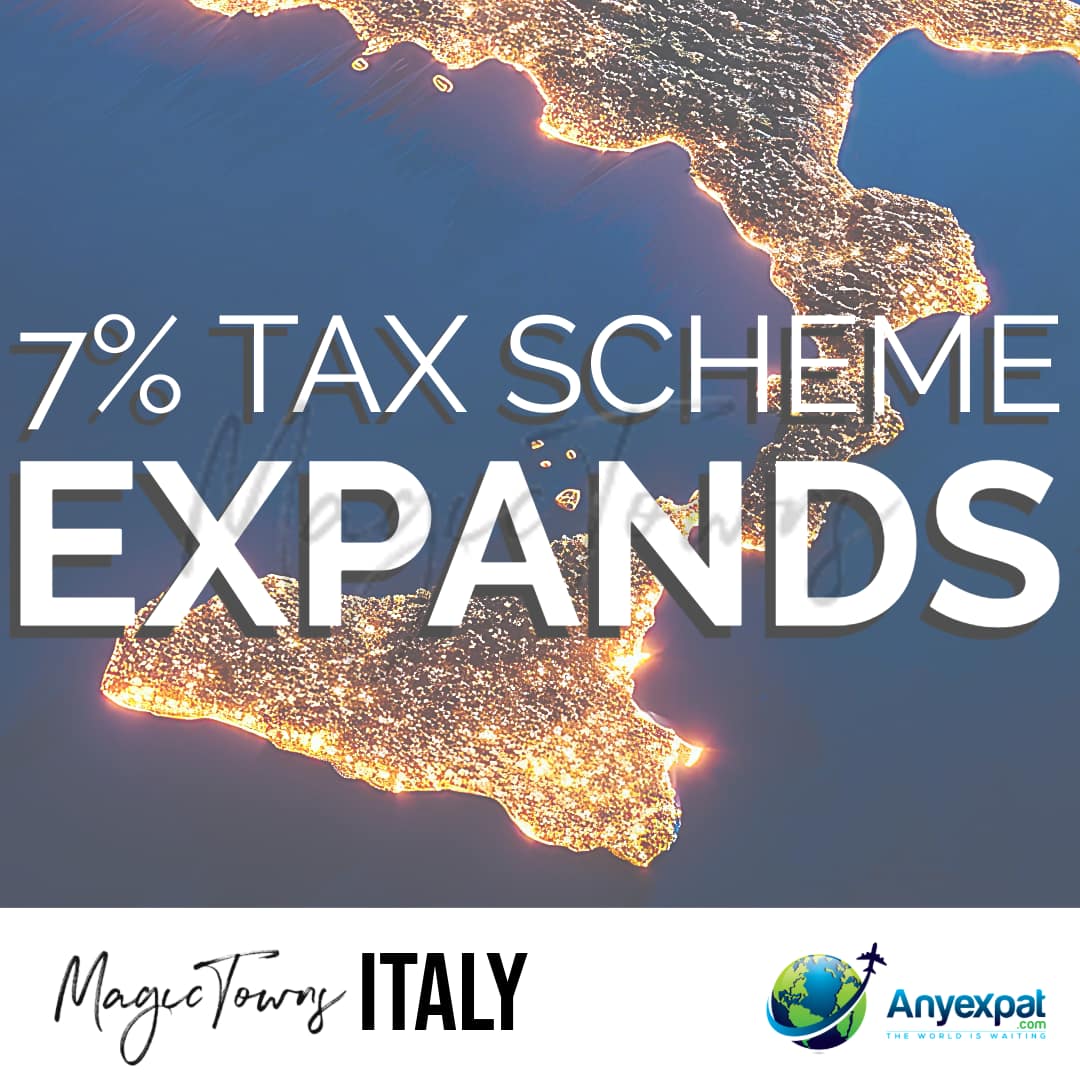
La loi a relevé le seuil de population dans la législation du régime fiscal 7% de 20.000 habitants à 30.000 habitants. Cela signifie que le régime 7% peut désormais s'appliquer à un plus grand nombre de villes qu'auparavant, pour autant que la ville se trouve dans les régions déjà couvertes par la loi. Et ceci est applicable à partir de lundi dernier, c'est-à-dire le 7 avril 2026.
Ce qui s'est passé, c'est que le menu, si vous voulez, des [00:02:00] villes éligibles s'est élargi, ce qui rend la situation très intéressante pour les personnes qui essaient de choisir une ville où s'installer.
Anna : Parce qu'il est évident que beaucoup de lieux éligibles étaient, je veux dire, très petits.
Luca : Minuscule ? Oui.
Et c'est la principale plainte que nous recevions de nos lecteurs et de nos auditeurs : les villes qualifiées étaient souvent belles, charmantes, quelque peu bon marché, mais de nombreux candidats au déménagement regardaient la liste et se disaient : "Oh, ça a l'air bien, mais c'est beaucoup trop petit pour moi".
Anna : Et petit, ça veut dire quoi ? Comme
Luca : Well, we’ve talked a lot about demographic resilience. We did a podcast a couple weeks ago. Towns dying out. And normally smaller towns mean fewer services, fewer shops that are open year round, fewer transportation links, fewer healthcare options, and also a quite a bit of isolation more than people can take.
Anna : D'accord, la réforme fait passer le régime à un niveau plus pratique.
Luca : Yeah, that’s what [00:03:00] I would say. The list of towns now includes a whole band of towns that still feel local and “Italian”, but they are more livable on an everyday basis because they are simply bigger.
Anna : So, before we get carried away. Let’s also be clear about what has not changed.
Luca : Yes, that’s important, and these are the basic rules that underlie the 7% tax regime. It does not mean that the regime now applies everywhere in Italy. While the whole of Italy included, the North has plenty of towns that will benefit from such a tax break, the geography is still limited to the territories that were originally in the law.
What does this mean? It means that qualifying municipalities in Sicily, Calabria, Sardinia, Campania, Basilicata, Abruzzo, Molise, and Puglia, plus very few earthquake [00:04:00] affected municipalities in Central Italy qualify. Outside of these regions, nothing qualifies. No matter how big or how small. The town doesn’t qualify.
Second, it is still a tax break for people that have a qualifying foreign source pension income. It doesn’t matter what kind of pension it is: private, public, state. Irrelevant. If you receive a foreign pension, you can qualify for this.
You transfer your tax residence to one of the qualifying towns in Southern Italy. And you’re good. So this is not a general expat regime. It is not for digital nomads, and it is something aimed at foreign retirees.
Anna : Nous avons été très surpris car certaines de ces villes sont en fait assez populaires, je dirais.
Luca : Yes, well known, and that’s the fun part of this.
Anna : Okay, so let’s talk through a few of the towns that now qualify.
Luca : Absolument.
Anna : Let’s begin in Abruzzo with Francavilla al Mare.
Luca : Yes. [00:05:00] We picked this one as the first out of the 80 new qualifying towns. It is a very good example. Francavilla al Mare is the kind of town that people makes think: “Okay, well I can see me moving here”. It’s on the Adriatic coast, just south of Pescara. Vous avez donc la mer. Il y a une très belle promenade. Elle a le rythme d'une ville de plage, mais elle n'est pas coupée du reste du monde.
Anna : And that is important, isn’t it?
Luca : Yes. It’s a place where 7% town doesn’t mean you are isolated in the corner of somewhere. You are close to a bigger urban area, close to an airport, Pescara Airport. And you can, I think in many cases, imagine to have a very pleasant day-to-day life in a place like this.
Anna : La ville suivante est Sulmona, qui jouit déjà d'une certaine notoriété auprès des acheteurs étrangers et des expatriés.
Luca : It does. Sulmona is often mentioned by people moving to Abruzzo. It was quite attractive. It has a decently sized expat community. It’s an elegant city [00:06:00] with the mountains, historic, and then it has that kind of Abruzzo mix of beauty, elegance and value, and it is one of the few mountain towns in Abruzzo with a significant population.
Anna : Absolument. On a l'impression d'être dans une vraie ville. Et Pompéi ?
Luca : L'une de mes préférées. Tout le monde connaît Pompéi : poids culturel énorme, patrimoine mondial de l'UNESCO, mais quand on pense à vivre dans la Pompéi d'aujourd'hui, c'est une autre question.
Anna : Pourquoi ?
Luca : Well, it isn’t just archeology. It is certainly a place with a global cultural cachet. Tourism has a huge impact. You’re gonna find holds of tourists at peak times, but it is also a large-ish town, around 25,000 people. It has a real infrastructure, supermarkets, there’s something going on all year. It has transport services. The ancient side of course, is one of the great historical landscapes in the world, [00:07:00] but for relocation, you’re thinking more about the modern town, and that is of course a more realistic option now that the tax regime has expanded.
Anna : So for some people, this incentive turns Pompeii from ” lovely to visit” into possibly feasible to live in.
Luca : Maybe. I’ve been to Pompeii many times, it wouldn’t be my first choice to move to, with the tourism impact, I mean, but there is a proximity to Naples, Salerno, Le cadre naturel est très attrayant et mérite donc d'être examiné.
Anna : Maintenant de la Campanie aux Pouilles : Putignano!
Luca : Putignano! Putignano is a good example of another great pick that’s given to us by the tax reform because it has personality. It’s not just pretty, you know, it has a town energy. It has a famous carnival, which gives it a cultural difference from a lot of the mid-size towns in the [00:08:00] list.
Anna : Oui, c'est vrai. Et c'est important si vous voulez y vivre à long terme. En fait, de nombreux lecteurs ont dit qu'ils étaient fatigués du manque de vie dans certaines des villes 7% actuelles. Ils finissent donc par avoir envie d'atmosphère, d'énergie, de rythme, de texture.
Luca : Oui, c'est vrai. Oh, la texture. Oui, je dirais que oui. Putignano est un bon exemple, car la vie locale y est très forte. Elle n'est certainement pas sur le radar des touristes ou des expatriés, mais vous savez, elle a une énergie qui lui est propre.
Anna : To finish this off, let’s go to Sicily and Noto.
Luca : Noto we kept for last because it’s the one that will make listeners ears prick up. I wrote in our article on the website that I could almost hear the cheers from home if people found out that Noto was on the list.
Noto est l'un des noms les plus prestigieux de cette conversation, et les retraités veulent qu'il figure sur la liste 7% depuis longtemps. J'ai parlé à des gens qui étaient [00:09:00] déçus que certains des hameaux les plus éloignés qui font partie de Noto ne soient pas éligibles. Aujourd'hui, ils le sont. La ville a un poids symbolique important. Un autre site du patrimoine mondial de l'UNESCO, elle a un énorme pedigree baroque et c'est dans ce cadre qu'elle est classée. Modica, Ragusa, general area of southeastern Sicily. And it has that kind of look, that’s iconic. The stoves, the streets, it has a very distinctive architecture. So we welcome it to the expanded list of 7% towns.
Anna : Oui, absolument. L'emplacement est idéal.
Luca : It is already not obscure, but it is on people’s mental shortlist for Sicily. But now it’s going to attract, I imagine far greater retention, which is important both for people that want to move there and this being almost more so for investors.
Anna : Et probablement beaucoup d'auditeurs visitent notre guide de la ville expatriée de Noto.
Luca : Je l'espère vraiment. Il y en a un, alors n'hésitez pas à vous rendre sur le site web et à le lire.
Anna : Ok. [00:10:00] Donc, pour résumer : cette réforme ouvre le régime 7% à 80 grandes villes du sud de l'Italie, dont beaucoup ont à la fois du charme et des infrastructures fonctionnelles.
Luca : That’s right. And our whole project, at Magic Towns, is about helping people think beyond the usual big cities. And at the same time, we don’t want to pretend that every tiny bit suits everyone. So this reform opens up an interesting list of middle ground towns, and I think a lot of good decisions will get made around these newly editable towns.
Anna : C'est également la raison pour laquelle nous avons mis à jour notre documentation sur les nouvelles villes éligibles.
Luca : So we’ve already listed out all the newly added municipalities. Every one of them has a profile in the Town Explorer on Magic Towns. You can search for those towns by using the 7% tax button. And listeners, if you want to go from “that sounds interesting” to “what is daily life [00:11:00] actually like there?”, now you know where to go to find that information.
Anna : Exactement. Cet épisode est informatif, il ne s'agit donc pas d'un conseil fiscal personnel.
Luca : C'est tout à fait vrai. Les changements juridiques sont réels, mais votre éligibilité dépend de votre situation. Lisez donc, informez-vous et ne déménagez pas sur la seule base d'un épisode de podcast.
Anna : Mais continuez à écouter le podcast.
Luca : Oui, c'est ce que j'allais dire. Nous sommes très reconnaissants d'avoir un public aussi engagé et intéressé. Si vous avez des idées ou des demandes pour les prochains épisodes, n'hésitez pas à nous contacter sur Facebook, Instagram, le site web, et merci beaucoup de nous avoir écoutés cette semaine.
Anna : Merci à tous. A la semaine prochaine !
Luca : A la semaine prochaine ! Au revoir.

 English
 French
 German
 Italian
 Danish