


Anna: Welcome back to the Magic Towns Italy podcast! I’m Anna.
Luca: Ja, das bist du. Und ich bin Luca. Hallo Anna.
Anna: Hi. Hope everyone had a nice Easter break and you didn’t miss our podcast too much last weekend. So, today we are back with big news for anyone looking at retiring in Italy. It’s a legal change that sounds tiny on paper, but is actually quite a big deal.
Luca: Ja, in der Tat. Dies ist eine klassische italienische Geschichte, bei der ein paar Worte im Gesetz geändert werden, was am Ende die Landkarte in einer sehr bedeutenden Weise verändert.
Anna: Ja. In diesem Fall betrifft die Änderung die so genannte 7%-Rentnersteuerregelung, die vielen unserer Leser und Hörer bereits bekannt ist. Ich meine, wir haben viele Artikel darüber geschrieben.
Luca: Yeah. And we’ve done [00:01:00] so many podcasts about it. But this is possibly the biggest change in the scheme since it was launched about 10 years ago. What has changed is not the tax rate itself and not the basic logic that’s underlying the tax regime, but it’s a type of town that you can choose.
Anna: Was in der Praxis vielleicht sogar noch wichtiger ist.
Luca: Ganz genau.
Anna: Okay, so let’s start with the simple version. What happened?
Luca: Die einfache Version lautet wie folgt.
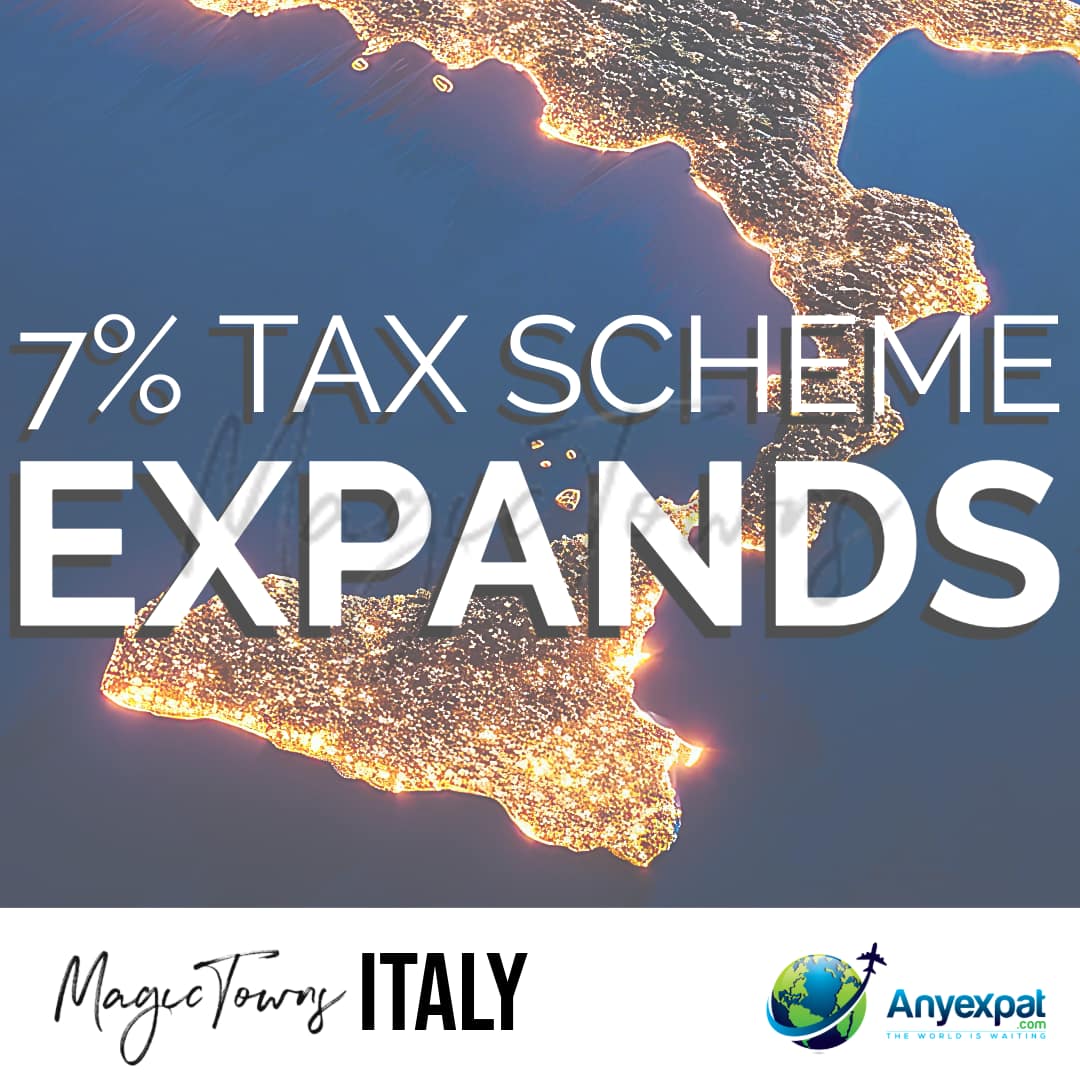
Mit dem Gesetz wurde die Bevölkerungsschwelle für die 7%-Steuerregelung von 20.000 auf 30.000 Einwohner angehoben. Das bedeutet, dass die 7%-Regelung nun in deutlich mehr Städten als bisher gelten kann, solange die Stadt in den Regionen liegt, die bereits unter das Gesetz fallen. Und dies gilt ab dem vergangenen Montag, dem 7. April 2026.
Die Palette der [00:02:00] in Frage kommenden Städte ist breiter geworden, und das macht es für Menschen, die sich für eine Stadt entscheiden wollen, sehr interessant.
Anna: Denn offensichtlich waren viele der förderfähigen Orte, ich meine, sehr klein.
Luca: Winzig? Ja.
Und das war die Hauptbeschwerde, die wir von unseren Lesern und Zuhörern bekamen: Qualifizierte Städte waren oft schön, charmant, etwas billig, aber viele potenzielle Umzugshelfer sahen sich die Liste an und sagten: "Oh, das sieht gut aus, aber es ist viel zu klein für mich.
Anna: Und was bedeutet klein? Wie
Luca: Well, we’ve talked a lot about demographic resilience. We did a podcast a couple weeks ago. Towns dying out. And normally smaller towns mean fewer services, fewer shops that are open year round, fewer transportation links, fewer healthcare options, and also a quite a bit of isolation more than people can take.
Anna: Okay, die Reform bringt die Regelung also in einen praktischeren Bereich.
Luca: Yeah, that’s what [00:03:00] I would say. The list of towns now includes a whole band of towns that still feel local and “Italian”, but they are more livable on an everyday basis because they are simply bigger.
Anna: So, before we get carried away. Let’s also be clear about what has not changed.
Luca: Yes, that’s important, and these are the basic rules that underlie the 7% tax regime. It does not mean that the regime now applies everywhere in Italy. While the whole of Italy included, the North has plenty of towns that will benefit from such a tax break, the geography is still limited to the territories that were originally in the law.
What does this mean? It means that qualifying municipalities in Sicily, Calabria, Sardinia, Campania, Basilicata, Abruzzo, Molise, and Puglia, plus very few earthquake [00:04:00] affected municipalities in Central Italy qualify. Outside of these regions, nothing qualifies. No matter how big or how small. The town doesn’t qualify.
Second, it is still a tax break for people that have a qualifying foreign source pension income. It doesn’t matter what kind of pension it is: private, public, state. Irrelevant. If you receive a foreign pension, you can qualify for this.
You transfer your tax residence to one of the qualifying towns in Southern Italy. And you’re good. So this is not a general expat regime. It is not for digital nomads, and it is something aimed at foreign retirees.
Anna: Wir waren wirklich überrascht, denn einige dieser Städte sind eigentlich recht beliebt, würde ich sagen.
Luca: Yes, well known, and that’s the fun part of this.
Anna: Okay, so let’s talk through a few of the towns that now qualify.
Luca: Ganz genau.
Anna: Let’s begin in Abruzzo with Francavilla al Mare.
Luca: Yes. [00:05:00] We picked this one as the first out of the 80 new qualifying towns. It is a very good example. Francavilla al Mare is the kind of town that people makes think: “Okay, well I can see me moving here”. It’s on the Adriatic coast, just south of Pescara. Sie haben also das Meer. Sie haben eine sehr schöne Promenade. Es hat diesen einfachen Strandstadt-Rhythmus, aber es ist nicht von der Welt abgeschnitten.
Anna: And that is important, isn’t it?
Luca: Yes. It’s a place where 7% town doesn’t mean you are isolated in the corner of somewhere. You are close to a bigger urban area, close to an airport, Pescara Airport. And you can, I think in many cases, imagine to have a very pleasant day-to-day life in a place like this.
Anna: Die nächste Stadt ist Sulmona, die bei ausländischen Käufern und Expatriates bereits ein recht hohes Ansehen genießt.
Luca: It does. Sulmona is often mentioned by people moving to Abruzzo. It was quite attractive. It has a decently sized expat community. It’s an elegant city [00:06:00] with the mountains, historic, and then it has that kind of Abruzzo mix of beauty, elegance and value, and it is one of the few mountain towns in Abruzzo with a significant population.
Anna: Ganz genau. Es fühlt sich wirklich, ähm, wie eine echte, wie eine richtige Stadt an. Und was ist mit Pompeji?
Luca: Einer meiner Favoriten. Nun, jeder kennt Pompeji: riesiges kulturelles Gewicht, UNESCO-Weltkulturerbe, aber wenn man darüber nachdenkt, tatsächlich im modernen Pompeji zu leben, ist das eine andere Frage.
Anna: Warum?
Luca: Well, it isn’t just archeology. It is certainly a place with a global cultural cachet. Tourism has a huge impact. You’re gonna find holds of tourists at peak times, but it is also a large-ish town, around 25,000 people. It has a real infrastructure, supermarkets, there’s something going on all year. It has transport services. The ancient side of course, is one of the great historical landscapes in the world, [00:07:00] but for relocation, you’re thinking more about the modern town, and that is of course a more realistic option now that the tax regime has expanded.
Anna: So for some people, this incentive turns Pompeii from ” lovely to visit” into possibly feasible to live in.
Luca: Maybe. I’ve been to Pompeii many times, it wouldn’t be my first choice to move to, with the tourism impact, I mean, but there is a proximity to Naples, Salerno, Die natürliche Umgebung ist sehr reizvoll und daher sicherlich einen Blick wert.
Anna: Jetzt von Kampanien nach Apulien: Putignano!
Luca: Putignano! Putignano is a good example of another great pick that’s given to us by the tax reform because it has personality. It’s not just pretty, you know, it has a town energy. It has a famous carnival, which gives it a cultural difference from a lot of the mid-size towns in the [00:08:00] list.
Anna: Ja. Und das ist wichtig, wenn man dort langfristig leben will. Viele Leser sagten, sie seien des Mangels an Leben in einigen der heutigen 7%-Städte überdrüssig. Deshalb sehnen sie sich nach Atmosphäre, Energie, Rhythmus und Struktur.
Luca: Ja, genau. Oh, Textur. Ja, das würde ich so sagen. Putignano ist ein gutes Beispiel dafür, dass es ein starkes lokales Leben gibt. Es ist sicherlich nicht auf dem Radar der Touristen oder Auswanderer, aber wissen Sie, es hat eine ganz eigene Energie.
Anna: To finish this off, let’s go to Sicily and Noto.
Luca: Noto we kept for last because it’s the one that will make listeners ears prick up. I wrote in our article on the website that I could almost hear the cheers from home if people found out that Noto was on the list.
Noto ist einer der glamourösen Namen in diesem Gespräch, und die Rentner wollen es schon lange auf der 7%-Liste haben. Ich habe mit Leuten gesprochen, die [00:09:00] enttäuscht waren, dass einige der abgelegeneren Weiler, die zu Noto gehören, nicht dazugehören. Jetzt sind sie es. Die Stadt hat eine große symbolische Bedeutung. Sie gehört ebenfalls zum UNESCO-Weltkulturerbe, hat einen großen barocken Stammbaum und befindet sich in diesem Modica, Ragusa, general area of southeastern Sicily. And it has that kind of look, that’s iconic. The stoves, the streets, it has a very distinctive architecture. So we welcome it to the expanded list of 7% towns.
Anna: Ja, absolut. Die Lage ist großartig.
Luca: It is already not obscure, but it is on people’s mental shortlist for Sicily. But now it’s going to attract, I imagine far greater retention, which is important both for people that want to move there and this being almost more so for investors.
Anna: Und wahrscheinlich besuchen viele Zuhörer unseren Noto-Stadtführer für Auswanderer.
Luca: Das hoffe ich wirklich. Es gibt eine, also gehen Sie bitte auf die Website und lesen Sie sie.
Anna: Okay. [00:10:00] Also, um es zusammenzufassen: Diese Reform öffnet die 7%-Regelung für 80 größere Städte in Süditalien, von denen viele sowohl Charme als auch eine funktionierende Infrastruktur haben.
Luca: That’s right. And our whole project, at Magic Towns, is about helping people think beyond the usual big cities. And at the same time, we don’t want to pretend that every tiny bit suits everyone. So this reform opens up an interesting list of middle ground towns, and I think a lot of good decisions will get made around these newly editable towns.
Anna: Aus diesem Grund haben wir auch unser Material rund um die neuen qualifizierten Städte aktualisiert.
Luca: So we’ve already listed out all the newly added municipalities. Every one of them has a profile in the Town Explorer on Magic Towns. You can search for those towns by using the 7% tax button. And listeners, if you want to go from “that sounds interesting” to “what is daily life [00:11:00] actually like there?”, now you know where to go to find that information.
Anna: Ganz genau. Diese Folge ist also informativ, also keine persönliche Steuerberatung.
Luca: Sehr sogar. Der rechtliche Wandel ist real, aber ob Sie dazu berechtigt sind, hängt von Ihren eigenen Umständen ab. Informieren Sie sich also, und ziehen Sie nicht allein aufgrund einer Podcast-Folge um.
Anna: Aber hören Sie sich den Podcast trotzdem weiter an.
Luca: Ja, das wollte ich gerade sagen. Wir sind sehr dankbar, dass wir ein so engagiertes und interessiertes Publikum haben. Wenn Sie irgendwelche Ideen oder Wünsche für die nächsten Folgen haben, kontaktieren Sie uns bitte auf Facebook, Instagram oder auf unserer Website, und vielen Dank, dass Sie uns diese Woche zugehört haben.
Anna: Danke, Leute. Bis nächste Woche!
Luca: Bis nächste Woche! Auf Wiedersehen!.

 English
 French
 German
 Italian
 Danish