

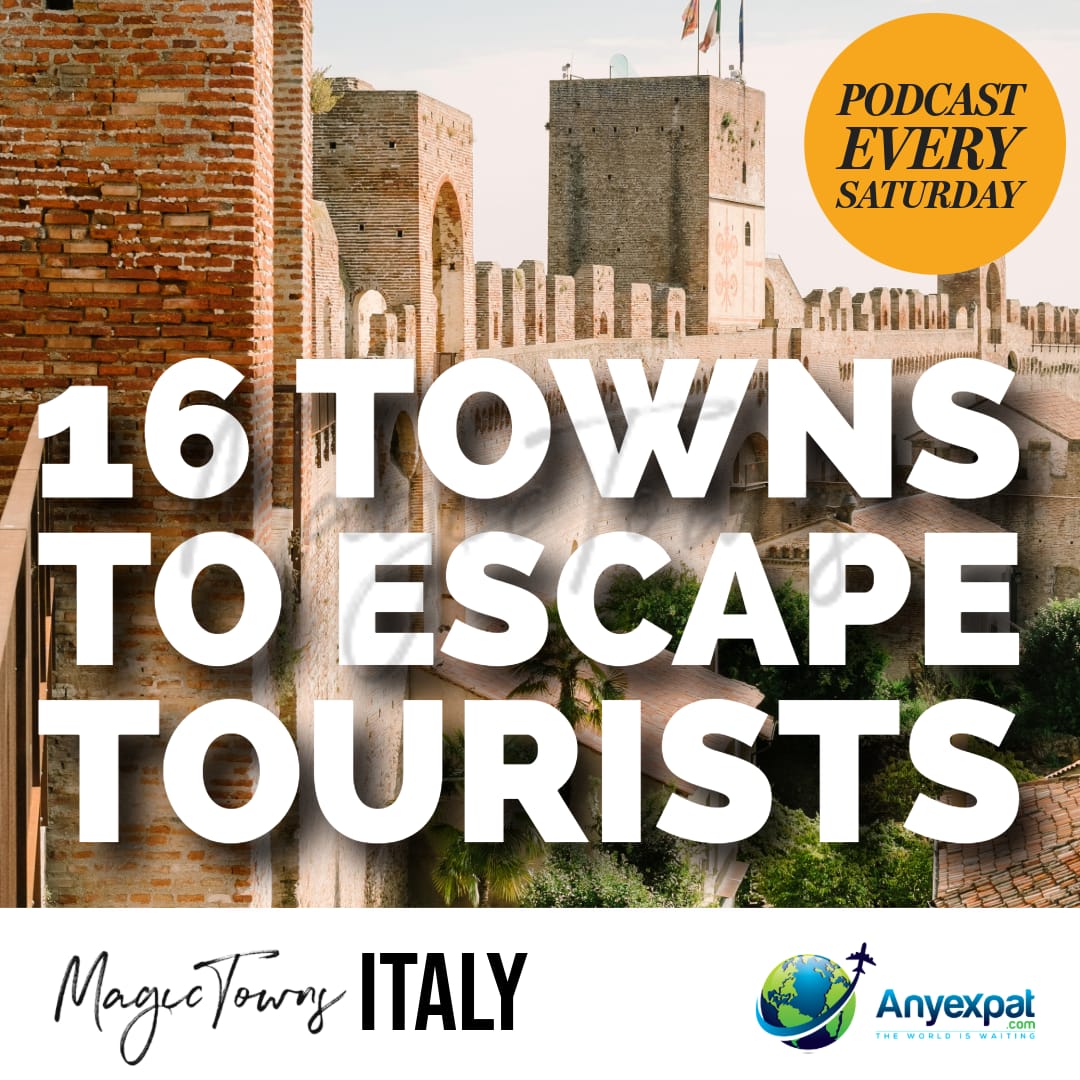

Meilen: Willkommen zurück zum Magic Towns Italien-Podcast. . Italien, sonnenüberflutete Piazzas, antike Ruinen, fantastisches Essen und der unwiderstehliche Charme von La Dolce Vita,
Alessia: It’s a dream destination for so many people.
Meilen: But for anyone actually thinking about living there beyond the two week vacation, that dream can often collide with a less glamorous reality. Let’s talk about overtourism.
Alessia: Yeah, that’s the crux of it. While Italy consistently ranks among the world’s top tourist destinations, which is fantastic, of course, this popularity creates some pretty significant, often hidden challenges for residents.
We’re going to use original data from a recent article on Magic Towns Italy. It’s called Paradise Packed, 16 Italian Towns that Escape Overtourism. They developed some really neat tools. Oh yeah. There’s a touristy index basically measures how packed a place is with visitors and a quality of life index [00:01:00] looking at livability.
We’ll use these because honestly, the sheer number of visitors can completely change daily life.
Meilen: Das belastet die Ressourcen, nicht wahr?
Alessia: Ganz und gar. Und er kann sogar den authentischen Charakter untergraben, der die Menschen überhaupt erst dorthin gelockt hat. Unsere heutige Aufgabe besteht also darin, herauszufinden, wo der Übertourismus am stärksten zuschlägt, aber was noch wichtiger ist.
Heben Sie einige unglaubliche Städte hervor, die noch immer diese erstaunliche italienische Kultur, Gemeinschaft und Lebensqualität bieten. Nur weg von den Menschenmassen.
Meilen: Perfekt für Expats, Rentner und alle, die dort leben und nicht nur ein paar Tage zu Besuch sind.
Alessia: And this problem, it’s not just a vague feeling of, oh, it’s a bit busy.
The article has some hard numbers, doesn’t it? Here’s a staggering statistic. 70% of international tourists in Italy, they flock to just 1% of its territory.
Meilen: Wow. 70% in 1%. Just think about that. I know it means in places like Venice, you’re not just, you know, a tourist in a crowd. You’re often one of maybe 100 others for every single resident jostling for [00:02:00] space in what used to be someone’s quiet neighborhood square.
Alessia: Und Sie können sich wahrscheinlich die üblichen Verdächtigen vorstellen. Venedig, Florenz, die Amalfiküste. Cinque Terre schön. Ja. Absolut atemberaubende Orte.
Meilen: That beauty comes at a price for locals, a steep price. There’s a quote in the article from a local activist about Naples that really hits home. What does it say?
Alessia: The historic center of Naples is dead. Those streets aren’t neighborhoods anymore. They’ve become playgrounds, open air shopping malls. It’s quite powerful.
Meilen: Das ist sehr anschaulich, aber können Sie das aufschlüsseln, z. B. für den praktischen Alltag?
Alessia: Sicher. Denken Sie nur an die kompakten mittelalterlichen Stadtgrundrisse. Wenn man Tausende von zusätzlichen Menschen hineinzwängt, gerät alles unter Druck. Der öffentliche Nahverkehr, die Müllabfuhr, die grundlegende Infrastruktur,
Meilen: Allein die Fortbewegung muss manchmal ein Alptraum sein.
Alessia: Absolutely. It’s not just inconvenient. It fundamentally changes the place and the daily struggles are real.
Stellen Sie sich vor, Sie wollen nur Besorgungen machen. Ein Reporter des Corriere della Sera hat einen Bericht über den Gardasee veröffentlicht.
Meilen: Ach ja. In Sirmione. Er beschrieb, dass er 40 Minuten damit verbrachte, [00:03:00] einen Parkplatz zu suchen. 40 Minuten.
Alessia: Und dann sieben Euro für eine Eiswaffel zu bezahlen.
Meilen: Seven euros. Okay. That’s not the relaxed evening passeggiata you picture, is it that leisurely walk?
Definitely not. And beyond the traffic and queues, there’s the whole short-term rental issue. Ah, the Airbnb effect.
Alessia: You got it. In some parts of Naples, the article says there’s literally one BNB for every three homes. Think about that density.
Meilen: That’s incredible. And it’s hollowing out the fabric of the city as they put it.
Rents go up, local tenants get pushed out. It really destabilizes communities. I guess some people would argue, you know, that these rentals bring in money for homeowners, especially if the local economy isn’t great, or maybe give tourists some more local experience.
Alessia: It’s a fair point. People do make that argument, but the data and the lived experience in many places suggests the cost to the actual resident community often outweighs those benefits.
In Venedig sieht man das extreme Ende dieser Entwicklung.
Meilen: Es leben jetzt weniger Einheimische dort, oder?
Alessia: Way fewer. The historic [00:04:00] center has under 50,000 residents left. It’s a stark reminder as locals can’t afford to live there. The city just dust it slowly depopulates. It becomes more like a museum than a living, breathing city,
Meilen: ihre Seele im Wesentlichen verlieren.
Alessia: That’s a good way to put it. And then there are the seasonal swings,
Meilen: oder? Die Jekyll und Hyde-Sache.
Alessia: Ganz genau. Im Sommer ist es immer voll. Dann unheimlich ruhig. Im Winter, wenn die Reisebusse abfahren, schließen die Geschäfte und die Dienstleistungen nehmen ab,
Meilen: Die Einwohner, die das ganze Jahr über dort leben, haben das Nachsehen.
Alessia: Totally. So it raises a big question for anyone thinking of moving, uh, whether you’re an expat or retiring there, what kind of daily life are you really signing up for in these famous spots?
Das bedeutet oft, dass der authentische Charakter, der Sinn für Gemeinschaft verloren geht.
Meilen: Okay, wenn der Traum von Venedig vielleicht eher eine überfüllte Realität ist, wie misst Magic Towns Italien das eigentlich? Und vor allem, was bedeutet das für Ihren Geldbeutel?
Alessia: Nun, sie verwenden den von mir erwähnten Tourismusindex, der die Besucherzahlen im Verhältnis zur Wohnbevölkerung betrachtet, und einige der Zahlen sind einfach extrem.
Meilen: Wie extrem
Alessia: Nehmen Sie ein winziges Alpendorf wie [00:05:00] Sexten in Südtirol, das Südtirol, Bevölkerung, etwa 1.900 Menschen, Besucher im Jahr 2023, etwa 184.000.
Meilen: Wait, that’s like nearly 100 tourists for every resident over the year.
Alessia: 99 im Grunde. Ja, genau. Oder Rio Maggiore in Cinque Terre mit etwa 1.300 Einwohnern, aber über 100.000 Besuchern pro Jahr.
That’s about 82 tourists per resident. Santa Doro in Sardinia, 1,200 locals, about 110,000 visitors. That’s almost 89 tourists per local. These numbers just show the immense pressure on local infrastructure, water waste, and prices.
Meilen: Not just the total number either, is it? It’s when they all arrive at once.
Alessia: Exactly. It’s the concentration during peak season that really overwhelms things. It’s not just crowded streets, it’s the town’s actual capacity. It’s water, it’s waste system, its ability to maintain its charm. Getting swamped.
Meilen: Die menschlichen Kosten sind klar. Aber was ist mit der finanziellen Seite? Sie haben den Zusammenhang zwischen Tourismus und Immobilienkosten erwähnt.
Alessia: Oh, it’s sharp, undeniably sharp. [00:06:00] These super touristy places often have sky high property prices. Homes become vacation rentals or investments, pricing out locals, and frankly, most expats too.
Meilen: Geben Sie ein paar Beispiele. Von welcher Höhe sprechen wir?
Alessia: Na gut. Sehen Sie sich Capri an. Durchschnittliche Hauspreise um 10.000 Euro pro Quadratmeter.
Meilen: 10.000 Euro.
Alessia: Yep. More than double the average for the province. Positano Amalfi, you’re looking at 7,000 to 10,000 per square meter easily. That’s like big global city prices.
Meilen: Cortina vor den Olympischen Spielen.
Alessia: Cortina d’Ampezzo, it’s surged to Parisian levels. Average around 12,000 euro per square meter, prime spots hitting over 20,000.
Meilen: Okay. That’s inaccessible for most people.
Alessia: Ja, ja.
Meilen: Wie sieht das im Vergleich zu, sagen wir, einer normalen italienischen Stadt aus?
Alessia: It’s a huge contrast. More typical towns are usually in the low thousands per square meter, maybe 1,500 euro, 2000, something like that.
Meilen: Der Capri-Preis beträgt also 10.000 Euro. Gibt es irgendwelche lokalen Vorschriften, um dies zu regeln, oder ist es einfach nur ein wilder Markt?
Alessia: It’s mostly market [00:07:00] forces. Unfortunately, some cities like Florence are trying to limit short-term rentals, but it’s a massive uphill battle.
Meilen: Und das große Ganze,
Alessia: Das bedeutet einen enormen Aufschlag bei den Lebenshaltungskosten. Nicht nur für die Wohnung, sondern für alles, sogar für den täglichen Kaffee. Und das führt leider zu einer Entvölkerung dieser berühmten Städte, was sie auf lange Sicht für alle weniger authentisch macht.
Meilen: It’s a vicious cycle.
Alessia: It really is. The data clearly shows this trend as tourist density goes up, property prices follow suit. It’s a whole economic shift where only tourism businesses really thrive.
Meilen: Okay, wenn die Postkartenorte vielleicht nicht die besten Orte zum Leben sind, wo kann man dann die reiche Kultur und Geschichte finden, ohne sich zu quälen?
Sie haben zwei Kategorien genannt,
Alessia: right? The first category includes towns that are actually quite well known, maybe even famous in their own right, but they’ve managed to stay relatively livable. They aren’t total hidden gems yet, but they’re definitely not the overwhelmed hotspots.
Meilen: Was macht sie anders?
Alessia: Oft haben sie ihre eigene starke lokale Wirtschaft, vielleicht eine große Universität [00:08:00] oder eine Industrie, die sie das ganze Jahr über lebendig hält, nicht nur, wenn Touristen da sind. Sie sind in der Regel erschwinglicher, fühlen sich authentischer an und bieten den Bewohnern einfach ein besseres Alltagserlebnis.
Meilen: Okay, let’s hear some examples.
Alessia: we take Padova in the Veneto region. It’s only 30 minutes from Venice by train.
Meilen: Right? I know. Padova Historic University. Giotto’s Chapel,
Alessia: exactly. One of Europe’s oldest universities founded in 1222. The Scrovegni Chapel, amazing squares like Prato della Valle, but when you’re there, it feels lived in.
Man sieht die Einheimischen in den Cafés und auf den Märkten,
Meilen: weniger Touristen als Venedig, nehme ich an.
Alessia: Way fewer. It gets about 770,000 visitors a year, which sounds like a lot, but compare that to Venice’s 5.6 million. So Padova has this easygoing vibe, plus median home prices are around 2,400 Euro per square meter, much less than Venice.
Auch bei der Lebensqualität schneidet es gut ab, vor allem in den Bereichen Verkehr und Gesundheitswesen.
Meilen: Sehr schön.
Alessia: What else? How about Trieste way up in the northeast corner? It’s a really unique city. [00:09:00]
Meilen: Österreichisch-ungarischer Einfluss, richtig?
Alessia: Es war der Haupthafen des Kaiserreichs. Sie haben also diese großartige habsburgische Architektur, berühmte alte Kaffeehäuser.
Sie unterscheidet sich deutlich von anderen italienischen Städten. Jährlich kommen etwa 480.000 Touristen in die Stadt. Ziemlich moderat für eine Stadt dieser Größe, so dass es selbst in der Hochsaison ruhig ist.
Meilen: und Lebensqualität.
Alessia: Exceptionally high. It scored 90 out of 100 on our QOL index. Great balance of city life and nature. You’ve got the Karst Hills right behind it, the sea in front, and it’s surprisingly affordable.
Median Wohnungen um 2.500 Euro pro Quadratmeter.
Meilen: Okay, noch einer aus dieser Kategorie. Vielleicht etwas aus der Renaissance, aber nicht Florenz.
Alessia: Ferrara in Emilia Romagna. It’s a gem seat of the Esta court, so it has elegant palaces, a cool moated castle, and these amazing medieval walls. You can walk or bike on nine kilometers worth.
Das gesamte historische Zentrum steht unter dem Schutz der UNESCO
Meilen: aber nicht überschwemmt von Touristen.
Alessia: Nein, es kommen nur etwa 230.000 Besucher pro Jahr. Die Stadt hat trotz ihrer Geschichte eine [00:10:00] schöne, lockere, fast kleinstädtische Atmosphäre. Sie nennen sie die Stadt der Fahrräder, sehr fahrradfreundlich, ruhige, gepflasterte Straßen
Meilen: und Eigentum, wirklich erschwinglich.
Alessia: Die Grundstücke kosten im Durchschnitt etwa 1.400 Euro pro Quadratmeter.
Meilen: Okay. The article mentioned a few others briefly too, didn’t it?
Cesenatico auch, mit dem Kanal.
Alessia: Um, charming port, designed by Da Vinci, QOL 83, real estate, about 3050 per square meter and even Jesolo, which is actually one of Italy’s most visited beach spots. The article notes, it manages the high numbers well, good organization, QOL 78 prices around 4,300 per square meter.
Meilen: That’s a great list. Uh, I’m curious though, thinking about Cervia versus Jesolo, both manage tourism well, you said, but what’s the feel like? What’s a typical day like in each, beyond the numbers?
Alessia: That’s a really good question. Cervia has this strong focus on sustainability. It’s pine forest, it’s salt pins. It attracts maybe a more eco-conscious [00:11:00] visitor, someone looking for nature alongside the beach.
Es fühlt sich das ganze Jahr über ruhiger an,
Meilen: Für diejenigen, die wirklich weg von allem wollen, um sich zu integrieren und etwas abseits der ausgetretenen Pfade zu finden, ist die nächste Kategorie die versteckten Juwelen. Oder?
Alessia: Exactly. This is where it gets really interesting for people wanting to integrate. We’re talking towns that are genuinely not on the typical tourist map,
Meilen: wie wirklich unter dem Radar.
Alessia: Totally fewer than one or two tourists per resident per year, but, and this is key, they have incredibly high livability scores, QOL, often 93 to 95 out of 100 plus distinctive local charm, and they’re remarkably affordable. This is where you find that genuine Italian small town life without the crowds.
Ja,
Meilen: I’m excited. Where do we start?
Alessia: Let’s go to Marche Ascoli Piceno. Ever heard of it?
Meilen: Vage, aber erzählen Sie mir mehr.
Alessia: It’s a medieval city, about 46,000 people nestled between the Apennine Mountains and the Adriatic coast. The whole place is built from this beautiful travertine stone. It just glows and its main [00:12:00] square Piazza del Popolo.
Honestly, it’s often called one of Italy’s most beautiful, pure Renaissance elegance.
Meilen: Klingt erstaunlich. Touristenzahlen.
Alessia: This is the kicker. Only about 38,000 tourists a year. That’s basically zero crowding. You’ll feel like you have the place to yourself most of the time. Living there. High quality of life, low crime, excellent healthcare. Reported lots of cultural events. Markets twice a week. Plus you can be hiking in the mountains or swimming in the Adriatic in under an hour.
Meilen: Okay, der Haken. Die Immobilienpreise,
Alessia: No catch. It’s a bargain around 1,300 euro per square meter on average. It really delivers that Dolce Vita Dream. Incredible.
Meilen: Okay, was nun?
Alessia: let’s head northwest to Piemonte.
Cuneo ist eine mittelgroße Stadt mit etwa 55.000 Einwohnern, die von Ausländern oft übersehen wird.
Meilen: What’s special about Cuneo?
Alessia: Lage, Lage, Lage. Es liegt direkt am Fuße der Seealpen, so dass man einen spektakulären Blick auf die Berge hat. Die Stadt wirkt wohlhabend, aber ruhig. Die elegante Hauptstraße ist von [00:13:00] Arkaden gesäumt, und es gibt einen großen zentralen Platz.
That’s buzzing on market days, and the food Piemonte is famous, right? Chocolate chestnut, slow food movement.
Meilen: Klingt schön. Lebensqualität, Touristen.
Alessia: QOL is impressive. 93 out of 100. Low pollution, low crime, good schools and healthcare, tourists, very few, only about 55,000 annual visitors. Lots of parks, bike paths, good cultural calendar, and you’re only about 20 kilometers from the French Riviera if you fancy a day trip.
Meilen: Und Erschwinglichkeit.
Alessia: Äußerst erschwinglich. Immobilien um 1.500 Euro pro Quadratmeter.
Meilen: Wow. Okay. Let’s head south now. Sicily.
Alessia: Yes. Ragusa right in the heart of Sicily’s Baroque region. It’s a stunning hill town rebuilt after a massive earthquake. It’s actually split into the upper modern town in the older part, Ragusa Ibla, which is UNESCO listed
Meilen: Barocke Architektur.
Labyrinthartige Straßen
Alessia: exactly. Golden stone palace’s, incredible churches perched on the hillside. The views are so [00:14:00] cinematic. They actually filmed the Inspector Montalbano TV series there.
Meilen: Oh, cool. Ist es wegen der Show so voll?
Alessia: Überraschenderweise nicht. Die bescheidenen 163.000 Touristen pro Jahr sorgen dafür, dass sich die Stadt ihr lokales Flair bewahrt hat, und sie glänzt durch ihre Lebensqualität. QOL-Wert von 91. Tolle Luftqualität, wenig Stress. Die Leute sprechen von der engen Gemeinschaft, die hier herrscht.
Meilen: Das hört sich gut an.
Alessia: There’s a local saying, we have watches, but in Ragusa we don’t have time.
Meilen: Huh. I love that we have watches, but in Ragusa we don’t have time. That says it all doesn’t. It captures that slower pace. So many people are looking for
Alessia: Das tut es wirklich, und die Lebenshaltungskosten sind sehr vernünftig. Der durchschnittliche Immobilienpreis liegt bei etwa 1.400 Euro pro Quadratmeter.
Meilen: Fantastisch. Gibt es noch weitere kurze Erwähnungen auf dieser Liste versteckter Juwelen?
Alessia: Auf jeden Fall Forlì in der Emilia Romagna. Reich an Kunst und Geschichte. Weniger als ein Tourist pro Einwohner.
Unglaublich. QL von 95. Grundstück 1.550 pro Quadratmeter. Conegliano in Venetien. Die Prosecco-Hauptstadt umgeben von [00:15:00] UNESCO-Weinbergen, QL 95 Wohnungen 1.750 pro Quadratmeter.
Meilen: Die Prosecco-Hauptstadt Nizza
Alessia: and Cittadella also invented, oh, it’s this amazing medieval walled town where you can walk the entire circuit of the 13th century walls.
Sehr wenige Touristen, QOL 93 Immobilien im Durchschnitt 2.500 pro Quadratmeter, alle nur unglaubliche Orte, die echtes italienisches Leben bieten.
Meilen: I’m really drawn to that idea of Forlì rich history, but fewer than one tourist per resident. How do towns like that manage to stay? So under the radar, is it just location?
Alessia: It’s often a mix of things.
Manchmal liegen sie etwas abseits der Haupttouristenströme, vielleicht auch nicht direkt an der Hochgeschwindigkeitszugstrecke, die Rom und Florenz verbindet. Also weniger geeignet für einen schnellen Tagesausflug.
Meilen: Das macht Sinn.
Alessia: Other times they just haven’t been heavily marketed internationally. Or maybe their treasures are more spread out, less concentrated in one single must see spot.
That’s easy for tour groups. [00:16:00] They require a bit more effort, a bit more intention to discover,
Meilen: Gerade deshalb bleiben sie für die Menschen, die dort leben, authentisch.
Alessia: Ganz genau.
Meilen: So wrapping this up, what does this all mean for you, the listener, if you’re dreaming of that authentic Italian life?
Alessia: Well, I think the main takeaway is that while Italy’s famous spots are famous for a reason, they’re captivating, they often come with significant trade-offs if you actually wanna live their day-to-day.
Meilen: Overtourism isn’t just an inconvenience. It can really strain the place and change that la Dolce Vita dream into something quite different, maybe quite frustrating for residents.
Alessia: But the striking thing is Italy’s sheer variety. As these examples show, there are so many incredible places offering history, beauty, a livable scale in that authentic life without the downsides of mass tourism.
Meilen: Whether you’re drawn to a lively mid-size city like Padova or Triste, or a real hidden gem like Ascoli Piceno, or Cuneo
Alessia: Richtig, die Daten und Erkenntnisse von Magic Towns Italien, wie z.B. der Touristenindex und die Lebensqualität [00:17:00], bieten einen wirklich guten Ausgangspunkt, um die ideale Balance zu finden.
Meilen: Der letzte Gedanke für die Hörer,
Alessia: ultimately finding your perfect Italian town, your magic town, it’s a deeply personal journey.
Wir möchten Sie ermutigen, weiter zu recherchieren und Tools wie den Magic Towns, Italy Town Explorer, zu nutzen. Sie können nach Klima, Kosten, Gesundheitsversorgung und vielem mehr filtern.
Meilen: Lesen Sie auch diese Expat-Guides. Holen Sie sich die Perspektive aus erster Hand.
Alessia: Ganz genau. Hier finden Sie praktische Tipps und echte Erfahrungen,
Meilen: Because it seems like with just a bit of research beyond the obvious postcard views, Italy’s vast 99% untapped territory holds incredible opportunities. Opportunities to really live La Dolce Vita, not just as a visitor passing through, but as a welcome member of a real local community.
Alessia: Gut gesagt. Bleiben Sie auf Entdeckungsreise und Sie können wirklich Ihr perfektes italienisches Zuhause finden.
 English
 French
 German
 Italian
 Danish