

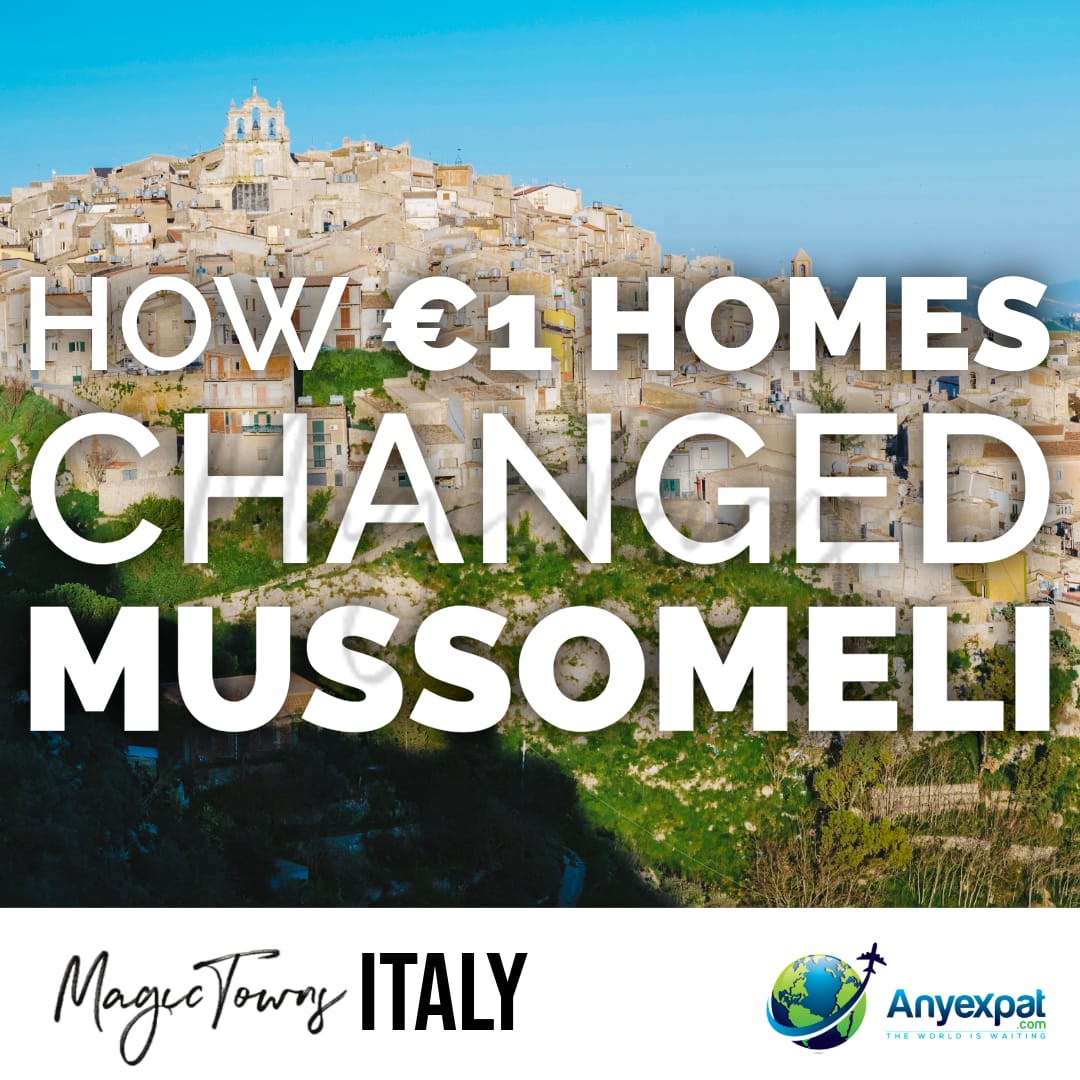

Anna: Hallo und herzlich willkommen zurück zum Magic Towns Italien-Podcast.
Luca: Willkommen zurück. Einen schönen Samstag euch allen.
Anna: Happy Saturday. So, yeah, today we’re talking about, one euro homes, Sicily, visas.
Luca: And before you say, oh no, another episode about one euro homes, we’re actually starting with something completely novel, which is the first one euro home program in northern Italy.
Anna: Wie?
Luca: Really? Yes. Anna don’t act all surprised. You wrote an article about that.
Anyway, it’s just an inside joke. So this week?
Anna: Ja, erzähl mir mehr davon. Entschuldigung.
Luca: Ja, also diese Woche die Städte Recoaro, [00:01:00] Posina, und Valli del Pasubio, ganz in der Nähe von Vicenta. Und für diejenigen, die wissen, wo Vicenza is, that’s very near Venice have announced that the first batch of one euro homes in those, uh, lovely mountain villages.
Anna: Oh, okay. Und warum gerade jetzt?
Luca: Well, you see, it’s actually a very interesting area that I personally know. I would say intimately. It was a magnet for tourists about a hundred years ago. Even Nietzsche, the German philosopher, used to go on holiday there and
Anna: Machst du Witze?
Luca: Nein, nein. Das ist wirklich wahr.
There’s proof of it. He wrote about it. He wrote, that, it was one of the most beautiful places they had ever been to, but, it kind of fell off the map tourism wise. Because, uh, spas are not as popular now as they used to be in the past in Italy at least. And so even when I was a child at this [00:02:00] place, which was in huge tourist magnet had become less popular in the past few years. It has suffered a massive exodus of people that go and work and live in the nearby cities.
So there’s a lot of empty homes and quite simply the local governments decided to make them available to investors and people that want to move there preferentially to restore very much like the schemes in southern Italy.
Anna: Ja, aber das sind nur die ersten in Norditalien.
Luca: Ganz genau. Die ersten in Norditalien.
Wenn Sie also mehr darüber wissen wollen, gehen Sie auf magictowns.it und lesen Sie den Artikel, in dem wir alles über dieses brandneue Programm berichten.
Anna: Und seien Sie der Erste, der sie kauft.
Luca: Yeah, maybe. And then we can have a chat with there about how you feel about that. That is, if Anna and I don’t buy them first.
Was gibt es sonst noch in unserer heutigen Folge, Anna? Wir haben ein Interview, richtig?
Anna: Ja, wir trafen George nach einem Besuch Mussomeli und es war, wie war es, Luca, denn du warst [00:03:00] dort.
Luca: George ist jetzt das schlagende Herz von Mussomeli in England.
We spent, half an hour chatting with him about how things are going, how the city is changing now that he has brought in his massive social media following. He also has some new plans that he briefly mentions and he’s going to officially unveil in the next couple of weeks.
So without further ado, here’s a little excerpt of our chat with George.
Hallo George. Wie geht es dir?
George: Hallo. Wie geht es uns?
Gill: Hallo. Ich glaube, wir haben Sie um einen Tag in Mussomeli verpasst.
Luca: But we met some of your fans. Even the people that haven’t met you, they’re basically all there for you, which is very interesting. We’ve actually never seen anything like this.
George: It’s been great for Mussomeli. All the locals are very happy, all the one euro houses have been sold now, all the prices are slowly starting to creep up and everyone’s spending money at the businesses. So it is just a win-win situation for everyone really.
Luca: Ganz genau. Wissen Sie, wir leben im Norden. Und wir haben [00:04:00] herausgefunden, dass sie zum ersten Mal, gerade heute, das Ein-Euro-Haus-Programm gestartet haben, ganz in unserer Nähe, 10 Meilen entfernt.
George: Wow.
Luca: So that’s quite exciting because, you know, so far it has only been in the south.
George: I think a lot of the times, you know, one of the reasons people have sort of come to Mussomeli. It is purely just because it’s one of the few towns in Sicily, which someone’s really marketing it heavily.
Alle diese Städte sind sich ziemlich ähnlich und bieten ähnliche kulturelle Erfahrungen und ähnliche Immobilienpreise. Aber Mussomeli hat meiner Meinung nach einfach Glück gehabt. Und der Bürgermeister hat sich sehr positiv ausgewirkt, denn in vielen dieser Orte gibt es so viel Bürokratie.
You know, with the one euro house scheme I went through, there was no upfront deposit. You had three years to do the roof and the facade, which they’ve now scrapped that rule and to incentivize people to keep coming, they’ve now introduced a new rule where you can remove the roof of your one euro house and make a garden.
The only time I’ve heard people having bad experiences in Mussomeli is by using contractors who want to charge you upfront. I know one girl at the [00:05:00] moment, she’s from LA, she spent 20 grand in the house. I think she agreed to 120,000 pound renovation budget. And she paid someone upfront or didn’t pay them upfront and now the builder thinks they’ve done 40,000 pound worth of work.
She doesn’t think 40,000 pound worth of work has been done. She’s in legal battle with another contractor. So that’s one of the reasons why I like to do a lot of the work myself, because all the times I’ve heard about bad experiences always ends up by employing someone you employ, unfortunately.
Gill: We’ve been through that. And then when you employ someone new, they blame the old guy. And you never know where the train of responsibility ends or finishes. So it’s even no matter what, it’s a disaster going forward.
George: And you don’t know if they’re cousins or the person you had before. You know, everyone seems to know everyone will be related to someone somehow.
Luca: And so you have to be careful, because if you raze the ground around you in these small towns, it’s over.
George: Ja, das stimmt.
Luca: Haben Sie vor, Ihre Immobilien zu vermieten?
George: Yeah, I mean, for my first two properties, I’ve got a waiting list of about 500 people waiting to stay at the moment. I’m gonna start [00:06:00] taking bookings on my website. But, you know, my departments aren’t being ready for at least two or three months. Once they’re ready, they’ll just be rented out.
Gill: Da ich in London lebe, weiß ich, dass der Preis pro Quadratmeter einfach wahnsinnig ist. Man sieht es also und erkennt den Wert, aber dann muss man an die Kosten für die Reparatur denken.
George: Ja, ich habe mir eine YouTube-Sendung über diese Frauen angesehen, die einen Palast in Palermo, und sie sagten, dass das örtliche Municipio 500.000 Euro für einen Zuschuss wollte, um mit der Renovierung zu beginnen oder auch nur, um den Prozess zu beginnen. Sie wollten eine halbe Million. Nur um die
Luca: Oh, wie die Bankgarantie? Ja. Es muss ein historisches Ereignis gewesen sein.
George: it was a historical one right in the center where you’re looking over the main square, like the huge ones on the corner.
She was just like, we may be millionaires on paper, but we don’t have half a million pounds just to pay for a permit
Luca: Welche Art von Anreiz ist das? Italien ist voll von alten Immobilien. Sie sollten alles tun, was Sie können, um die Dinge zu erleichtern.
Gill: I guess the one thing everyone here believes in, we believe in Italy, we believe the property’s cheap and we believe we should be doing more to bring people in.
Luca: That’s what we’ve been working on. Finding towns where the local [00:07:00] government is supportive. Because as you know, everything changes from town to town.
George: It puts me in a very good position, and, every time I sell a house for Mussomeli, I don’t get paid for it. I’m just doing it out of goodwill. The reason I left London is I couldn’t afford half a million pound for one bedroom flat, so now I’ve got more chance of buying a house in London in a few years than I did staying there.
Luca: Hopefully we’ll get you to move to Italy permanently. You’re working on getting a visa, right?
George: Well, that’s the thing. At the moment, I don’t have a visa. I can only say ninety outta a 180 days. So for the last probably 40 months now, I spent two weeks in Mussomeli, two weeks in London. I’ve been doing that on rotation every month for 40 months now.
So at some point it would be nice to spend longer than a couple weeks at a time. But as far as I’m aware, either I get a student visa, which I have to go into college five days a week, four hours a day, and you know, I dropped outta uni after first days.
Luca: Jetzt haben sie das Gesetz geändert. Man muss mindestens B1 in Italienisch haben, um ein Visum zu bekommen. Man muss also Italienisch haben, bevor man sich an der Universität einschreiben kann.
George: Und die einzige andere Möglichkeit ist, ein Visum für digitale [00:08:00] Nomaden zu bekommen, das ich wahrscheinlich auch bekommen könnte.
Luca: Heutzutage haben sie das Verfahren einfach beschleunigt. Man kann sie in wahrscheinlich 45 Tagen bekommen.
Sie könnten auch einen Italiener heiraten. Sei nur vorsichtig mit den Ehemännern.
George: Basically 20% of the people I bring to Mussomeli realize they don’t wanna live in Mussomeli. Actually. They wanna live by the beach. And it’s just been a rule of thumb. I’ve realized averagely about 20% of all people end up moving to the beach after coming to Mussomeli.
Luca: It’s funny that you mentioned this thing about people, things, their minds, because like we spoke to this Australian woman, she’s like, you know, I need to be somewhere else.
I like to be in Italy, but I’d like to be somewhere else as a full-time thing. so finding the few different decent options is definitely important. There are people for whom Mussomeli matter will be fine, but there would also be looking for other things.
George: Well, I think that’s the beauty of, of Sicily. You know, there’s not many places left in the world you can buy a property for sort of 20 or 30,000 and you know, if you sold your property elsewhere for a couple hundred grand, you can have two, three properties all around Sicily. Jump between each of them, vent them out.
Luca: I think people don’t understand just how much of Italy is undervalued. We just bought a [00:09:00] house around the corner from here and we paid 50 K, and it’s big, like 3000 square feet.
George: Wow.
Luca: But the beauty of it is that it’s actually very thriving town. It’s near Venedig. It’s near Padova, it’s near Verona. Sie können überall billige Sachen finden. Man muss nur suchen.
George: Yeah. The thing that I’ve seen change about Mussomeli most recently is now all the one year houses and the house under 10 K is starting to go.
Das Haus unter 20 K beginnt zu verschwinden, aber die größte Veränderung ist die nächtliche Wartezeit pro Aufenthalt. Als ich das letzte Mal dort war, ging mein Kameramann von Channel four, der bei mir wohnte, in die Standardwohnung mit zwei Schlafzimmern in Mussomeli
He was paying a hundred euros per night on Airbnb. He paid 700 euros for the week. I couldn’t believe it.
Luca: Ich war schockiert.
Gill: And that’s a fraction of the house you just bought, you know,
Luca: das Zimmer, in dem wir wohnten. Ride, aber es war auch, es hatte auch ziemlich viele Probleme und 90 Euro Nacht
Anna: Yeah. That’s crazy. It’s even more, more expensive than bigger cities like Milan, Rome….
Gill: Es gab auch eine Menge guter Leute, die etwas für [00:10:00] soziale Aufrufe, ESG und Dinge wie die Gemeinschaftsküchen getan haben.
I met someone from Armenia who was like trying to set up something with wool that had indirectly met you. So there’s a lot of social good going on. On the sidelines of all the things you’ve introduced. ’cause you’ve got people who want to do good in an area where they can afford, you know, to set up premises.
Luca: And that’s what you can do when you’re in a place where you can actually play with property, where you can buy stuff and have a bit of fun with it. There’s no way someone can say, I’m gonna throw €100k something in London and make a coworking space out it. Because you’re not even gonna buy a garage.
George: There’s one guy in Mussomeli who I like a lot. He started with one house, bought it for 20,000. He now owns. All six adjoining houses in the first house, the top floor. He’s turned it into a hairdresser studio where he gets a couple young guys and girls is doing hairs. He’s turned the bottom floor into a cafe and he is got a license from the mayor to have tables and chairs outside and they’ve made a communal garden and he’s just turned his corner property now into like half the street, which he owns. And it costs him [00:11:00] like 150 grand in total.
Luca: He’s got empire
George: and he is got his own little empire, you know, and he gets people on WeWork who come and work for him for free, for sort of work experience. And um, you know, he’s living like a king.
Gill: Ja, das stimmt. Aber dann unterstützen sich die Leute gegenseitig und diese Art von Lebensstil vermissen die Leute.
And the thing is, if you relocate to a big city or you relocate somewhere, there’s no foreigners. You feel very lonely. Whereas that’s what Mussomeli has. You have like-minded people and you pull them all together to a place so that that dissipates the loneliness. So I can see how it really works.
Luca: Das macht einen großen Unterschied.
George: Yeah. And you know, when you live in a place where you are restrained financially and you’ve got so many bills coming out, it’s almost a luxury to be able to have all these sort of ideas and go through with them, you know? But because you’re not constrained financially or by the mayor, you know, there’s a lot of freedom to sort of, I say to anyone, if you’ve got 50 grand, you can come buy a house and start a business and have a good life.
Which is, you know. In London. That’s like a year’s rent, so
Luca: Ja, ja, absolut.
George: No, I mean there’s, [00:12:00] people ask, why’d you choose Miss Me? I didn’t really choose Miss Somme. It was just they had a one year house scheme going on and I wanted a cheap house. And then because I was there, I started promoting it.
You know, miss, so me’s beautiful, but you know, there’s another 10,000 towns which look pretty identical to Miss Milli around sissy. But you know, it really depends who’s there and who’s promoting it.
Luca: So they come over because it is like, I’m not gonna be the only foreigner in a town.
George: Yeah. Yeah. I mean, my, my problem is I don’t really tend to think things through too much. I just sort of go with the flow and, um, hope for the best. And, uh, that’s planned out pretty well so far.
Also, I try and show, you know, a positive side of this. You know, a lot of it people who document this process, it’s quite negative. They’re talking about all this sort of things that have gone wrong.
I just try and show, doing on a shoestring budget, with not speaking the language, not knowing anyone, you know, it’s still possible.
Luca: Ja, ja.
George: I see the people who end up in the biggest trouble are the ones who are just trying to throw money at problems all the time when that doesn’t really solve the problem.
A lot of the time, just constantly throwing money at the issue. But you learn from your mistakes and fortunately I’ve not made the [00:13:00] costly ones.
Gill: Or say, if you do nothing, you don’t make any mistakes. So the only you know, that’s how you learn, that’s how you progress.
Luca: Es war wirklich ein Vergnügen, mit Ihnen zu sprechen. Vielen Dank, George.
Anna: Das war ein tolles Gespräch.
Luca: Ja, er ist immer voller Einsicht.
Anna: Ich finde es toll, wie ehrlich George mit seinen Taten umgeht. Ich meine,
Luca: absolutely. We cut out some of the more, more honest, honest, honest parts, but he’s still very honest on record. Um. Anyway, it was a pleasure to talk to him. Uh, and, uh, we’re always following what he’s doing.
Und es wäre interessant zu sehen, wie sich die Region Sizilien entwickelt, da das Ein-Euro-Häuser-Programm sozusagen ausgereizt ist und die Leute anfangen, sich nach anderen Standorten umzusehen. Langfristig bin ich also optimistisch für Sizilien, wir werden sehen.
Anna: Yeah, I mean, it’s not just about cheap property. It’s about community. It’s about [00:14:00] building something bigger and yeah finding the right one isn’t that easy.
Luca: Absolutely. It’s mostly about community. I’d say if there’s something we learned, it’s that. Thank you listeners for being here thus far and for listening to us every week.
We really appreciate you and feel free to send us your comments. The last thing I want to mention before going on to enjoy my Saturday branch is that this week we have launched, on Magic Towns Italy two new indicators, which are very, very important. We’re gonna be talking about this in next week’s podcast in a little bit more detail, but we now cover demographic fragility as an indicator on our Town Explorer.
Es hat sich gezeigt, dass eine große Anzahl von Städten in Italien. Fast zwei Drittel von ihnen schrumpfen in einem ziemlich schnellen Tempo, und das ist natürlich ein gefährliches Signal für jeden. Sie könnten sich in einer [00:15:00] Gemeinde wiederfinden, die in den nächsten 20 Jahren schrumpfen wird. Wir haben also die Daten ausgewertet und so vereinfacht, dass jeder sie verstehen kann.
Jeder, der Zugang zum Stadt-Explorer auf Magic Towns Italien hat, kann jetzt danach filtern, ob eine Stadt aus demografischer Sicht solide ist, d. h. ob sie sich in den nächsten Jahren voraussichtlich gut entwickeln wird, oder ob sie sich in einer prekären Lage befindet. In diesen Fällen sollten Sie vielleicht zweimal darüber nachdenken, was Ihre eigenen Bedürfnisse in 10 oder 20 Jahren sein werden.
I hope you’re going to enjoy using this. I hope you enjoyed our podcast and I hope you enjoy your weekend.
Anna: Ich danke euch, Leute. Bis zum nächsten Mal.
Luca: Ich danke Ihnen, Anna. Ich danke Ihnen allen.
 English
 French
 German
 Italian
 Danish