 German
  English
  French
  Italian
  Danish
You’re in Italy and desperately need a medicine. You walk into what looks like a pharmacy, ask for antibiotics, and walk out empty-handed. Not because they don’t have them – but because you need a prescription, and no, they won’t make an exception.
This is a common scenario for Expats who have just moved to Italy. Italian pharmacies have their own logic, though, and once you understand it, it’s actually pretty straightforward. Here’s everything you need to know.
Farmacia vs. Parafarmacia in Italy
Although the names are pretty similar, there’s a big difference between a farmacia und eine parafarmacia.
Die parafarmacia sells different kinds of products: those that aren’t really considered medicines, like supplements, vitamins, and cosmetics; OTC medications, which are medicines you usually take when the problem you’re facing isn’t that serious (like sore throat tablets, headache pills, decongestant nasal sprays, and the like); and in general, all those medicines for which you don’t need a medical prescription. So let’s say it’s the place you go when you’re nicht dealing with a super serious problem.
On the other hand, a farmacia sells all of these products too, plus all the medicines for which you necessarily need a medical prescription. It’s a fully licensed body regulated by the state and contracted with the national health service (SSN).
So: if you have a prescription, you need a farmacia. If you just need ibuprofen, a vitamin supplement, or a skincare product, the parafarmacia around the corner will do fine.

Do You Actually Need a Prescription?
Not everything in Italy requires a prescription – but the list of things that do is longer than most expats expect.
For everyday problems – a headache, a sore back, hay fever, a cold, heartburn, or a mild fever – you don’t need one. You can just walk into any farmacia or parafarmacia and ask for what you need: paracetamol, ibuprofen, antihistamines, antacids, decongestants. All of these are called farmaci da banco (OTC) or farmaci senza obbligo di ricetta (SOP). Most of the time you’ll find them behind the counter (though OTC products can technically be on open shelves too) and you just ask and they hand them over. Both farmacie and parafarmacie carry these.
Things are different when the problem is more serious. For anything that is classified as farmaco soggetto a prescrizione medica, the pharmacist will ask for a prescription. No prescription, no medication – regardless of how well you explain your situation or how long you’ve been taking the drug. To give you an idea, these include:
- Antibiotics (Italy does not sell these OTC – not even amoxicillin)!
- Antidepressants and psychiatric medications
- Blood pressure and heart medications
- Thyroid and diabetes drugs
- Hormonal treatments, including most contraceptive pills (the morning-after pill is an exception)
- Controlled substances (benzodiazepines, opioids, certain sleep aids)
- Many dermatological treatments like tretinoin or strong topical steroids
The Two Types of Prescriptions
Sobald Sie eine prescription, there are two kinds you might come across:
The first is the SSN prescription, which is what you get from a doctor working within Italy’s public health system. It used to come on a distinctive red paper form; these days it’s mostly digital. The big advantage here is that you don’t pay the full price of the medication. Instead, you pay a small co-payment called a Ticket, which varies by region, by drug, and sometimes by your income level. Some medications are completely free for people with certain conditions. Others cost a couple of euros. And a few – those the SSN considers non-essential – aren’t subsidised at all, so you end up paying full price even with a valid SSN prescription.
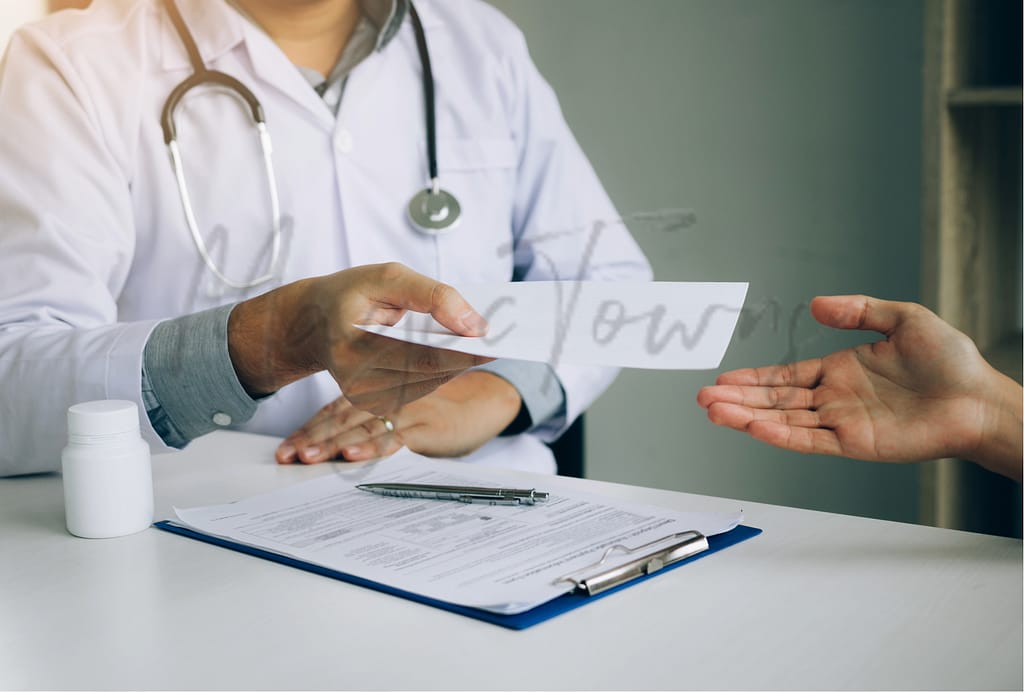
The second is the private prescription, called ricetta bianca (literally “white prescription”). This is what any doctor (public or private) can write when operating outside the SSN framework. It’s just a standard form or a sheet of paper with the doctor’s details and signature. The farmacia accepts it exactly the same way, but you pay the full price out of pocket. If you’re seeing a private doctor, or if your medication isn’t covered by the SSN, this is what you’ll get.
How to Get a Prescription: Your Scenarios
1. You’re registered with the SSN
This is the easiest situation to be in. Your medico di base (the GP assigned to you through the SSN) can prescribe most things within their competence, and for chronic conditions – say, blood pressure medication, thyroid drugs, or antidepressants – they’ll typically issue prescriptions covering 30 to 90 days at a time, sometimes up to six months.
For certain specialist medications, your GP might first need a piano terapeutico – a formal treatment plan put together by a specialist – before they can keep renewing the prescription. But once that’s in place, it’s usually a smooth process.
Wenn Sie not yet registered with the SSN: you do this at your local ASL (Azienda Sanitaria Locale) once you have Italian residency and a codice fiscale. You pick from a list of available doctors in your area. It’s free, and once registered you get a Tessera sanitaria (health card) that you bring to every appointment and pharmacy visit. While you wait for it to arrive, the ASL gives you a temporary certificate that works in the meantime. But we’ve covered this topic in detail in a separate article.
2. You’re an EU citizen passing through
If you’re an EU or EFTA citizen (Iceland, Liechtenstein, Norway, Switzerland) and you’re staying in Italy for up to 90 days, you can use your EHIC card – known in Italy as the TEAM card – to access public healthcare on the same terms as Italian residents. In theory, this covers prescription medications too. In practice, results can vary: some pharmacies and ASL offices handle EHIC smoothly, others less so.
For anything non-urgent, the simpler and more reliable route is often just to see a private doctor, get a ricetta bianca, and pay out of pocket. It’s not expensive, and it cuts out the uncertainty.
3. You’re a non-EU expat and not registered yet
No SSN registration means no medico di base. But you still have options.
So, if for example you’ve arrived with a prescription from your home country (US, UK, Canada, Australia, etc.) you should know that Italy doesn’t recognise foreign prescriptions, so you cannot take it straight to an Italian farmacia and get it filled. What you can do is take it to an Italian private doctor along with your documentation, and ask them to issue an Italian ricetta bianca for the same drug. For standard medications, most doctors do this quickly and without much fuss. And nowadays, there are also many websites online where you can talk to a doctor virtually, pay and get your prescription.
Sometimes, in smaller towns, if you show up with an empty box of a medication you clearly take regularly for a chronic condition, some pharmacists will dispense a small emergency supply on their own discretion. But this is entirely at their discretion, not a system you can count on, and varies a lot by pharmacist and location. If you do end up feeling unwell in Italy, you still have two other options:
Use the Guardia Medica (Continuità Assistenziale) for urgent but non-emergency situations outside normal hours. For example, if you wake up with a bad infection on a Sunday night and can’t wait until Monday, this is where you’d go. It’s a public service that’s theoretically accessible even without SSN registration, and they can issue prescriptions. That said, quality varies quite a bit depending on where you are.
Go to the Pronto Soccorso (ER) for genuine emergencies – a serious accident, chest pain, a high fever that won’t come down. They treat everyone regardless of registration status. If the visit is later deemed non-urgent, you may receive a bill. They can also issue a prescription on discharge if needed. Just bear in mind that waiting times can be very long (often several hours).
A Few More Things Worth Knowing
Like most shops in Italy, farmacie close for lunch and wrap up around 19:30. If you need something outside those hours – on a Sunday, a public holiday, or late at night – don’t worry: every area has a farmacia di turno, at least one pharmacy that stays open at all times. You’ll find which one it is posted on any pharmacy window, or you can look it up online by city.
Another thing worth knowing is that you don’t always need to see a doctor first. Italian pharmacists are well trained and genuinely useful as a first point of contact for minor issues. If you have a sore throat and no doctor yet, or you’re not sure whether what you’re dealing with needs a prescription, go talk to a pharmacist before doing anything else. They’ll often be able to sort you out with an OTC product, tell you whether you need to see a doctor, oder point you in the right direction.
And if you’re taking a medication from home and running low, don’t panic – just bring the original box to the farmacia. The pharmacist can look up the principio attivo (active ingredient) and find the Italian equivalent. And if you want to save some money, you just need to ask for generic versions (farmaci equivalenti), which are basically the same medicines, but without the brand, and are much cheaper.
As you’ve seen, the system is more structured than what viele Auswanderer are used to, but it’s definitely not complicated once you know the rules.

War dies hilfreich?