
This is the 2026 update of our Italian Public Healthcare scoring. The 7,896-town analysis of Italy’s public health system finds a country where the gap between best and worst is wider than between Italy and the United States. Northern Tuscany and the Veneto top the table. Parts of Southern Italy anchor the bottom, but there are areas in the North that show up surprisingly poorly. The story is mostly about which local health authority you happen to live under.
(Almost) As Good As Sweden, But Not Everywhere
Italy as a whole runs one of the best healthcare systems in the world. The Lancet’s Healthcare Access and Quality Index ranks it ninth globally. The OECD records Italian amenable mortality (deaths that should not occur given timely medical intervention) at roughly two-thirds the OECD average. Italians live longer than almost anyone else on earth.
![Where Italian Public Healthcare Actually Works [2026 Update] 6 Italian public healthcare](https://magictowns.it/wp-content/uploads/2026/05/Screenshot-2026-05-15-alle-12.20.22.png)
On life expectancy Italy is essentially indistinguishable from the Dutch and Swedish frontier. On the harder clinical outcomes, like survival after a heart attack, survival after a stroke, Italy is half a step behind. The Nordic and Dutch systems get specific acute episodes right slightly more consistently than Italy does. But the entire OECD non-frontier sits well below Italy, including the United States, the United Kingdom in much of its recent post-NHS-strain history, and several G7 peers.
That is the national average. The local reality varies dramatically.
This study scored every Italian town in our coverage on a 0-to-100 scale combining two elements: the measured quality of the local public health authority (the AULSS, ASL, etc., that organises hospitals, GPs, clinics and emergency services in the area), and the physical accessibility of healthcare dal town itself (farmacie, clinics, hospitals, drive times). The first counts for 70% of the rating, the second for 30%. AULSS quality is anchored on AGENAS Monitor 49, the national health agency’s annual cross-AULSS performance assessment, calibrated against international benchmarks.
The headline number for any individual Italian town is therefore one figure between roughly 25 and 95. The country average is 55. The best is 90 (Vicenza). The worst is 25 (Aliano, in the inland Matera province where Carlo Levi set his novel Cristo si è fermato a Eboli over 80 years ago). The 65-point spread between Vicenza and Aliano is, on the OECD scale, comparable to the gap that separates the Netherlands from the United States.
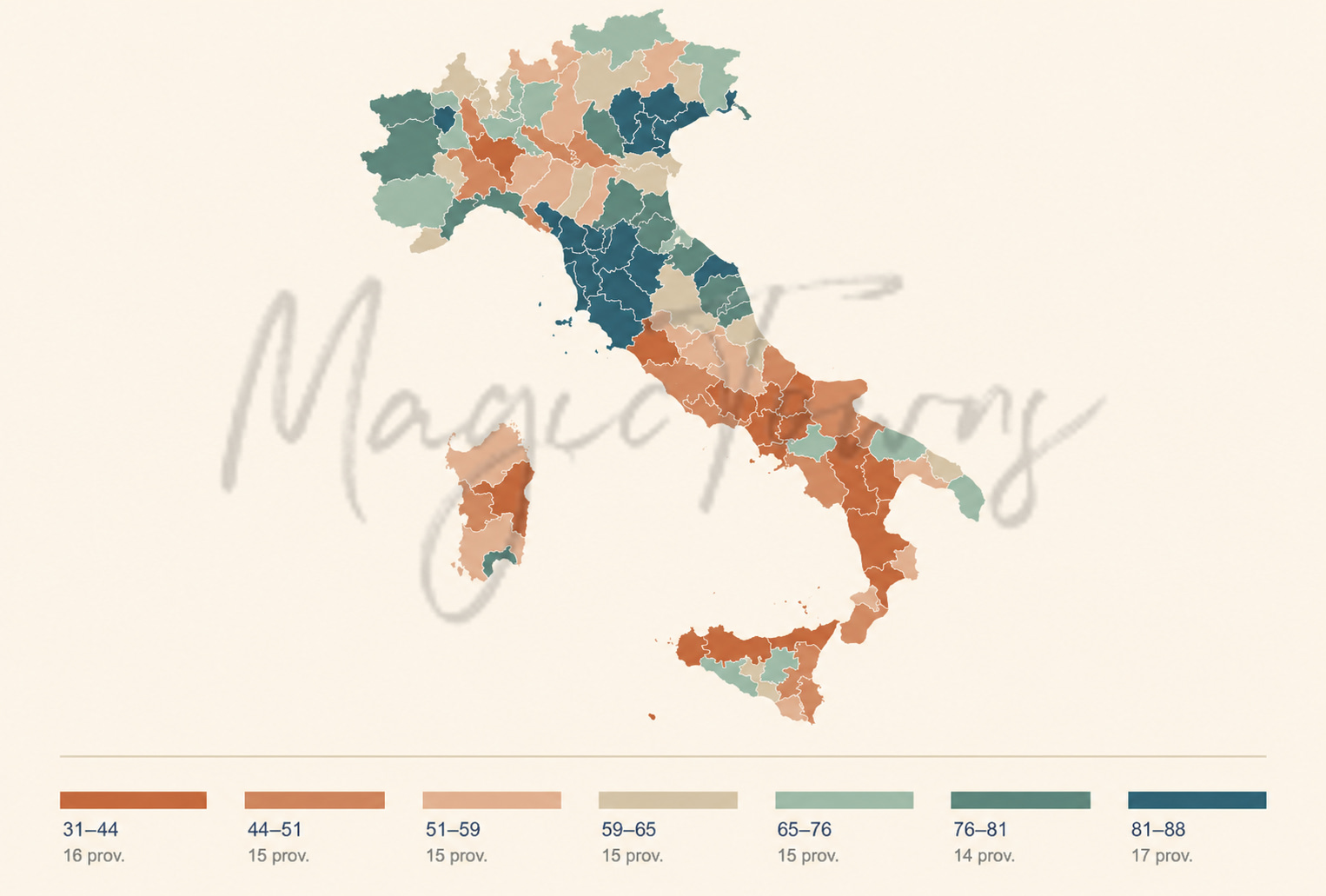
Where Is Italian Healthcare Best? The Map
![Where Italian Public Healthcare Actually Works [2026 Update] 7](https://magictowns.it/wp-content/uploads/2026/05/ChatGPT-Image-15-mag-2026-12_09_13-1024x692.png)
Three patterns are quite visible from the map:
Primo, the Tuscan-Veneto arc. From the Tuscan coast across the Apennines into Firenze and Siena, then turning north into the Marche and onward to Vicenza e Padova, there is an almost unbroken band of strong-to-top-tier healthcare provinces. The mean rating in Veneto is 79; in Tuscany 78; in the Marche 76. These are not merely above-average — they are statistically distinct from the rest of the country.
To many readers’ likely surprise, Lombardy underperforms. Lombardy’s regional average is 49, below average. The plain that stretches from Brescia through Mantova, Cremona, e Pavia is consistently weak on the hard AGENAS clinical outcomes that drive the bulk of our rating: 30-day survival after surgery, readmissions, stroke recovery. Milano itself rates 73, which is solid, but not exceptional. The Lombard reputation for world-class medicine is built largely on a handful of teaching hospitals (San Raffaele, Niguarda, Humanitas) that sit outside the AULSS structure we are measuring. They are real, but they serve patients from across Italy and are not the system you fall back on as a resident.
Terzo, the Lazio-Basilicata weakness. Lazio averages 39, dragged down by the four ASL surrounding Roma. Frascati and the Castelli Romani sit at 42, Latina at 51, Frosinone at 40. Rome itself rates 67, kept respectable by access density rather than ASL quality (ASL Roma 1’s quality percentile is 55th nationally, which is average, in a country where the average is 50th). Further south, Basilicata averages 30, the lowest of any Italian region.
Why Vicenza, of all places
The single highest-rated town in the country is Vicenza, at 90. The province as a whole averages 88. This may surprise readers who associate Italian healthcare excellence with the famous brand names like Bologna, Florence, Milan, the Mayo-Clinic-style university hospitals.
Vicenza’s strength is not driven by famous institutions. It is driven by a public-system catchment (ULSS 8 Berica) that scores in the 93rd percentile of all 105 Italian health authorities on AGENAS measurements. Its emergency response pillar is 64; its hospital care pillar 60; its community-care pillar 60. None of these is exceptional on its own, but the combination is unusually balanced, and the territory it covers is densely populated with farmacie, clinics, and a tight hospital network.
![Where Italian Public Healthcare Actually Works [2026 Update] 8 Italian public healthcare](https://magictowns.it/wp-content/uploads/2026/05/ChatGPT-Image-15-mag-2026-12_03_39-1024x692.png)
The same applies to the Tuscan cluster. The five Tuscan ASL covering Lucca, Massa-Carrara, Pisa, Livorno, Pistoia, Prato, Firenze, Siena and Arezzo all score at or near the 100th percentile of AGENAS authorities. Lucca, Massa-Carrara, Livorno and Pisa share a single AULSS (ASL Toscana NordOvest); Pistoia, Prato and Firenze share another (ASL Toscana Centro); Siena, Arezzo and Grosseto share a third (ASL Toscana SudEst). All three are top-decile nationally. That clustering means a small Apennine village like Cortona inherits the same AULSS quality as the Florentine bourgeoisie, ending up at 87 in our rating — within two points of Florence itself.
The Garda Paradox
The clearest illustration of how much AULSS catchment matters is Lago di Garda, where the regional border between Lombardia and Veneto runs through the middle of the lake.
![Where Italian Public Healthcare Actually Works [2026 Update] 9 Italian public healthcare](https://magictowns.it/wp-content/uploads/2026/05/ChatGPT-Image-15-mag-2026-12_13_46-1024x692.png)
The east-shore towns (Bardolino, Garda, Lazise, Malcesine, Peschiera, Torri del Benaco) average 77 in our rating. West-shore towns like Salò, Desenzano, Sirmione, Gardone Riviera, and Limone, average 45. That is a 32-point gap on a 100-point scale, between towns separated by a few kilometres of lakeshore. The climate is identical. The wealth is similar. The difference comes almost entirely from the local public health authority.
ATS Brescia (which covers the west shore) sits at the 29th percentile of Italian health authorities on AGENAS. ULSS 9 Scaligera (east shore) sits at the 71st. The east shore’s primary care is stronger, its readmission rates are lower, its emergency response is faster. Patients seeking elective care will often cross the lake to a private clinic in Verona regardless of which side they live on — the gap is large enough that the choice is rational.
The Sicilian Surprise
A finding that surprised our analysis: central Sicily, which includes the provinces of Enna, Agrigento, Caltanissetta, and Ragusa, outperforms large portions of northern Italy on measured clinical outcomes. ASP Enna scores in the 76th percentile nationally. Its 30-day mortality after acute myocardial infarction, NSTEMI and ischaemic stroke is materially better than the Italian average. Its hip-fracture surgical timeliness is decent.
This partly contradicts the conventional north-south healthcare narrative. The conventional narrative is not wrong, but it is geographically narrower than it is usually told. Coastal Sicily is where the genuine weakness is. The interior performs differently, and the reasons appear to be administrative rather than economic. The four central-Sicilian ASP have unusually stable management histories and well-organised provincial hospital networks. Whatever they are doing differently from coastal Sicily is showing up in the survival data.
The Bolzano question
Several readers of earlier drafts of this analysis questioned why South Tyrol, long held up as Italy’s “Swiss-adjacent” healthcare benchmark, sits in the merely-good rather than top-tier band. Bolzano rates 76 in our analysis. Trento, similar at 71. These are good numbers, but they are below the Tuscan ASL and the eastern Veneto ULSS by 10-15 points.
The explanation lies in how AGENAS measures performance. AGENAS measures the public SSN system, that is, the AULSS that handle the public-card-funded healthcare available to all residents. South Tyrol’s public SSN performance is genuinely middle-of-the-pack on AGENAS measurements, particularly on community care (the indicator AGENAS specifically flags for Bolzano is flu hospitalisations, suggesting the GP and vaccination network is less effective at keeping seasonal cases out of hospital than it could be).
What South Tyrol è renowned for is its private healthcare sector, the integration with Austrian clinics, and the dense network of private specialists in Bolzano and Merano. None of that is captured by AGENAS or by our rating. For a resident who plans to use private cover, South Tyrol’s overall package is exceptional. For a resident who plans to use the SSN as their primary system, our rating tells you what you would actually get — and it is fine, just not Tuscan-Veneto fine.
Explaning Our Ratings: What Goes In The Sausage
The rating is built from two layers:
- The first layer measures the autorità sanitaria locale using state data from AGENAS, the national agency covering all 105 Italian health authorities across roughly 60 clinical indicators. We take all 58 scoreable indicators (excluding 11 volume threshold measures and three indicators AGENAS publishes only as absolute counts, which create unfair size bias), assign each a reliability tier, and compute a tier-weighted composite percentile. In essence, there are three tiers of ratings which we rank by importance, and assign a weight to accordingly. For instance, 30-day readmissions after major surgery “count for” more than flu hospitalisations. The reason is simple: the former is unequivocal in importance and directions, the latter could mean either strong primary care, or absence of GP referrals. It’s ambiguous, and we give it a lower weight.
- The second layer is town-level physical access: farmacie within 10 km (full credit at 10+); hospitals and clinics within 10 km (full credit at 5+ combined); hospitals reachable within a 30-minute drive (full credit at 5+); drive time to the nearest hospital (full credit at ≤10 min, zero at ≥60 min). Where the count-based POI data is sparse, we use the 5km-buffer Real Population as a fallback proxy. The fallback only ever raises a town’s access score; it never lowers one.
Final rating = 70% calibrated AULSS quality + 30% physical access.
Why This Analysis Should Matter To Expats
There is a use case for this analysis. Anglophone retirees moving to Italy under the favourable Italian tax regimes — the 7% tax for Southern villages, the various flat-tax options for high earners — generally do not see the full healthcare picture before they choose where to live. The conventional wisdom equates “Italian healthcare” with the national average. The data say the local AULSS is what determines the daily reality, and AULSS quality varies more than any other dimension we measure.
A retiree thinking about Tuscany has a fundamentally different healthcare prospect from one thinking about southern Lazio, even though both regions look comparable on a wealth or climate map. The same applies inside regions: a retiree in the eastern Veneto sits in genuinely top-tier territory; one across the Garda lakeshore in Brescia province sits in below-average territory.
A practical reading guide: anything above 65 on our scale means a comfortable life on the SSN with private supplementation as a personal choice rather than a necessity. Anything between 50 and 65 means a workable SSN system where private cover for elective care is wise. Anything below 50 means private supplementation should be planned from arrival — the public system will handle emergencies and routine care, but quality on the harder outcomes is materially below the Italian average.
Who’s At The Bottom Of The Ranking
The last point that deserves to be made carefully. The bottom-rated places in this analysis — Aliano, Stigliano, the inland Matera villages, the deeper Basilicata interior — are not failed-state healthcare. They are towns of three or four hundred people, often elderly, an hour’s drive from the nearest hospital, served by an AULSS whose AGENAS scores genuinely place it in the lowest decile of the country. The 25 floor on our scale exists precisely so that these places are not reduced to single digits when the percentile is 1.
These are also towns of extraordinary cultural value — Aliano above all, where Carlo Levi spent his political exile and wrote the book that defined Italian post-war literature. Anyone moving to these places is making a particular kind of choice, and they will know what they are signing up for. Our rating exists to make sure they know it before they commit.