

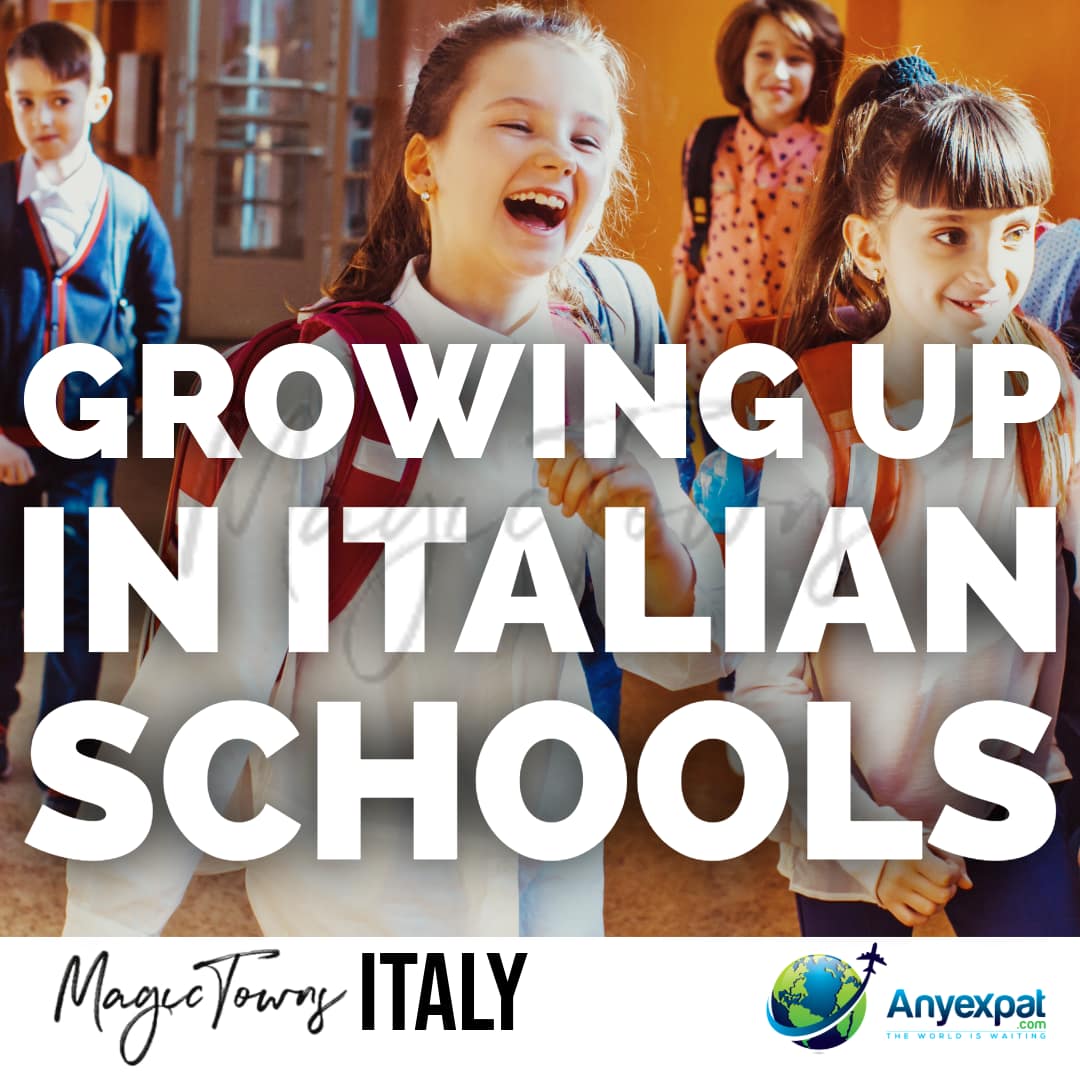

Anna: Today we’re talking about something that matters enormously if you’re thinking of moving here with children. What is actually like to grow up and to go to school in Italy? There’s a lot of mythology around the Italian education system.
It’s chaotic or outdated. Others, imagine something like idyllic and community driven, but the truth as usual sits somewhere in between.
Luca: That’s right. Hi Anna. So if you zoom out and look at the data, Italy’s broadly in line with the average of developed countries. In the latest PISA Le classifiche PISA sono classifiche internazionali di vari tipi di istruzione, i quindicenni italiani ottengono un punteggio intorno alla media in matematica. Circa tre quarti degli studenti raggiungono un livello di base solido in tutte le materie, e dove la situazione è più debole è nella fascia più alta.
There are fewer academic high flyers than in some Northern European and Asian systems. So it’s a system that works and works fairly well, but it is not especially elite. But we don’t want to talk about the data. You’ll be happy to hear that, Anna. We actually want to talk about what it feels like and, um, talking about that you actually grew up in that, inside the Italian system. Talking about the big picture, what did it feel like to grow up in a small Italian town?
Anna: I actually feel very lucky, because, you know, there is this kind of freedom that just comes with it naturally. So you know, your village, you can basically walk the whole thing and that makes you feel independent, even if you’re like just a kid. So, you know, I just grab my bike, I go buy bread or text my friends to figure out when to meet up.
I’m going to cinema. It seems like I’m [00:02:00] still doing these things, but
Luca: I know the cinema in your town, uh, it’s like, uh, tiny, but you know, still kids going to the center by themselves. It’s not taken for granted these days.
Anna: So yeah. You know, little things, but they made me feel independent. And because there’s less stuff to do, you end up being more creative about it. So, you know, you’re playing the hills behind the house.
Ti inventi le cose, le capisci da solo. E credo che questo ti formi in modo positivo. E credo che, almeno all'epoca, ci si sentisse davvero al sicuro.
Luca: Maybe we’ll talk in the future about whether it feels less safe now, but anyway. Yeah, that sense of embeddedness in a place is something the expat families often underestimate. It isn’t just about test scores, it is more about the feeling of being a child in Italy.
But since we’re talking about schools, most Italian children attend public schools run by the state, and the [00:03:00] state system is what carries the country. There are private schools, but historically have not, they have not been seen as premium. There are income gaps, of course. Immigrant students have increased now, right now in the makeup, about 11% of the students. And that’s double what it was 15 years ago. But once you adjust for the socioeconomic factors of the families of origin, basically, once you cancel out the differences in, family economics immigrant children, Italian children perform the same in the Italian system. So that’s good news.
E come ti è sembrata la scuola in queste diverse fasi, Anna?
Anna: Dipende. L'asilo era meraviglioso. Avevamo lezioni di inglese, arte e una cosa in cui i bambini più grandi aiutavano i più piccoli. Quindi si sentiva davvero la comunità. La scuola primaria era, era [00:04:00] buona. A parte il grembiule, l'ho odiato.
Luca: Have to tell, you’re gonna have to tell our listeners what the grembiule
Anna: That’s awful. It’s, like uniform. So we all had to wear it and I hated it.
Luca: Frequenta una scuola religiosa?
Anna: No,
Luca: Okay. We didn’t have a uniform in my state school. Maybe it was just your school that
Anna: Davvero?
Luca: Yes. Most schools don’t have a uniform.
Anna: Oh, no, no. Eravamo per.
Luca: di rompere con voi.
Anna: No, no. Siamo stati costretti a mettere quell'uniforme, ma...
Luca: That’s the point of a uniform. You’re forced to wear it
Anna: yeah. Well that was so bad. Like younger me was very much, why can’t I just express myself and wear what I want? But. Now I understand that the idea is to reduce differences, visible differences between families.
Quindi sì, il liceo dipende molto dalla classe in cui sei finito. Questo conta più di quanto si pensi. Ma c'era sicuramente spazio per la creatività. Quindi [00:05:00] intorno ad Halloween o a Carnevale la vecchia scuola si traveste e sceglie il costume migliore, a volte c'erano giornate di laboratorio in cui si poteva, c'era così.
Luca: dolce.
Anna: A volte c'erano giornate di workshop in cui ci si poteva iscrivere a corsi di skateboard, graffiti, fotografia e arte. Era fantastico. Ma probabilmente era solo un'eccezione. Probabilmente era solo la mia scuola.
Luca: Lo penso anch'io.
Anna: No. Oh, ok.
Luca: No, no, no. Credo che la maggior parte delle scuole lo faccia. Anzi, a mio parere, lo fanno più ora che in passato.
Anna: Yeah, the only thing that I’ve more mixed feelings about is how specific Italian school gets. So it’s very focused on, exact definitions. Sometimes it pushes you into memorization mode, so you do learn a lot, but you also forget a lot. I like it, but I wasn’t that good. Exactly because of this reason
Luca: because you couldn’t remember dates.
Anna: Sì.
Luca: Sì, lo so che [00:06:00] è fastidioso. E questo è un aspetto del sistema italiano, che è molto orientato ai fatti.
Anna: Sì.
Luca: date, ricordare i nomi, ricordare le poesie. E... mi sembra pesante
Anna: Sì.
Luca: Ad alcune persone si addice più che ad altre, giusto? Avete presente quando nella vostra classe ci sono persone che ricordano tutto?
Anyway, I’m a bit like you, meaning that I did everything in the, in the Italian public system, kindergarten, primary high school, university. And I personally think the Italian school system is one of Italy’s great institutions, possibly the greatest one, I wanna say kindergarten’s excellent.
Che sia ufficialmente montessoriano o meno, è sempre fortemente influenzato dalla filosofia del mondo dell'imparare facendo. È gratuito a partire dai tre anni. Si può usufruire di un asilo nido completo con classi flessibili, attività strutturate, e persino i miei amici del Nord Europa, quando vengono a vedere dove va a scuola il mio bambino più piccolo, rimangono veramente impressionati dall'asilo.
What I think is tricky is the jump between kindergarten and primary school. So you spend three years playing in the garden, playing with your friends, and then suddenly you’re sitting at the desk for hours. And understandably, children struggle with that transition. Personally I thought that things really turned out for the best in high school. Because you move away from that kind of standardized curriculum and you start doing what you actually want to do, whether it is languages or ancient Greek or STEM or whatever it might be.
But the tricky thing about the Italian system is that you still tested on everything. my friends from the US and the UK. The, the minds are blown by this, that in our finals we are tested on every single subject and they all count the same. So it doesn’t matter if you went to a language high school, still have to get passing marks in chemistry, physics, [00:08:00] religion, uh, so on and so forth.
Quindi, francamente, può risultare piuttosto pesante.
Anna: È diverso negli altri paesi?
Luca: Yeah. In some other countries, you pick some subjects that you want to take to your finals. So you say, I’m gonna do this, this, and this.
Anna: Oh, wow. Incredibile.
Luca: E' facile?
Anna: Yeah, I would’ve skipped like math or something like that.
Luca: Già. E la storia.
Anna: Bene,
Luca: avete trovato tre soggetti da fare
Anna: no, no languages. Literature. Uh, no, history is important. Like really, it’s really
Luca: Certo.
Anna: It’s just,
Luca: lo studierà.
Anna: Sì, ma ti rende più completo, sai?
Luca: Si'. Sì, è così. È una specie di ritorno alla sopravvivenza del più adatto. Una cosa che è veramente
Anna: Mm-hmm.
Luca: Opinion, I don’t know if you disagree, is oral examinations. Maybe 80% of my tests in high school and 90% of my tests at university were oral. So you, you know how it works.
You stand up by the blackboard or the whiteboard and [00:09:00] then, uh, your teacher professor questions you and you have to defend yourself from the attack. I think it works wonders for your presentation skills. For your intellectual resilience and that’s something that you carry with you throughout, life.
Anna: Già,
Luca: se avete la stessa opinione.
Anna: assolutamente 100%. Ero molto più bravo negli esami orali.
Luca: Yeah, yeah, yeah, me too. Where I think that Italy really needs to improve is teaching foreign languages, especially English. We don’t have enough native, English speakers. And this is a political third rail, so you never hear a politician say this. My middle high school English teacher was from Sicily and she was a lovely woman, but, you know, uh, her accent was just not understandable to any native speakers. Uh, why would you have someone that can’t speak English, teach you English? Doesn’t make much sense. Things have improved, but [00:10:00] not that much. And I think people, when they come and visit, they can see that when they go to a bar or restaurant and they like, why can’t people speak English?
Uh, this is why they can’t speak English.
Anna: Com'era?
Luca: Uh, she was, she was lovely. I won’t say her name because she might sue me. You remember that article you wrote this week about suing people in Italy, how easy it is defamation. So I’m not gonna say her name. Uh, she was a lovely woman, but she couldn’t speak English. This is irrelevant to our listeners because thankfully they and their kids can already speak English. So that’s our problem to fix.
Anna: Yeah, absolutely. But that’s true. Like a lot of people learn grammar very well. But speaking confidently, it’s, it’s another matter.
Luca: That’s right. And then there’s a matter of the private schools that we touched on before. In Italy, Historically, private schools are not seen as elite. They were often religious institutions. I’m sure you had a couple of friends that ended up in Montagnana per studiare con le suore. E tu? E tu Anna?
Anna: There was the [00:11:00] school. Oh my God. My mom wanted, that’s another topic, however. Yeah. Lots.
Luca: podcast.
Anna: Sì.
Luca: So you’d be sent to private school if there something wrong with you and things are changing a little bit, but it’s actually nice that, everyone in Italy, from the senator’s son to the chimney sweeper’s daughter, we all go to the same schools because then we have a vested interest in the system working well. Um, now for expats, the matter is a bit different because often they choose international schools because of language continuity. For Italian families, public school is absolutely normal. And I can say myself, I moved back to Italy where my kids, uh, um, mature of them were pretty old, you know, between inverted commas. They were like eight and nine. We actually never spoke Italian at home and they took to Italian like a fish to water. Within six months they spoke perfectly. So I can attest to the fact that kids have an amazing ability to learn [00:12:00] foreign languages without, any help. But still, I can see why expats are looking for, international schools for that reason..
Anna: Al giorno d'oggi, ci sono molte scuole internazionali che sono davvero, davvero buone. Ho parlato con Charlotte la scorsa settimana e mi ha detto che in Sardegna, vicino a Cagliari, there’s this international school, that has like a pool, yoga classes, like, I don’t know, lots of different things, but she said that the costs were are like, I mean are okay.
Come rispetto al
Luca: ragionevole.
Anna: Yeah, they’re reasonable.
Luca: No, è assolutamente vero. Ho amici in Danimarca, anzi ho una storia divertente. Avevo un amico in Danimarca. Lavoravamo nello stesso posto. Aveva lavorato per Morgan Stanley a Londra e si era trasferito in Danimarca con metà dello stipendio, mandando i suoi tre figli alla scuola privata o alla scuola pubblica, come la chiamano nel Regno Unito, era così costosa che si mangiava metà del suo stipendio.
Anna: Mio Dio,[00:13:00]
Luca: Oh sì. Conosco persone che pagano 40, 50.000 sterline all'anno per mandare i loro figli alla scuola primaria e secondaria. Quindi
Anna: that’s.
Luca: Italy, the costs, yeah, it’s, it’s crazy. In Italy, the costs for a private school, uh, between five, 10,000 euro a year at the very top, it is rare for things to be more expensive than that. So yeah, it’s an attractive country for, for that reason too.
Anna: Sì.
Luca: Comunque, per riassumere. Penso che il risultato di ciò che abbiamo detto sia che se le persone stanno considerando di trasferirsi in una piccola città italiana che ha solo scuole statali italiane con bambini, il sistema non è perfetto. Non è progettato per produrre prodigi in massa, ma è una comunità solida e ampiamente basata. Funziona per tutti. Voglio anche dire che da marzo aggiorneremo tutti i profili delle città su Magic Towns Italia, con le nuove [00:14:00] metriche di rendimento scolastico per i test standardizzati, in modo che le persone possano effettivamente guardare a quali città hanno risultati migliori e producono studenti migliori per il futuro quando scelgono dove vivere.
Anna: Because at the end of the day, it’s, it’s not just about moving house, it’s about choosing the environment your children will grow up in.
Luca: That’s right. And many Italian towns may surprise you in a good way. Thank you, listeners for listening to us again, and we’ll talk to you next week.

 English
 French
 German
 Italian
 Danish