

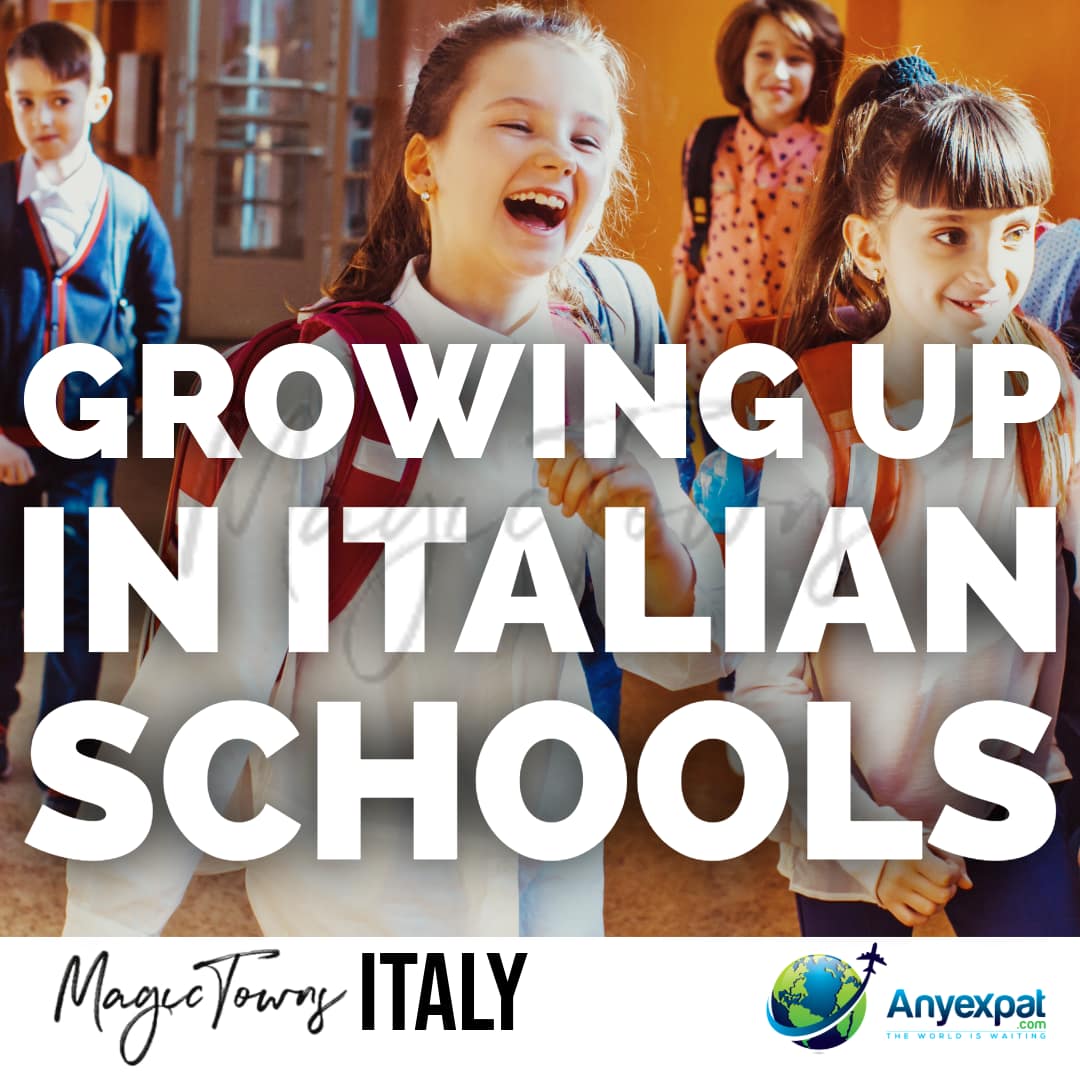

Anna: Today we’re talking about something that matters enormously if you’re thinking of moving here with children. What is actually like to grow up and to go to school in Italy? There’s a lot of mythology around the Italian education system.
It’s chaotic or outdated. Others, imagine something like idyllic and community driven, but the truth as usual sits somewhere in between.
Luca: That’s right. Hi Anna. So if you zoom out and look at the data, Italy’s broadly in line with the average of developed countries. In the latest PISA PISA-ranglisterne er disse internationale ranglister over forskellige typer uddannelse. Italienske 15-årige scorer omkring gennemsnittet i matematik. Lidt over gennemsnittet i læsning og lidt under i naturvidenskab. Omkring tre fjerdedele af de studerende [00:01:00] når et solidt udgangspunkt på tværs af fag, og der, hvor det er svagere, er i den allerøverste ende.
There are fewer academic high flyers than in some Northern European and Asian systems. So it’s a system that works and works fairly well, but it is not especially elite. But we don’t want to talk about the data. You’ll be happy to hear that, Anna. We actually want to talk about what it feels like and, um, talking about that you actually grew up in that, inside the Italian system. Talking about the big picture, what did it feel like to grow up in a small Italian town?
Anna: I actually feel very lucky, because, you know, there is this kind of freedom that just comes with it naturally. So you know, your village, you can basically walk the whole thing and that makes you feel independent, even if you’re like just a kid. So, you know, I just grab my bike, I go buy bread or text my friends to figure out when to meet up.
I’m going to cinema. It seems like I’m [00:02:00] still doing these things, but
Luca: I know the cinema in your town, uh, it’s like, uh, tiny, but you know, still kids going to the center by themselves. It’s not taken for granted these days.
Anna: So yeah. You know, little things, but they made me feel independent. And because there’s less stuff to do, you end up being more creative about it. So, you know, you’re playing the hills behind the house.
Du finder på ting, du finder ud af ting på egen hånd. Og jeg tror, det former dig på en god måde. Og jeg tror, at det, i hvert fald dengang, føltes meget trygt.
Luca: Maybe we’ll talk in the future about whether it feels less safe now, but anyway. Yeah, that sense of embeddedness in a place is something the expat families often underestimate. It isn’t just about test scores, it is more about the feeling of being a child in Italy.
But since we’re talking about schools, most Italian children attend public schools run by the state, and the [00:03:00] state system is what carries the country. There are private schools, but historically have not, they have not been seen as premium. There are income gaps, of course. Immigrant students have increased now, right now in the makeup, about 11% of the students. And that’s double what it was 15 years ago. But once you adjust for the socioeconomic factors of the families of origin, basically, once you cancel out the differences in, family economics immigrant children, Italian children perform the same in the Italian system. So that’s good news.
Og hvordan følte du, at skolen var på de forskellige stadier, Anna?
Anna: Det kommer an på. Børnehaven var vidunderlig. Vi havde engelskundervisning, kunst og en ting, hvor de ældre børn hjalp de yngre. Så det føltes virkelig som et fællesskab. Folkeskolen var, den var [00:04:00] god. Bortset fra grembiule, Jeg hadede det.
Luca: Have to tell, you’re gonna have to tell our listeners what the grembiule
Anna: That’s awful. It’s, like uniform. So we all had to wear it and I hated it.
Luca: Går du på en religiøs skole?
Anna: Nej,
Luca: Okay. We didn’t have a uniform in my state school. Maybe it was just your school that
Anna: Virkelig?
Luca: Yes. Most schools don’t have a uniform.
Anna: Åh, nej, nej. Vi var for.
Luca: at sige det til dig.
Anna: Nej, nej, nej. Vi blev tvunget til at tage den uniform på, men
Luca: That’s the point of a uniform. You’re forced to wear it
Anna: yeah. Well that was so bad. Like younger me was very much, why can’t I just express myself and wear what I want? But. Now I understand that the idea is to reduce differences, visible differences between families.
Så ja, gymnasiet afhænger meget af, hvilken klasse du endte i. Det betyder mere, end folk er klar over. Men der var bestemt plads til kreativitet. Så [00:05:00] omkring halloween eller karneval klædte den gamle skole sig ud, og de valgte det bedste kostume, nogle gange var der værkstedsdage, hvor man kunne, der var så.
Luca: Det er sødt.
Anna: Nogle gange var der workshopdage, hvor man kunne melde sig til ting som skateboarding, graffiti, øh, fotografering, kunstkurser. Det var helt fantastisk. Men det var nok bare en undtagelse. Det var nok bare på min skole.
Luca: Det tror jeg.
Anna: Nej. Åh, okay.
Luca: Nej, nej, nej. Jeg tror, de fleste skoler gør det. Faktisk gør de det mere nu end før i tiden, efter min mening.
Anna: Yeah, the only thing that I’ve more mixed feelings about is how specific Italian school gets. So it’s very focused on, exact definitions. Sometimes it pushes you into memorization mode, so you do learn a lot, but you also forget a lot. I like it, but I wasn’t that good. Exactly because of this reason
Luca: because you couldn’t remember dates.
Anna: Ja.
Luca: Ja, jeg ved godt, at det [00:06:00] er irriterende. Og det er en, det er en ting ved det italienske system, at det er meget faktadrevet.
Anna: Ja.
Luca: datoer, huske navnene, huske digtene. Og det føles tungt
Anna: Ja.
Luca: Det passer nogle mennesker bedre end andre, ikke? Kender du det, at der er nogle i din klasse, som kan huske alt?
Anyway, I’m a bit like you, meaning that I did everything in the, in the Italian public system, kindergarten, primary high school, university. And I personally think the Italian school system is one of Italy’s great institutions, possibly the greatest one, I wanna say kindergarten’s excellent.
Uanset om det officielt er Montessori eller ej, er det altid stærkt påvirket af den slags lær ved at gøre verdensfilosofi. Det er gratis fra treårsalderen. Og du får fuld dagpleje med fleksible klasseværelser, strukturerede aktiviteter, selv når mine venner fra Nordeuropa kommer og ser, hvor mit yngste barn går i skole, er de oprigtigt imponerede [00:07:00] over børnehaven.
What I think is tricky is the jump between kindergarten and primary school. So you spend three years playing in the garden, playing with your friends, and then suddenly you’re sitting at the desk for hours. And understandably, children struggle with that transition. Personally I thought that things really turned out for the best in high school. Because you move away from that kind of standardized curriculum and you start doing what you actually want to do, whether it is languages or ancient Greek or STEM or whatever it might be.
But the tricky thing about the Italian system is that you still tested on everything. my friends from the US and the UK. The, the minds are blown by this, that in our finals we are tested on every single subject and they all count the same. So it doesn’t matter if you went to a language high school, still have to get passing marks in chemistry, physics, [00:08:00] religion, uh, so on and so forth.
Så det kan føles ret tungt, helt ærligt.
Anna: Er det anderledes i de andre lande?
Luca: Yeah. In some other countries, you pick some subjects that you want to take to your finals. So you say, I’m gonna do this, this, and this.
Anna: Åh, wow. Fantastisk.
Luca: Er det nemt?
Anna: Yeah, I would’ve skipped like math or something like that.
Luca: Ja, ja. Og historie.
Anna: Nå, men..,
Luca: du har fundet tre emner at lave
Anna: no, no languages. Literature. Uh, no, history is important. Like really, it’s really
Luca: Helt sikkert.
Anna: It’s just,
Luca: vil studere det.
Anna: Ja, men det gør dig afrundet, ikke?
Luca: Ja, det gør den. Ja, det gør det. Det går lidt tilbage til den stærkestes overlevelse. En ting, der virkelig er
Anna: Mm-hmm.
Luca: Opinion, I don’t know if you disagree, is oral examinations. Maybe 80% of my tests in high school and 90% of my tests at university were oral. So you, you know how it works.
You stand up by the blackboard or the whiteboard and [00:09:00] then, uh, your teacher professor questions you and you have to defend yourself from the attack. I think it works wonders for your presentation skills. For your intellectual resilience and that’s something that you carry with you throughout, life.
Anna: Ja,
Luca: hvis du har samme mening.
Anna: absolut 100%. Jeg var meget bedre til mundtlige eksamener.
Luca: Yeah, yeah, yeah, me too. Where I think that Italy really needs to improve is teaching foreign languages, especially English. We don’t have enough native, English speakers. And this is a political third rail, so you never hear a politician say this. My middle high school English teacher was from Sicily and she was a lovely woman, but, you know, uh, her accent was just not understandable to any native speakers. Uh, why would you have someone that can’t speak English, teach you English? Doesn’t make much sense. Things have improved, but [00:10:00] not that much. And I think people, when they come and visit, they can see that when they go to a bar or restaurant and they like, why can’t people speak English?
Uh, this is why they can’t speak English.
Anna: Hvordan var hun?
Luca: Uh, she was, she was lovely. I won’t say her name because she might sue me. You remember that article you wrote this week about suing people in Italy, how easy it is defamation. So I’m not gonna say her name. Uh, she was a lovely woman, but she couldn’t speak English. This is irrelevant to our listeners because thankfully they and their kids can already speak English. So that’s our problem to fix.
Anna: Yeah, absolutely. But that’s true. Like a lot of people learn grammar very well. But speaking confidently, it’s, it’s another matter.
Luca: That’s right. And then there’s a matter of the private schools that we touched on before. In Italy, Historically, private schools are not seen as elite. They were often religious institutions. I’m sure you had a couple of friends that ended up in Montagnana for at studere med nonnerne. Gjorde du det? Gjorde du, Anna?
Anna: There was the [00:11:00] school. Oh my God. My mom wanted, that’s another topic, however. Yeah. Lots.
Luca: podcast.
Anna: Ja.
Luca: So you’d be sent to private school if there something wrong with you and things are changing a little bit, but it’s actually nice that, everyone in Italy, from the senator’s son to the chimney sweeper’s daughter, we all go to the same schools because then we have a vested interest in the system working well. Um, now for expats, the matter is a bit different because often they choose international schools because of language continuity. For Italian families, public school is absolutely normal. And I can say myself, I moved back to Italy where my kids, uh, um, mature of them were pretty old, you know, between inverted commas. They were like eight and nine. We actually never spoke Italian at home and they took to Italian like a fish to water. Within six months they spoke perfectly. So I can attest to the fact that kids have an amazing ability to learn [00:12:00] foreign languages without, any help. But still, I can see why expats are looking for, international schools for that reason..
Anna: I dag er der masser af internationale skoler, som er rigtig, rigtig gode. Jeg talte med Charlotte i sidste uge, og hun sagde, at på Sardinien, i nærheden af Cagliari, there’s this international school, that has like a pool, yoga classes, like, I don’t know, lots of different things, but she said that the costs were are like, I mean are okay.
Ligesom i forhold til
Luca: rimeligt.
Anna: Yeah, they’re reasonable.
Luca: Nej, det er helt rigtigt. Jeg har venner i... Jeg har faktisk en sjov historie. Jeg havde en ven i Danmark. Vi arbejdede samme sted. Han havde arbejdet for Morgan Stanley i London, og han flyttede tilbage til Danmark for den halve løn og sendte sine tre børn i privatskole eller offentlig skole, som de kalder det i Storbritannien, og det var så dyrt, at han spiste halvdelen af sin løn.
Anna: Min Gud, [00:13:00].
Luca: Åh, ja. Jeg kender folk, der betaler 40-50.000 pund om året for at sende deres børn i grundskole og gymnasium. Så
Anna: that’s.
Luca: Italy, the costs, yeah, it’s, it’s crazy. In Italy, the costs for a private school, uh, between five, 10,000 euro a year at the very top, it is rare for things to be more expensive than that. So yeah, it’s an attractive country for, for that reason too.
Anna: Ja.
Luca: Nå, men for at opsummere. Jeg tror, at det, man kan tage med sig fra det, vi sagde, er, at hvis folk overvejer at flytte til en mindre italiensk by, der kun har italienske statsskoler med børn, så er systemet ikke perfekt. Det er ikke designet til at masseproducere vidunderbørn, men er solidt samfundsbaseret i bred forstand. Det fungerer for alle. Jeg vil også gerne sige, at vi fra marts vil opdatere alle vores byprofiler på Magic Towns Italy med de nye [00:14:00] skolepræstationsmålinger for standardiserede tests, så folk faktisk kan se, hvilke byer der klarer sig bedre og uddanner bedre elever til fremtiden, når de skal vælge, hvor de vil bo.
Anna: Because at the end of the day, it’s, it’s not just about moving house, it’s about choosing the environment your children will grow up in.
Luca: That’s right. And many Italian towns may surprise you in a good way. Thank you, listeners for listening to us again, and we’ll talk to you next week.

 English
 French
 German
 Italian
 Danish