

The idea for this article (or the straw that broke the camel’s back) came from an incredibly successful Instagram reel we published about the town of Recoaro Terme. This town in the Veneto, long famous for its spas and tourists like Friedrich Nietzsche, has been bleeding inhabitants for a couple of decades (-14% inhabitants between 2011 and 2025, -41% tourists between 2005 and 2024), and is attempting to turn the tide by jumping on the 1-euro homes bandwagon, and through local government investment. A town like this needs, and openly says it wants, new blood.
It was inevitable that, among the 1.2 million people who watched the reel, we would meet the usual accusation. “You are displacing the locals”. “Another village lost to foreigners”. Total confidence, zero numbers to back it up. And if the usual refrain is sung for a shrinking town like Recoaro, it’s a full-throated chorus for more popular destinations. “They are buying up Tuscany”. We’re starting to see some politicians bang that drum.
As we do, we got the numbers, and they give you the answer for the next time anyone accuses you of being part of the problem: you, the newcomer to Italy who takes away homes from the locals.
Our analysis focuses on three main sources:
- the census record of which dwellings are lived in
- the official register of dove foreigners settle
- and for tourist load, registered bed capacity per resident together with annual arrivals.
Put together, these numbers tell a story almost exactly opposite to the one on your timeline.
Usual note: this analysis uses the dreaded word “espatriato”. We employ this word, as others do, to define the group of the most mobile, non-permanent, non-economic migrants to Italy – such as most of our readers. Our intent is not to discriminate between nationalities.
If you are interested in the occupancy and property repair state information shown in these charts, they are available for members for all 7,968 towns we cover in the Town Explorer.
To start: what does an “empty” town look like in Italy?
Before you can say a town has been hollowed out by foreigners, you need to know what an ordinary Italian town looks like. Italy is divided into 402,678 census tracts, the smallest reportable unit we have data for; 296,403 of them contain at least ten dwellings. We measured all of those.
As of 2011 (the last time such a thorough analysis has been conducted by Italy’s statistical authority), half of Italy’s census tracts had 16% of its dwellings standing holiday-or-vacant. More than a quarter of them, 28%, were above 30%. One in seven was above half. If your eyes are skimming over the numbers, the takeaway is: it is extremely common, in Italy, for parts of a town to be vacant, not occupied by residents.
Empty houses are not a symptom of foreign invasion. They are the Italian baseline.
The famous “expat towns”: how much have they been hollowed out by foreign buyers?
Let us look at some of the famous towns, the ones that stereotypes say are being bought out by foreigners.
| Share of holiday-or-vacant homes | |
|---|---|
| San Gimignano | 21% |
| Siena | 21% |
| Volterra | 19% |
| Lucca | 18% |
| Greve in Chianti | 18% |
| Montepulciano | 16% |
| Certaldo | 12% |
| Arezzo | 11% |
| Venezia (whole comune) | 11% |
| Firenze | 3% |
Five of them sit a few points above the 16% norm. Four sit below it. Montepulciano sits on it. These are not hollowed-out places. They are ordinary Italian towns, and several of them are more thoroughly lived in than the national average.
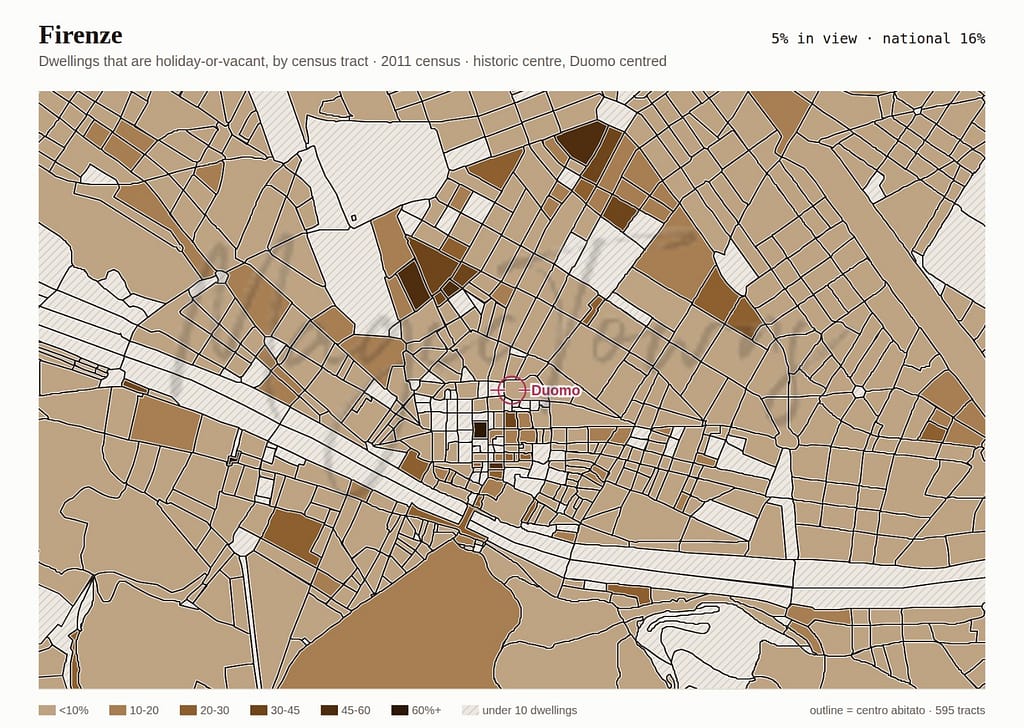
Firenze surprised even us. It recorded 3% “vacant-or-holiday” homes across the city borders. On the only nationwide measure of residential occupancy Italy has, the city most often accused of being emptied out was among the most thoroughly inhabited places in the country.
Venice IS being hollowed, in select areas
Venezia is a real case of hollowing out, although the city-wide figures hide it. This is because the borders stretch out to the mainland, which averages the (comparatively small) islands away.
If we zoom to the historic centre, centred on Rialto, the picture changes: 23% holiday-or-vacant, rising to 26% in the tightest crop around the Grand Canal. Double the municipality-wide figure and above the national norm.
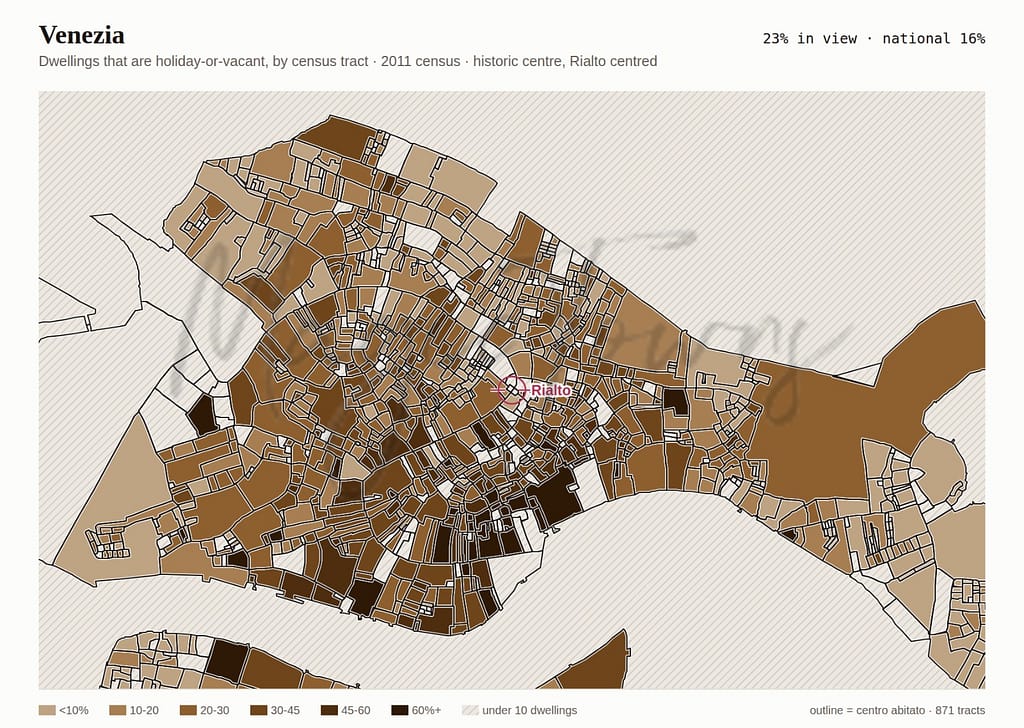
We could not find the same for Firenze. Even cropped to the Duomo, the historic centre reads 5%. Whatever is happening to Florence, it does not show up as empty homes.
Are foreigners displacing Italians?
If expats and foreign retirees were displacing Italians, the towns with the highest concentration of expats should be the towns losing the most Italians.
We took current, 2025 data, as fresh as it gets, and looked at every town with at least 1,500 residents and at least 20 western European or anglophone residents per thousand. It’s a high concentration bar, representing towns that are truly favoured by expats. The filter found 68 towns. Forty-three of these sixty-eight expat favourites lost population between 2011 and 2025.
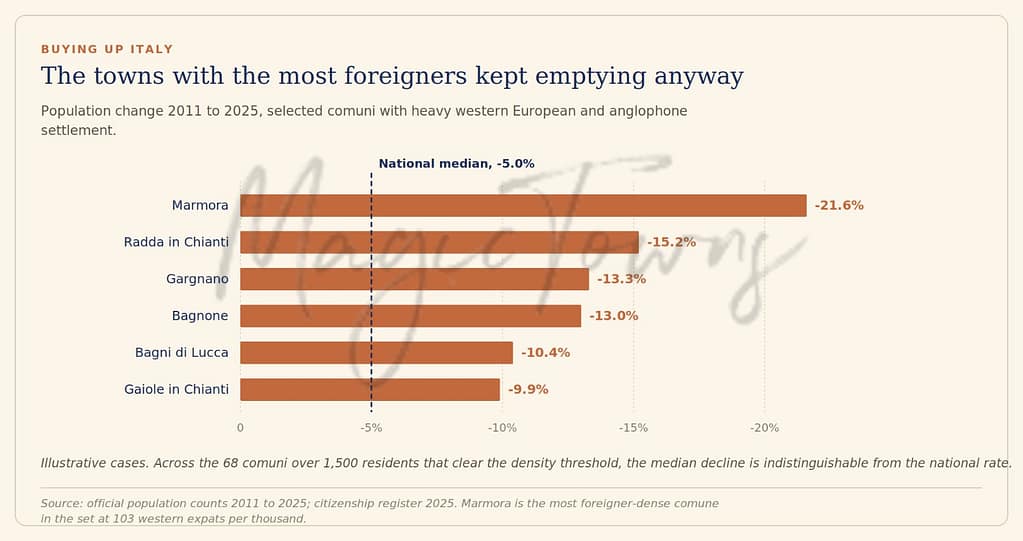
More importantly, the median population change over this period was minus 5.3%, against a national median of minus 5.0%. That difference is nothing. Italy’s most expat-heavy towns are emptying at a rate indistinguishable from the country as a whole. Whatever the foreign presence is doing, it is not replacing anybody, and it is not arresting the decline either (a point we have made earlier about the success, or lack thereof, of the 7% scheme).
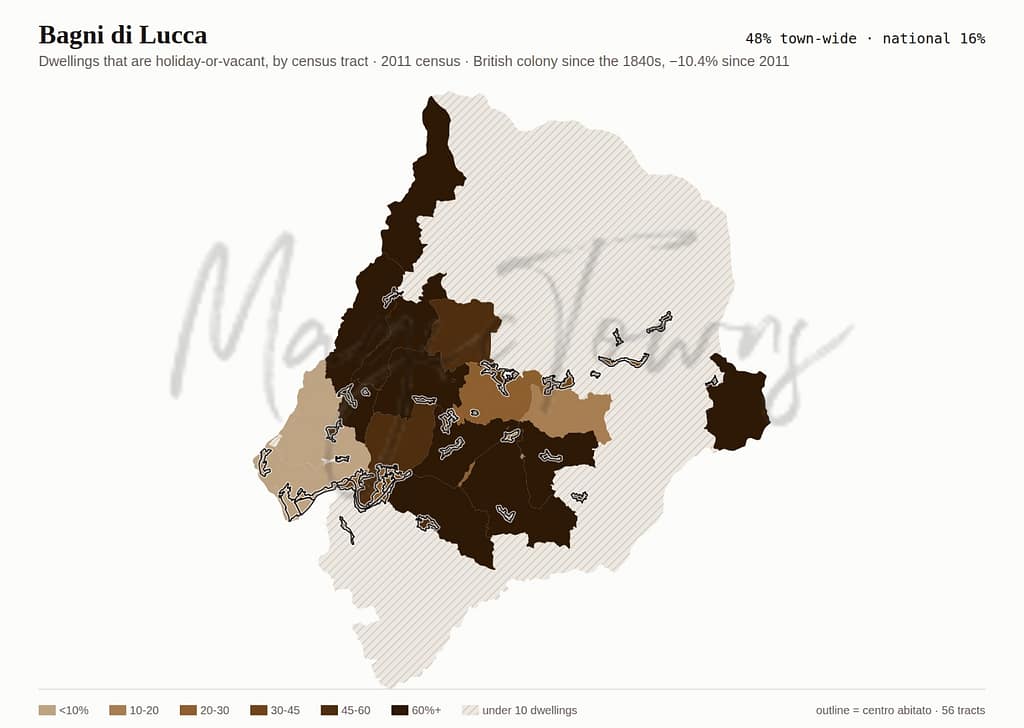
The individual cases are even starker. Bagni di Lucca has been a British colony since the 1840s and carries the third-highest western-expat density of any Italian town over 1,500 people. Its population is down 10.4%. Gaiole in Chianti, in the middle of the wine country everyone is supposedly buying: down 9.9%. Bagnone in the Lunigiana: down 13.0%. Gargnano on Lake Garda: down 13.3%.
What is actually happening in Chianti
Here our very detailed Census data shows something that no town average can.
Take Radda in Chianti. The town recorded 50% holiday-or-vacant across the comune in 2011, high, well above the national median. Break it into areas and the picture inverts. The historic centre was 24% empty or second homes. The empty houses are not in the town: they are in the campagna. These are the farmhouses and villas scattered across the hills, the ones that emptied when Italian agriculture mechanised, decades before anyone had heard of Airbnb.
Castellina in Chianti showed the same shape: 35% across the comune, 15% in the centre, 51% in the median census tract.
When the towns of Chianti are still lived in, but the hills around are not, it is difficult to blame displacement by wealthy foreigners. It is a countryside that emptied out two generations ago, and a small number of foreigners bought, and still buy, some of what was left. Radda has lost a further 15.2% of its people since the 2011 census.
Tourist load, expat presence and second homes: where the deadly combo bites
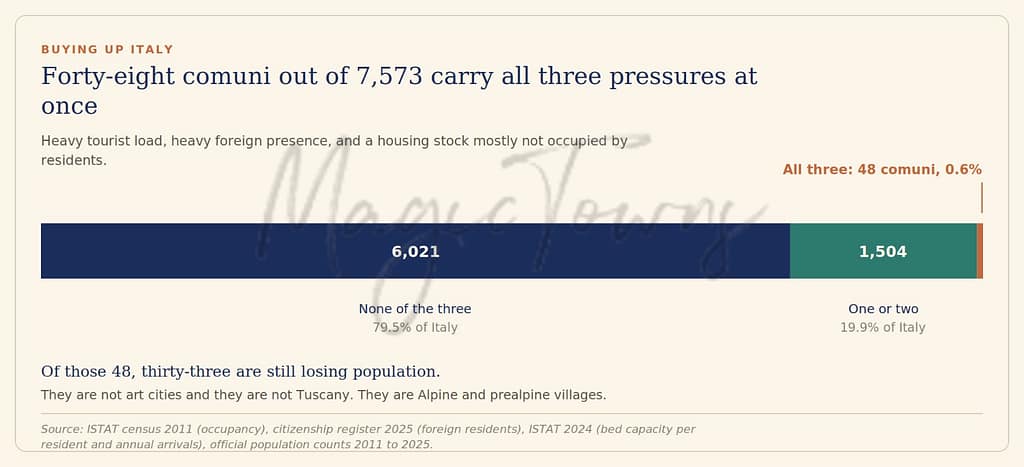
We looked for towns carrying all three pressures at once: heavy tourist load, heavy foreign presence, e un housing stock hollowed out by non-residents. Out of 7,573 comuni, 48 qualify. That’s six in a thousand. And they are not art cities, and they are not Tuscany. They are Alpine villages.
Marmora, in the Valle Maira, has lost 21.6% of its population since 2011. At the 2011 census 85% of its dwellings were already holiday-or-vacant, and it carries 103 western expats per thousand. Bognanco is down 13.9%, Tignale 11.8%, Courmayeur 10.4%, Sauze d’Oulx 9.6%.
Thirty-three of the forty-eight are still losing population. Even at the absolute maximum of measured pressure in Italy, the second homes stand in villages that were already emptying, and the emptying has not stopped.
Meanwhile, what’s happening in the other 80% of Italy
Of 7,573 municipalities, 6,021, eight in ten, have none of the three pressures at all. No tourist load, no foreign concentration, no empty housing stock beyond the national norm.
4,298 of them are losing population. That is 57% of all towns in Italy: no pressure, and emptying anyway. Zoom out further still: 72% of Italian comuni lost population between 2011 and 2025, with a median decline of 8.3%.
This is the actual Italian housing story, and it has nothing to do with foreigners. It is a country where 72% of municipalities are shrinking, where schools close for want of children, and where the realistic question for most towns is not how to keep outsiders out but whether anyone at all will be living there in thirty years.
Seen with this trend in mind, a few thousand foreign arrivals are not a threat. Often, they are the only inbound demographic movement some of these places have.
What about property prices? Are they displacing residents?
We’re covered demographic decline, vacant property, and massive tourist inflow. The obvious point left to discuss is property prices.
A town can lose residents while houses become unaffordable to the people who grew up there. The two are entirely compatible. Everything above shows that expats are not numerically replacing anyone. It says nothing about what a foreign buyer, to whom 400,000 euro is half of what their 2-bedroom apartment in Brooklyn cost, is doing to the asking price of a farmhouse outside Gaiole.
We have prices for 5,813 Italian comuni, so we can put a number on it. Take the towns with the most foreigners in them. Their houses cost about 1,730 euro per square metre. In the rest of Italy the figure is about 1,124. Expat-heavy towns are, on average, 54% more expensive.
This is an objective read, and it plays in the hand of anyone supporting the displacement argument. But here is why it proves less than it looks like it proves.
Primo, the link is weak. Across more than four thousand towns, knowing how many foreigners live somewhere tells you almost nothing about what a house there costs. Taken by itself, the density of expats in a town only explains about a seventh of the difference in property price differences between one town and another. The other six sevenths are something else entirely.
Second, the two towns with the most foreigners in Italy are cheap. Bagni di Lucca e Bagnone have the highest concentrations of British, American and northern European residents in the country. They also cost 793 and 864 euro per square metre, well below the national average of about 1,000. If foreign buyers set the price, these two would be the most expensive towns in Italy. They are among the more affordable.
In terzo luogo, il più costoso places barely have any foreigners at all. Cortina d'Ampezzo costs about sixteen times what Bagni di Lucca costs and has a seventh of the foreign residents.
| città | price per square metre | foreign residents per 1,000 |
| Cortina d'Ampezzo | 12,714 | 4.7 |
| Firenze | 4,336 | 13.7 |
| Radda in Chianti | 2,501 | 30.6 |
| Gaiole in Chianti | 2,353 | 24.1 |
| San Gimignano | 2,352 | 9.5 |
| Montepulciano | 1,513 | 7.5 |
| Bagnone | 864 | 35.8 |
| Bagni di Lucca | 793 | 36.5 |
| Recoaro Terme | 566 | 1.0 |
Arguably, the pattern is not about foreigners. It is about geography.
Chianti is expensive and full of foreigners at the same time. The Lunigiana e il Garfagnana, in the north of Tuscany, are full of foreigners and cheap. Same region, same nationalities, opposite prices. Whatever is going on, it is not one thing happening to all of Tuscany.
Expensive, beautiful towns attract foreigners. Foreigners may also make towns expensive. Both are plausible, and the same things, the views, the hill towns, the wine, would pull in both directions at once.
Being honest forces us to hedge our own argument, too. Foreigners are not replacing Italians, and we can prove it. Towns with lots of foreigners cost more than the Italian average, and we can prove that too. Which one is causing which, we cannot say, and we are not going to pretend otherwise.
Three smaller cautions while we are being careful. Population figures are net, so arrivals could be hiding a faster Italian departure underneath. Foreigners plainly pick places that were already emptying, because they are cheap and beautiful and quiet, which is our argument rather than a hole in it, but it does mean they are choosing these towns rather than causing their emptying out. And our count of foreign residents is a headcount for 2025, not a record of who arrived when. Bagni di Lucca has been a British colony since the 1840s. We can show that foreigners and depopulation turn up in the same towns. We cannot show which came first.
What this means if you are the one thinking of moving
If you have been made to feel that acquisto di una casa in an Italian village is a small act of colonisation, the data does not support your feeling guilty. In the overwhelming majority of Italy you would be moving into a town that is shrinking, into housing stock that was already standing empty, in a country where more comuni are losing people than keeping them.
There are places where restraint is warranted, and we have named them: the Venetian islands above all, a handful of Alpine resorts where the housing stock has essentially stopped being housing. They are rare, they are identifiable, and, this is the point, they are not where most people are looking anyway.
The rest of Italy has the opposite problem.
Our sources
Occupancy, 2011. ISTAT census, sezioni di censimento: 402,678 tracts across 8,092 comuni. These variables have not been updated since 2011, so every occupancy figure here comes from before the AirBnb era. We say holiday-or-vacant rather than “second homes” because the 2011 census leaves the second-home field at essentially zero; the measurable quantity is dwellings not occupied by residents.
Population change, 2011 to 2025. Official counts.
Foreign residents, 2025. Citizenship register, western European and anglophone nationalities, per 1,000 residents.
Tourist load, 2024. Registered bed capacity per resident, and annual arrivals, ISTAT.







 English
 French
 German
 Italian
 Danish