


As many thumb-tired readers know, Instagram is filling up with a new sub-genre of AI slop: “Can I live in Italy on $10,000 per month?”. “Am I rich in Italy with $3,000,000 in the banque?”. Whether these posts exist merely to rage bait, we cannot say. What we can say is that practically no one actually bothers to answer the question: how much do people actually make in Italy? (You probably guessed it, it’s generally a lot less than $10,000 per month).
The numbers are there, for those who want to look. Every year the Ministry of Economy and Finance publishes (in aggregate, for privacy) what every resident de every town declared, down to villages of two hundred taxpayers. It is the most detailed picture of national income, detailed to quasi-Danish or Norwegian levels – though, unlike in Norway, no one in Italy publishes your actual tax return.
At €46,000 You’ll Be In The Top 10% Of Taxpayers
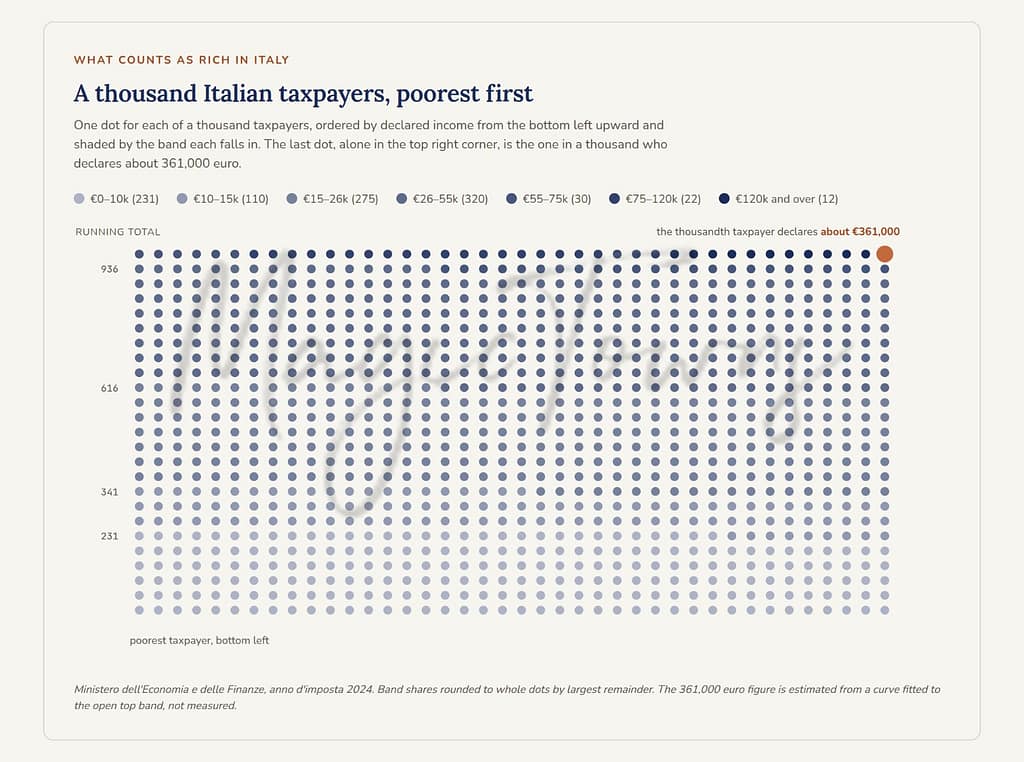
Italian incomes are compressed (more egalitarian, you might say?) in a way that surprises people arriving from Britain or North America. The midpoint of the whole country is €21,334. A quarter of taxpayers declare under €10,833.
To be in the top 10% of Italian taxpayers, you need to declare €45,932. Roughly 4.2 million people earn more. Climb further still, and you’ll be increasingly lonely: at €62,128 you are in the top 5%. And the highest band the Ministry publishes, at €120,000, puts you in a minority of 489,974 people, 1.18% of filers, through whom flows 9.9% of every euro declared in Italy.
The published figures run out at “€120,000 or higher”. By our estimate, 1 in 1,000 declares about €360,000 per annum, and 1 in ten thousand declares more than 1 million euro per year. That’s fewer than 5,000 people in a country of 59 million. They’d fit in a large wedding venue.
What Does “Income” Mean Here?
The figures reported by the Italian taxman sont already partly taxed. Mandatory social security contributions have been removed, and Italy isn’t a high wages country, so if they look low to you, that’s why. However, you still need to subtract national income tax and local surcharges to get to the net figure.
A British reader comparing their £60,000 gross salary to these figures is comparing two different things, and placing themselves too high by the size of their own National Insurance. It is pre-tax in every other sense. Nothing has yet been taken for income tax, or for the regional and municipal surcharges that come after it.
So, Am I Rich in Italy on €50,000 a year?
A fair question. The figure puts you squarely in the top 10% nationally, though not necessarily locally, as we will see later. Coming in from abroad, you will in fact likely be far better off than the locals. Italy runs several tax regimes for newcomers, and they do not merely reduce what you pay. They change whether your income appears in these statistics at all (and that is one of the reasons why we can only guess at what 7% tax retirees are bringing into the state coffers).
| If you live in Italy on… | …the reported tax figures show |
|---|---|
| a foreign pension, under the 7% southern regime | nothing. Foreign income sits under a substitute tax, outside the ordinary system entirely |
| employment income, under the impatriati relief | half. A large share of employment income is exempt. In these statistics, you’ll be shown as declaring €50k when you invoice €100k. |
| foreign income, under the €300,000 flat charge for new residents | nothing of the foreign part |
| an ordinary Italian salary or pension | all of it |
This changes nothing in your tax obligations, but it explains why some high earners coming from abroad are essentially invisible in national statistics.
So, Am I Rich in Portofino on €50,000 a year?
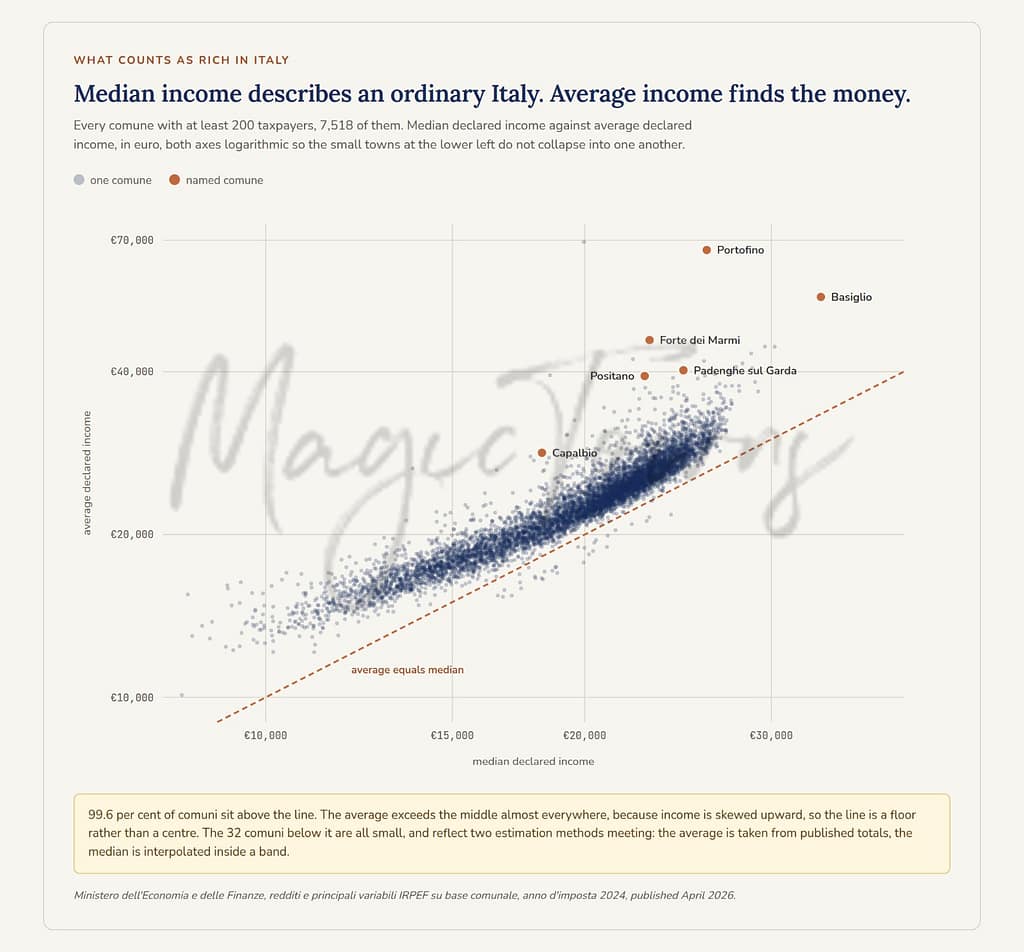
That’s a whole different matter. If you look at Italy’s towns through the lens of median income (that line that divides the top 50% of taxpayers from the bottom 50%), the country looks entirely unremarkable. It will show as a list of towns in the Milan commuter belt – Cusago, Arese, Cernusco sul Naviglio. Towns with well paid employees, but that’s not where the real wealth hides.
Look at towns by their average income (the age-old “I have no chickens, you have ten, average five” story) and the story changes: Portofino, Forte dei Marmi, Positano, Capalbio, the shores of Lac de Garde take their place on the map. Portofino is the whole story in one village: it had 299 taxpayers as of last data available, and the one in the middle declares €26,070 – a respectable, unremarkable sum. The average for Portofino is €67,157.
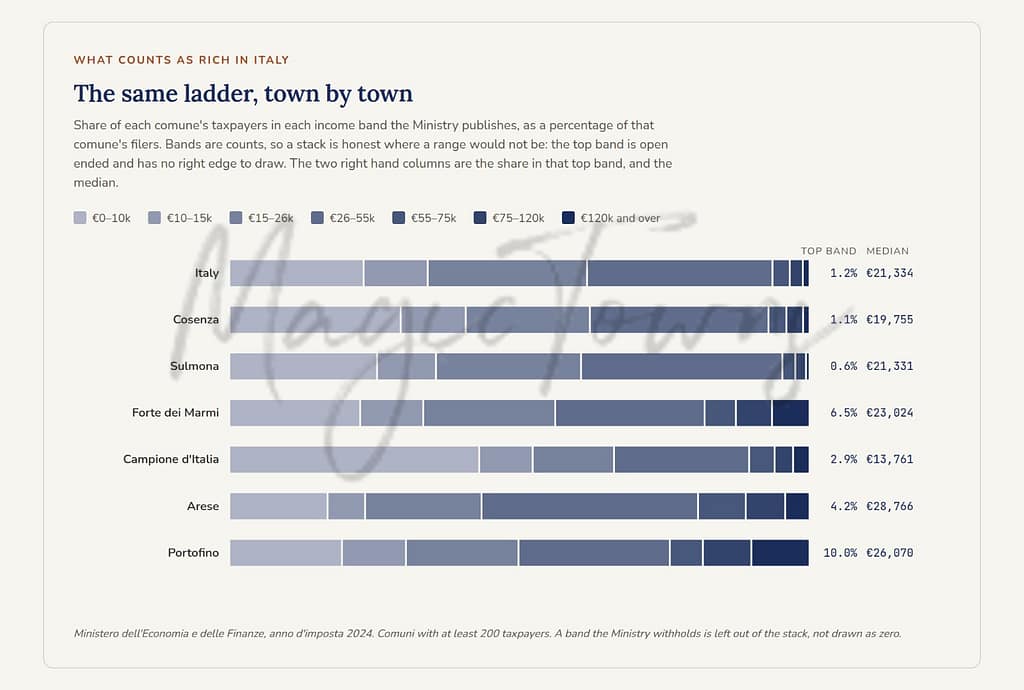
Thirty of 299 Portofino taxpayers declare over €120,000. That’s 10.03% of the village’s filers, against 1.18% nationally. This is the highest concentration in Italy, and up from 6.48% in 2022. So, no, your €50,000 tax return won’t turn any heads in Portofino.
The same maths work in reverse, and it’s worth saying it now before someone mistakes the Swiss border for the poorest part of Italy. Some of the lowest declared incomes belong to villages along the Swiss border (Valle Cannobina, Valsolda, Campione d’Italia which is physically IN Switzerland) where most residents work in Switzerland and are taxed there. The genuine bottom of the table is Calabria and Campaniaet Reggio Calabria et Cosenza between them supply thirty-five of the hundred towns with the lowest median reported income.
“Local Surcharges”, You Said. Should I shop around by town?
The few who know about Italian local taxes ask whether local taxes vary by town. They do, and much less than people expect. Italy adds two surcharges on top of national income tax, one regional and one municipal. The combined bill on €40,000 of taxable income runs from about €55 in the cheapest Alto Adige villages to €1,426 in the dearest, Salerno, then Rome. The average is €871.
Set that against the national income tax on the same €40,000, which is roughly €10,700. On that income, the 7% tax scheme represents a €7,900 difference against ordinary Italian taxation. The whole town-to-town variation is €1,371 (and the 7% scheme exempts you from local taxes on foreign income anyway). A reason to shop region, if you can, rather than by local tax surcharges.
So, Am I Rich in italy or not?
In a perhaps anticlimactic reveal, we should add that even if your income puts you in the top echelons of local taxpayers, we aren’t talking about wealth. In Italy, income and wealth diverge hard, harder than almost anywhere in Europe. It is a country of high household assets and modest declared earnings, where home ownership is Europe-leading and a great deal of value sits in assets that generate no taxable income.
Stories abound of unassuming, local town dwellers leaving absolute fortunes to their children. Just yesterday, I asked a small-time farmer why he hadn’t bought the adjoining property when it had come on the market. As it turns out, his ageing dad will bequeath him his 16th-century estate with several hectares of land, and he thinks he’s got enough property to manage. Never assume.
Another matter. These figures count where people are résident fiscal, not who owns what. Much of Forte dei Marmi belongs to people whose tax residence is Milan. Second-home towns are systematically understated. Inconveniently, that is the exact category most people reading this are shopping in.
One last caution for couples. These are per-taxpayer figures, not per-household. It is tempting to double them and call it a family income. Don’t. Female employment in Italy runs near 55%, so a great many households have one earner, and doubling overstates. There is no town-level household series to compare against. If you come in from abroad with two full incomes, you’re likely ahead.
Conclusion: So what counts as rich in Italy?
Even with all the caveats and the hedging, you can likely draw a great deal of understanding and, why not, comfort from this analysis. As discussed, €129,000 puts you in the top 1% of Italian taxpayers, and about €360,000 in the top thousandth. Those are the honest answers to the question as asked.
What this data is genuinely good for – and members now find it in 7,518 town profiles via the Explorateur de villes – is to answer the question that this article did not ask: what your neighbours declare, which unassuming villages are full of people who declare a great deal, and which apparent poverty is really a border town and a Swiss payslip.
And, the answer to the Instagram rage bait question is: yes, you can live in Italy on ten grand a month. 93% do it on less than half.









 English
 French
 German
 Italian
 Danish