
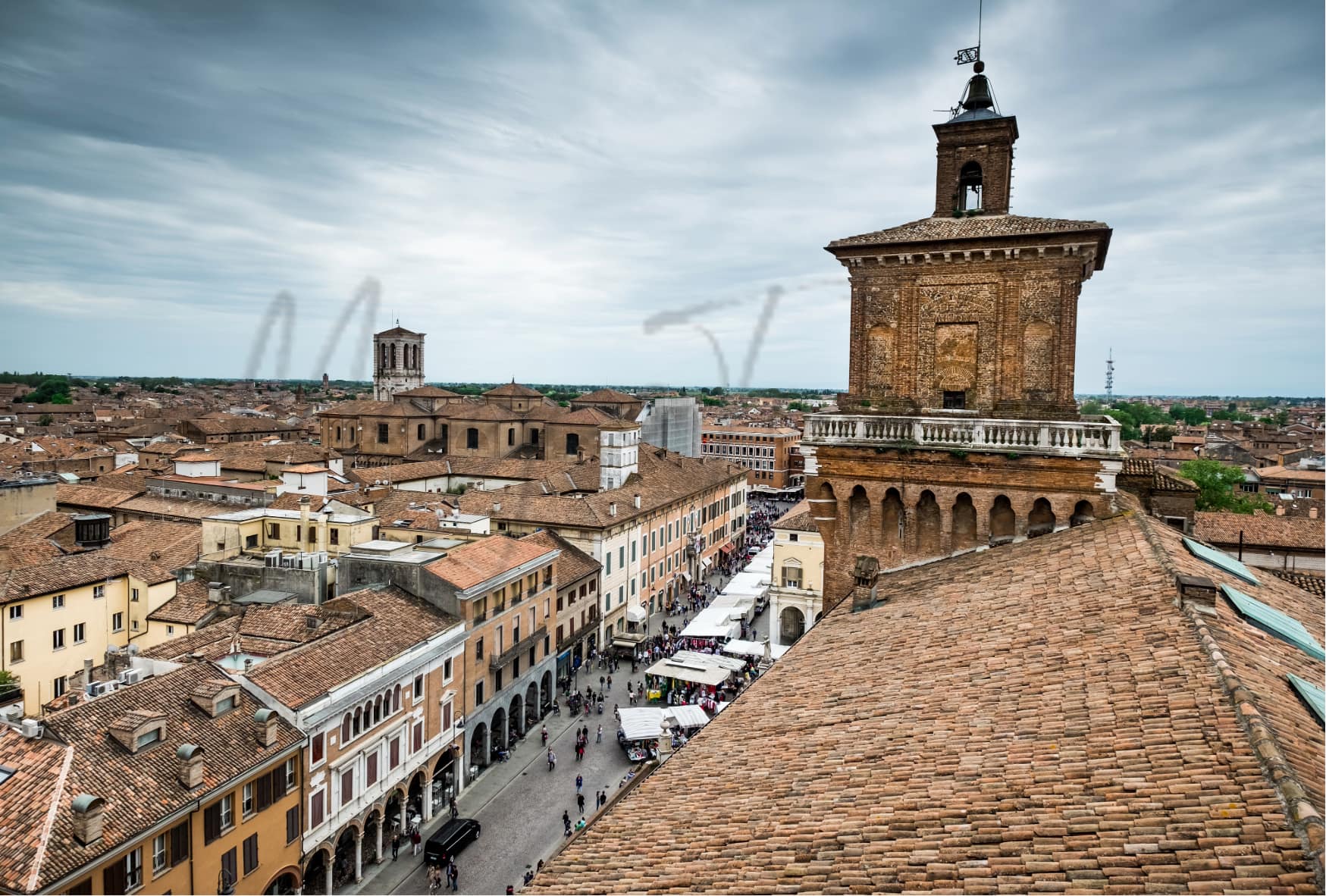
Between the famous Bologna and Venice, there’s a beautiful, livable, and quite affordable town that’s not yet well known among expats. This is Ferrara, a city of around 129,000 inhabitants, perfect for anyone looking for a place that’s gut vernetzt, where you don’t necessarily need a car for daily life, and full of history – from the Este Castle to the medieval walls and the wide Renaissance streets.
To get a real sense of what daily life here looks like, we combined our city data with reviews from people who’ve actually lived there.
Life in Ferrara: What People Say
The first thing people notice about Ferrara is how easy it is to actually move around. The historic centre is almost entirely car-free, and locals cycle everywhere. It’s flat, compact, and the kind of place where you don’t have to stress too much about getting from one place to another.
Die Standort helps a lot too. Sitting between Bologna, Venedig, Paduaund Ravenna, Ferrara gives you easy access to some of the best of northern Italy without actually being in any of those cities – which, from a cost-of-living perspective, is a real advantage.
“Ferrara is genuinely lovely and surprisingly easy to live in. The location is a big plus – Bologna, Parma, Padua, Venice, Ravenna are all within easy reach.”
Culturally, there’s more going on than you might expect from a city this size – from museums, to events, and great restaurants:
“Beautiful city. The food is incredible (but that’s Emilia-Romagna for you, it’s just on another level). And there’s actually a lot going on culturally – museum events, festivals, a real buzz – which has picked up a lot since the new mayor came in.”
That said, this is still a mid-sized provincial city, not a cosmopolitan hub. The Expat-Gemeinde exists, but it’s not large, and integrating into daily life here means getting used to Italian rhythms rather than finding an English-speaking bubble. It also comes up as a good place for families. Quiet, safe for the most part, schools that rank in the top 30% nationally. Not a city that will dazzle you on first arrival, but one that tends to grow on people once they’re actually living there.

Transport and Connectivity in Ferrara
Ferrara is great in terms of Konnektivität. With the local train station, you can easily reach cities like Bologna in around 30 minutes, and Venedig und Padua in under an hour. This means that even if you don’t have a car, you can just hop on a train and take a shuttle bus to the airport from there.
“Train connections are solid – fast trains to Bologna, Venice, Padova, Florence, Rome – so it works well as a base.”
Der nächstgelegene Flughafen ist Der Flughafen Guglielmo Marconi in Bologna, 30 minutes away by car. It’s not a huge hub, but it has quite a few connections across Europe and beyond. If you travel overseas often, you’d likely look to Venice Marco Polo instead, which is only 65 minutes away.
Within the city itself, ein Auto is largely unnecessary. You can easily reach everything on foot or by bike if you live in the centre. And if you want to go on a day trip to one of the bigger cities, the train has you covered. However, as we explained in our last article, living in Italy without a car is limiting in most cases – not so much within Ferrara itself, but when it comes to freely exploring the surrounding areas. Factor that into your budget if you’re planning a move to Italy.
Where to Live in Ferrara: Housing & Cost of Living
Property prices in Ferrara are quite affordable compared to nearby cities. The average price is around €1,744/m², so for a 100m² flat you’d be looking at around €174,400. However, as you can see in the table below, there are much cheaper areas – and prices can drop even further if you consider nearby towns like Voghiera (€754/m²) or Portomaggiore (€832/m²).
| Zone | Verkaufspreis (€/m²) | Miete (€/m²) |
|---|---|---|
| Centro | €2,234 | €10.63 |
| Fuori Mura Est | €2,014 | €10.13 |
| Fuori Mura Sud | €1,760 | €10.51 |
| Ferrara Sud, Fabbri, Fossanova | €1,424 | €6.11 |
| Über Modena, Stazione | €1,381 | €8.87 |
| Cona, Villanova, Pontegradella | €1,331 | €8.39 |
| Boara, Francolino, Correggio | €1,216 | €8.08 |
| Porotto, Arginone | €1,136 | €8.25 |
| Casaglia, Pontelagoscuro | €1,055 | €7.99 |
| San Martino, San Bartolomeo | €1,101 | €8.26 |
Die historic centre is, as always, the most expensive zone. But it’s beautiful, walkable, well-served – basically, it’s the price you pay for living somewhere you’ll never need to move your car at all. Fuori Mura Est and Sud, the areas just outside the medieval walls, are also well-priced for what they offer: you’re still close to everything but in quieter, more residential streets.
For the most affordable options, the peripheral zones like Casaglia or Porotto drop below €1,100/m², and rents follow a similar pattern. Verfügbarkeit von Wohnraum here is pretty high, which is another advantage over Bologna, where finding something decent at a reasonable price is noticeably harder. However, keep in mind that Ferrara is also a university city, so availability can tighten at certain times of year – do your research before you start looking.
“For long-term stays, accommodation is definitely more affordable than Bologna or Venice.”
Challenges of Living in Ferrara
The single thing that comes up most often is the Klima, especially in winter. Ferrara sits in the Po valley, an area well-known for fog – real, dense, persistent fog that rolls in during autumn and doesn’t fully leave until spring. So if you’re expecting that beautiful, sunny Italian climate, Ferrara might not be for you. Die summer side of that coin is its own issue: hot and humid. Not unbearably so compared to the deep south, but unlike the south you don’t have a crystal-clear sea on your doorstep to make up for it:
“Winter in Ferrara is something else. The fog doesn’t just visit – it moves in and stays for months. I lived there three years. You need to be prepared for that.”
Another downside is Luftqualität. The Po valley generally has some of the worst air quality in northern Italy, due to its geography and the concentration of industry and agriculture in the area.
“One thing people don’t talk about enough: the air quality in the Po valley is rough. I spent a year in Rovigo, just down the road, and it was a real issue for me. Worth considering if that kind of thing affects you.”
Die flat landscape – the entire Po delta and surrounding area – is also something to think about if you value hills, hiking, or varied terrain. There’s a Strand about 42 minutes away at Porto Garibaldi, and mountain resorts exist further out, but the immediate surroundings of Ferrara are flat and largely agricultural.
Endlich, flood risk is worth factoring in. Emilia-Romagna has unfortunately dealt with this more than once in recent years – the last major event in the region was in 2024. If you love the area and want to settle here, just go in with your eyes open.

Ferrara by the Numbers: Key Data
- Bewertung der Lebensqualität: Wirklich gut (89/100)
- Nächstes Krankenhaus: Sant’Anna (9 min drive)
- Sicherheit: Moderate to low earthquake risk; elevated flood risk
- Internet-Geschwindigkeit: Excellent (Avg. 286 Mbps download)
- Transport: bike-friendly centre; car largely unnecessary
- Flughäfen: Bologna Guglielmo Marconi (30 min), Reggio Emilia Airport (1h), Venedig Marco Polo (65 min)
- Bahnhöfe: Ferrara (10 Minuten), Cona Ospedale (7 Min.), Quartesana (11 min)
If you want to explore all the specific details about Ferrara, visit its Magic Towns Stadtprofil.
Is Ferrara Right for You?
✅ Choose Ferrara if:
- You want to live in a genuinely beautiful historic city without paying Bologna or Venice prices
- Train connectivity matters to you – you can be in Bologna in 30 minutes, Venice in under an hour
- Sie aus der Ferne arbeiten and want fast internet, a walkable city, and easy European flights from Bologna
- You’re comfortable in a mid-sized Italian city without a große Expat-Gemeinde
- Sie wollen eine car-free, flat, bike-friendly environment
❌ Denken Sie zweimal nach, wenn:
- Fog, damp, and grey winters would genuinely wear you down – this is one of Italy’s foggiest cities
- Luftqualität is a concern for health reasons – the Po valley is not a strong point
- You need hills, varied landscapes, or outdoor activity right on your doorstep
- Complex or specialist healthcare is a priority – the hospital is adequate but the quality score is middling
- You want lively year-round nightlife or a large international community

Abschließende Überlegungen
Ferrara is a well-placed, affordable, and genuinely liveable city – one that often surprises people who hadn’t really considered it. The historic centre is exceptional, the train connections are among the best you’ll find in a city this size, and the cost of living is meaningfully lower than its more famous neighbours.
The thing to go in clear-eyed about is the Winter. The fog is not a cliché – it’s a real, months-long atmospheric condition that several residents mentioned unprompted, and which can make the city feel quite closed-in between November and February. If you can make peace with that, Ferrara has a lot going for it.