


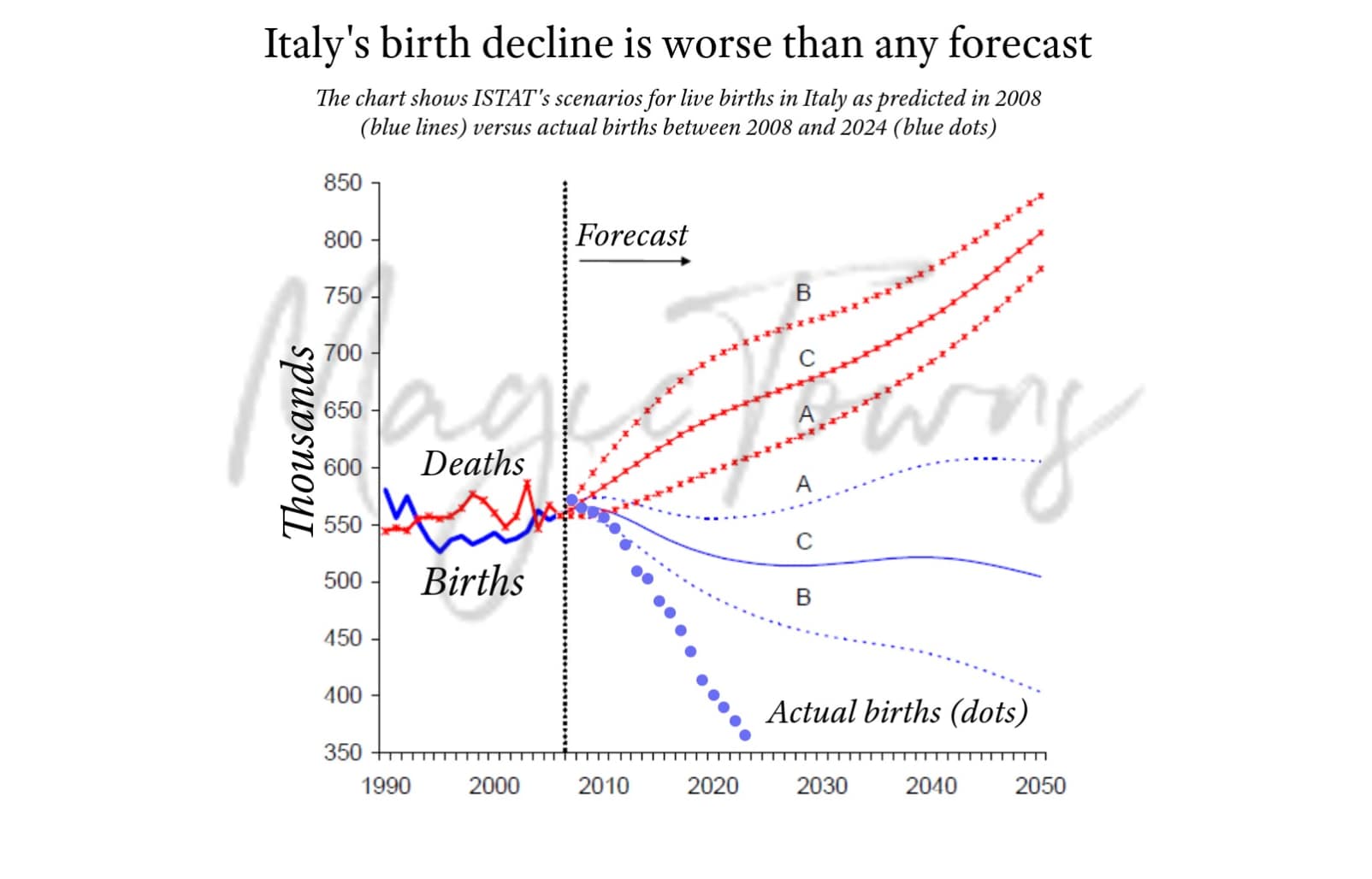
A chart has been making the rounds lately, shining a light on something we at Magic Towns have been harping on for a while: Italy is shrinking, fast. In 2008, ISTAT researchers projected that annual births would stabilize around 500,000. Instead, last year Italy slipped below 380,000 new births. The worst-case scenario they imagined wasn’t even that bad. In reality, about 207,000 fewer babies were born in 2024 than in 2008 (a −35.8% drop). This is a structural collapse with far-reaching consequences for the economy, public services, and the country’s long-term viability. The decline in arrivals of foreign workers, for decades Italy’s only demographic buffer, only deepens the problem.
Back in 2008, experts assumed a few things: that fertility would rebound to around 1.5 children per woman, that immigration would stay solid, and that second-generation immigrants would help lift birth numbers. None of that happened. Instead, fertility fell to ~1.2 and keeps dropping; the inflow of young migrants slowed and skewed older; the Great Recession morphed into 15 years of bleak prospects for Italy’s youth; delayed family formation turned into no family formation. In short, Italy veered onto a lowest-fertility, zero-momentum path. This is a trajectory even the doomsayers didn’t foresee.
“So what?”, one might ask. Fewer kids could mean smaller classes, less competition for jobs, maybe even more elbow room on the train. But this birth dearth is only one side of Italy’s demographic dilemma. The other side is that Italy is also losing people, especially young people, at an alarming rate. In this piece (and our podcast), we dig into why this matters and what it might mean for the country’s future. We’ll also touch on what could be done to attract new residents (hint: when a system grants 500 investor visas but 1,200 footballer visas a year, perhaps the priorities are a tad skewed). This is the first article in a series on Italy’s demographic crunch. Over the coming weeks we’ll explore different facets of the crisis and what it means for expats and would-be expats eyeing Italy.
Young Italians Leaving
Let’s start with Italy’s “brain drain”, the exodus of young Italians seeking greener pastures abroad. The raw numbers are sobering. Between 2011 and 2024, about 630,000 Italians aged 18–34 officially moved out of Italy. Even accounting for those who later came back, the net loss is around -440,000 people – nearly half a million young adults gone for good. To put it another way, for every one young person from countries like France, Germany or the U.S. who moved to Italy, 14.5 young Italians moved in the opposite direction. Yes, 14 to 1! This lopsided exchange ratio was the worst among all advanced economies studied in a recent CNEL report. Italy, essentially, is exporting its youth and not getting much in return.
Where are they all going? Primarily to other parts of Europe. London, Berlin, Paris, Barcelona – these have been the magnets for Italian talent (the UK and Germany alone accounted for a huge share of young Italian émigrés in the 2010s). Freedom of movement in the EU makes it a no-brainer: why slog through Italy’s stagnant job market when you can hop on a plane to Dublin or Amsterdam and be hired tomorrow? By contrast, very few young Italians brave the visa hurdles to try their luck in America or elsewhere: only about 4% of Italy’s 2010s emigrants went to the U.S.. The vast majority stick within the EU, which tells you that visa barriers work both ways: Italy’s youth have an easy escape hatch, and they’re using it.
Why do they leave? The reasons are not exactly shocking, but they are illuminating. In surveys of young Italians who moved abroad, the number one motive cited was work. About 16.5% said they left in search of better job opportunities (and another 8.9% specifically to advance their career). The next biggest reason was frustration with Italy’s institutions – 13.9% wanted to live in a country with more efficient bureaucracy and stronger civil rights. Close behind that was the draw of a higher quality of life (13.8%): think higher salaries, better public services, maybe less nepotismo and more meritocracy. Nearly 10% said their main reason was simply the desire for new experiences and different life environments. In short, young Italians are voting with their feet: they’re chasing careers, functional public services, decent pay, and a bit of adventure. That’s a pretty damning verdict on what they feel is lacking at home.
Internal Migration
It’s not only about leaving Italy. There’s also a huge internal brain drain from south to north. Within Italy’s borders, young people have been flocking from the poorer Mezzogiorno (South and Islands) to the more prosperous North for decades, and it hasn’t slowed down. In the 2011–2024 period, roughly 20% of all young adults originally living in the South packed up and moved to a region in Central or Northern Italy. That’s about 646,000 southern youngsters lost to the South’s communities. To break it down: around 484,000 went to live in the Center-North, and another 162,000 left the country altogether. Picture five friends from a Calabrian high school: one of them, statistically, is now up in Milan or abroad.
This hemorrhaging of human capital is in addition to the country-level emigration we already discussed. And it hits the South doubly hard, because it’s often the most educated and ambitious who leave. Of those ~484,000 southerners who headed north, more than one in three had a university degree – a share that has been rising every year. In fact, in the last few years, over half of young migrants from the South to the North have been college graduates. Meanwhile, those who stayed behind are more likely to be less-educated or unable to move. The term “brain drain” fits all too well: it’s the brains that are draining out of the South, leaving behind an older and less skilled population and weakening the local economies further.
Official statistics likely undercount this internal exodus. Many southern students and workers move north without officially changing their residence right away: they might keep their hometown address on paper (ciao, Mom and Dad!) while living in Turin or Bologna. For example, each year thousands of Southern-origin students enroll in northern universities but remain registered as Southern residents. In one recent academic year, about 17,000 such “hidden migrants” from the South were studying in the North yet still counted as southern residents. So the real loss of young people from regions like Sicily, Calabria, Puglia, etc. is even larger than the already startling registry data suggests.
This domestic brain drain has huge implications. Entire areas of the South have been depopulating and aging at a frightening pace. Towns empty out of young folks, local businesses can’t find skilled workers, and the cycle of decline perpetuates. Meanwhile, the big cities of the North (Milan, Bologna, Rome, etc.) gain energetic graduates at the South’s expense. One recent estimate put a price tag on it: the South in effect “subsidized” the North to the tune of €148 billion between 2011 and 2024 by educating young people who then moved north and contribute to the northern economy. Calabria alone has lost human capital valued around 70% of its GDP to out-migration. It’s a brain drain within national borders – a “Mezzogiorno diaspora” – and it’s arguably as problematic as the international kind, if not more so for Italy’s cohesion.
Attracting Foreign Talent (or Not)
One obvious way to offset these losses would be to attract young talent from abroad. After all, many countries balance their demographics by luring in immigrants to work, study, and settle. Is Italy doing that? In a word: no.
Italy today is among the least attractive destinations for young people from other advanced economies. The CNEL report crunched data on migration flows among 13 wealthy countries, and Italy came dead last in drawing in young migrants. Only about 1.9% of the youths moving between those countries headed to Italy. By contrast, Germany, the UK, Spain, and France each attracted between 15% and 20% of those migrating young professionals. For a bit of perspective, tiny Denmark managed to pull in 3.2%, and even Sweden got 3.4%. Italy at 1.9% is basically an rounding error in the grand scheme of youth mobility.
Another way to frame it: Italy exchanges young people with places like the UK, France, Germany, etc., but the exchange is profoundly one-sided. The earlier stat said it all – 14.5 Italians out for every 1 foreigner in. Italy is simply not on the radar for most young graduates or workers looking internationally. Case in point: lots of young Irish and Danes move abroad, but almost none of them come to Italy. About 22% of emigrating Irish 20-somethings go to Spain (sun and sangria calling), whereas only roughly 2% end up in Italy. Similarly, of the Danes who leave Denmark, 21.6% head for France, versus a microscopic 0.9% who choose Italy. In other words, even people from other developed countries – who could relatively easily move to Italy if they wanted, being EU citizens and all – mostly don’t want to.

Why is that? This is the million-euro question. Italy has so much going for it in quality of life, culture, and climate. Yet when it comes to young professionals, Italy just isn’t competitive with its European peers. The CNEL researchers pointed to a few factors. One is language: Italy, unlike the Netherlands or Nordics, doesn’t operate in English at work, and overall English proficiency is low (Italy consistently ranks near the bottom in Europe on the EF English Proficiency Index).
Another issue is salary transparency: only about 1 in 4 job postings in Italy includes salary info, a far lower share than in many other countries. Lack of clear salary expectations can deter international candidates who aren’t plugged into informal networks. In surveys, young expats also complain about Italy’s convoluted bureaucracy, insular business culture, and the infamous raccomandazione (who-you-know matters more than what-you-know).
What’s striking is that some of Italy’s supposed “disadvantages” haven’t stopped other countries. Sure, Italian isn’t a global work language, but neither is Spanish, and that hasn’t stopped Spain from becoming a top destination for Northern Europeans (besides Latin Americans obviously). And yes, Italian wages can be low, but wages in, say, Portugal or Greece are even lower, and they still attract more foreign remote workers than Italy does.
It seems there are deeper issues at play: visa and work permit hurdles, for one. Italy’s immigration system for non-EU citizens is famously archaic and unwelcoming. The country still has a strict annual quota system (the decreto flussi) for most work visas, a complex bureaucracy to navigate, and slow processing times. Want to hire a skilled Indian engineer or South African designer? Good luck with the paperwork. Other countries have rolled out the red carpet for global talent with fast-track visas; Italy is still stuck in the slow lane. Even for EU citizens or folks who don’t need a visa, Italy can present challenges: recognizing foreign qualifications, getting services without Italian language, dealing with a mountain of municipal paperwork to open a bank account or rent an apartment – it all adds up.
Perhaps the most damning fact is that Italy hasn’t really tried to compete in this arena. While others actively court young talent, Italy has been complacent, coasting on its natural appeal (who wouldn’t want to live under the Tuscan sun? Most young Europeans, it seems!) without tackling the practical barriers. The result is a kind of youth drain double-whammy: Italians leave, and foreigners largely don’t replace them. As one analyst quipped, “Italy is great at exporting made-in-Italy goods and its young brains, and not so great at importing either.” Harsh, but not entirely off the mark.
Learnings from Other Countries
So, what could Italy do differently? It’s not the first country to face a brain drain. Places like Ireland, Spain, or even Denmark have been in Italy’s shoes in the past – losing people, watching villages empty out – and they managed to turn things around or at least mitigate the damage. Here are a few lessons Italy might glean from their experiences:
• Make Opportunity at Home (Ireland): Perhaps the biggest lesson from Ireland is that people come back (and foreigners come in) when there are good jobs and hope for the future. Ireland spent decades as a place young people fled in droves; now it’s a thriving hub that reversed persistent emigration of its best and brightest. How? By aggressively attracting investment, nurturing a knowledge economy (tech, pharma, finance), and keeping taxes low to spur job creation.
Ireland’s unemployment rate fell dramatically and incomes rose; the country went from having one of the highest emigration rates in Europe to one of the highest immigration rates. Its population grew ~15% in a single decade (mid-90s to mid-2000s) thanks to the influx of workers coming in. The takeaway for Italy: you must fix the root causes that drive your youth away – chiefly the lack of attractive jobs and career prospects. No amount of marketing will retain or attract young talent if the economy doesn’t generate opportunities. Italy doesn’t need to become Ireland 2.0 (and Ireland’s model has its own issues), but it illustrates that a country’s narrative can flip when growth and innovation replace stagnation.
• Streamline and Open Up (Denmark & Co.): Many formerly emigrant-sending countries have learned to roll out the red carpet for skilled foreigners – and for their own expats abroad. Denmark, for example, actively reformed its immigration policies to make hiring non-EU talent easier and less bureaucratic. The government there literally stated that “foreign labour is beneficial for all Danes” and implemented a 21-point plan to help companies recruit globally.They even lowered salary thresholds and expanded their “positive list” of in-demand jobs to grant visas more readily. They tackled the infamously high Danish tax rates by providing substantial tax cuts for highly paid expats (personal anecdote: while living in the US, I rejected a job offer from Denmark outright on grounds of the infamous 50% income tax, and the recruiter was quick to add there would be a large tax break if I moved to Denmark – which I eventually did).
The message was: we want you here. Similarly, countries like Canada (outside Europe) have embraced point-based immigration systems that are user-friendly and fast, signaling openness. For Italy, the lesson is to cut the red tape and modernize the system. Ditch the outdated quota lottery for workers and create clear paths for qualified immigrants. Make it easy for an Italian-trained PhD or an international graduate from a top university to stay and work. Right now Italy’s bureaucracy and slow processes are practically chasing talent away. Also, embracing English in workplaces and public services wouldn’t hurt – places like the Netherlands, Sweden, and Denmark manage to integrate foreigners far more smoothly largely because everyone speaks fluent English and information is accessible. Italy doesn’t have to become fully anglophone, but offering some bilingual support (think: English versions of government websites, some university programs in English, etc.) could make a huge difference in attracting non-Italian speakers.

• Leverage Your Strengths (Spain): Spain has some similarities to Italy – Mediterranean lifestyle, language not widely spoken globally, relatively high youth unemployment in the past – yet Spain outperforms Italy in drawing foreigners and even luring back its own emigrants. Why? One factor is that Spain has smartly leveraged its cultural and historical ties. For instance, it offers a fast-track to citizenship for people from many Latin American countries (just 2 years residency required, instead of the usual 10), effectively encouraging those with Spanish heritage (or anyone from its former colonies) to put down roots.
Italy, by contrast, does have (now severely down-powered) ius sanguinis citizenship for Italian descendants, but getting it is a lengthy legal process and Italy hasn’t capitalized on broader cultural ties the way Spain has. Spain also jumped on the digital nomad trend quickly – it introduced a Digital Nomad Visa in 2023 that has already attracted global interest from remote workers. Italy only pushed through a similar digital nomad visa in 2025. Moreover, Spain’s immigration authorities, while not perfect, are reputed to be more straightforward than Italy’s. And anecdotally, Spain’s work culture is seen as a bit more welcoming to outsiders – there are big international communities in cities like Barcelona, and a foreigner can integrate there without feeling completely lost.
The lesson for Italy: market its lifestyle and heritage, but back it up with real incentives. Italy has incredible draws – who wouldn’t want to live in Rome, Florence, or along the Amalfi Coast? But you need to provide viable pathways: special visas, startup hubs, relocation packages, partnerships with universities, whatever it takes. Play up the unique strengths (culture, climate, affordable healthcare, etc.) and minimize the pain points (bureaucracy, uncertainty). Spain managed to get tens of thousands of young Europeans to move there for work or remote work – not just retirees on the beach. Italy could certainly do the same if it tried a bit harder.
In short, other countries show that decline is not destiny. With the right policies and attitudes, a brain drain can be slowed or even reversed. Italy has a lot to learn, but also a lot to offer – it just needs to bridge that gap with action.
FAQ
Is it true that there are no jobs in Italy?
No, that’s a myth. In fact, Italy currently has more job vacancies than job seekers in several fields. Unemployment has been falling, and many industries are actually experiencing labor shortages. Realistically, anyone with solid skills who wants to move to Italy can find a job with a bit of effort. The new visa for Italians abroad with ancestry ties (which is quota-free) might make it easier for some diasporans to return or for their descendants to come work in Italy.
The real issue isn’t an absolute lack of jobs, but rather a mismatch between the jobs available and the skills (or preferences) of job seekers. For example, there may be hundreds of openings for, say, CNC machine operators or nurses, but if young graduates all aspire to be public sector clerks or can’t relocate to where the jobs are, those posts stay unfilled. So, the quantity of jobs isn’t Italy’s biggest problem – it’s aligning the right people with the right roles, and upskilling people for the areas that are hiring.
Is it true that jobs are underpaid in Italy?
Yes and no. Italy’s salaries are famously a mixed bag. If you compare average wages, many Italian jobs (especially entry-level positions, service work, or public sector roles) pay lower than the equivalent in Northern Europe or North America. A junior office worker or a teacher in Italy will indeed make considerably less than their counterpart in, say, Germany or the UK. This can be a shock for expats coming from higher-wage economies.
On the other hand, not all jobs in Italy are poorly paid. There are sectors and regions where pay is quite competitive – often even higher than in some other EU countries. For instance, specialized professionals in manufacturing, automotive, or high-end design can earn good salaries, as can experienced IT developers, engineers, and managers especially in the North. International companies and industries like luxury cars, fashion, and pharmaceuticals often pay international-standard salaries to attract talent. Additionally, the cost of living in Italy (outside of big cities like Milan or Rome) can be lower, which makes a slightly lower salary stretch further in terms of quality of life. So while it’s true that many jobs (especially in the public sector or low-skill services) are underpaid and salaries have stagnated over the years, there is also a slice of the job market that rewards talent quite well. In short: you won’t get rich quick with a random job in Italy, but if you have the right skills and find the right niche, you can live comfortably.
Is it as easy to get to work in Italy as in other countries?
Not really, to be honest. If you’re an EU citizen, you at least don’t have legal barriers – you have the right to live and work in Italy. But anyone coming from outside the EU will find Italy’s system rather challenging. Italy still uses a quota-based work visa system (the decreto flussi each year) which caps the number of work permits and assigns them by category. This system is infamously cumbersome – imagine a “click day” where thousands of applications flood the system in minutes. Even if you qualify, the processing is slow and bureaucratic.
Then there’s the issue of recognizing foreign qualifications. If you’re, say, a non-EU nurse or an architect, getting your credentials recognized by Italian authorities can be a multi-year saga of paperwork (thankfully, regions like the Veneto have put together a moratorium on foreign qualifications to smooth out this process).
Italy also hasn’t embraced English as a working language in the way some smaller countries have. The average Italian office or government service operates almost entirely in Italian; so without language skills, many expats find themselves struggling (Italy consistently scores low in English proficiency rankings).
It’s worth noting Italy had some programs to attract talent – for instance, a generous tax break for Italian graduates or professionals who return after being abroad (the “brain return” incentive). However, the current government recently scaled back that scheme – reducing the tax rebate, shortening its duration, and raising the education requirements to qualify. So that’s now less attractive than it was a couple of years ago.

There are a few bright spots: for example, Italy created a special startup visa for entrepreneurs and a new “Italian descendants” work visa (for people of Italian heritage) which bypasses quotas. And if you’re a highly specialized talent (researcher, executive, etc.), there are EU Blue Cards or intra-company transfers that can be used. But on the whole, Italy has a reputation for red tape in hiring foreigners.
In comparison, places like Canada or Australia use points-based systems that are straightforward, and countries like Germany scrapped a lot of bureaucratic hurdles to welcome skilled workers. Italy hasn’t quite gotten that memo yet. And internally, without speaking Italian, it’s hard to access many jobs or even basic services. So, while it’s possible to come work in Italy (and many do successfully), it’s not as easy as moving to say, the Netherlands or Ireland where the process and integration tend to be smoother. A move toward a more merit-based, transparent immigration system and more support for English-speaking professionals (not just native English speakers, but anyone who operates in English) could work wonders for Italy’s attractiveness.
Italy is a fantastic place to live – no one doubts that – but making it a fantastic place to work (for locals and foreigners alike) is the real challenge going forward. Solving that is key to plugging the brain drain and perhaps even reversing it. As the saying goes, “Italy works when Italy works” – if the jobs and opportunities are there, the people (and maybe even the babies) will follow.








 English
 French
 German
 Italian
 Danish