
Skip to main content Scroll Top

Elevation

[?] Elevation of a city refers to the height above sea level at which the city is located, measured in meters.
26

Population

[?] This is a town's official population, measured each year by the national statistics authority.
21100

Real Population (5km)

[?] Our "Real Population" metric reflects more accurately a town's real size by including inhabitants in the immediate vicinity of the town's official borders.
98900

Air Quality Rating

[?] Based on PM10, PM2.5, NO2, SO2, and ozone levels. Higher scores indicate cleaner air.
96

Region

Toscana

Walkability

Walker’s Paradise

Housing availability

[?] Based on total number of properties (sale and rent) classifies housing availability into five categories: low, relativel ylow, medium, relatively high and high.
Low

Avg Download Speed (Mbps) / Avg Upload Speed (Mbps)

125
/ 59

Climate Description

Favorable climate with mild winters, warm summers, and moderate transition seasons.

Montecatini-Terme

Toscana

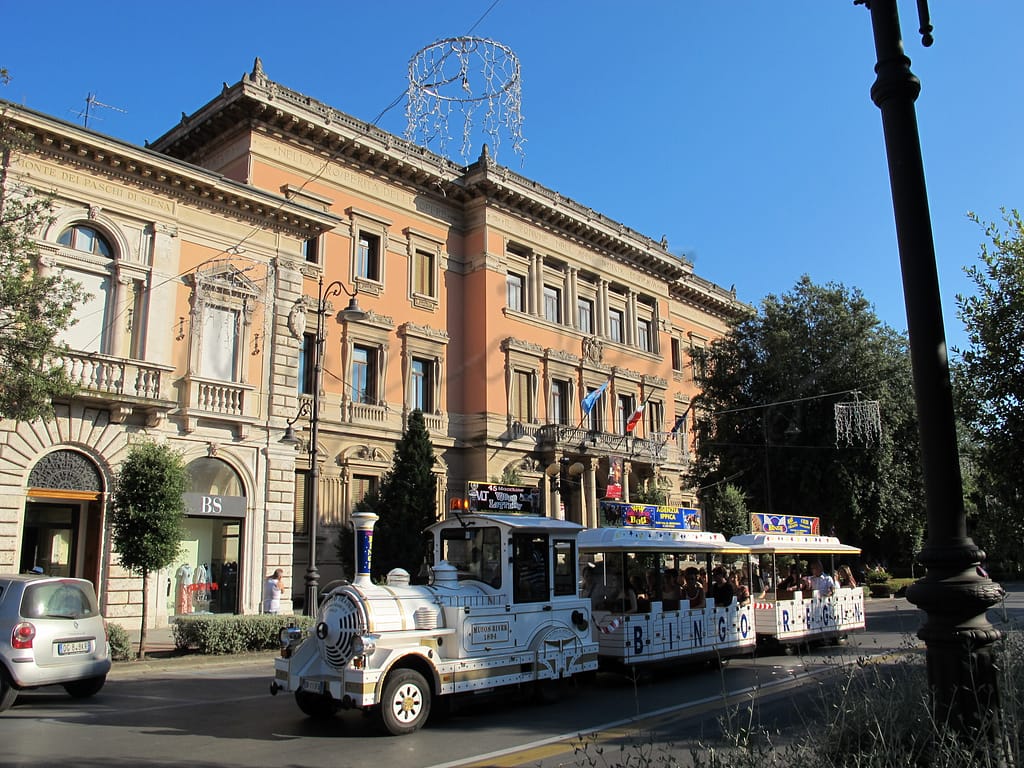
Historic spa town known for thermal waters, Art Nouveau architecture, and vibrant cultural life.

Quality of Life Score

[?]Factors in air quality, amenities, walkability, population, and environmental risks. Higher scores suggest better living conditions.

80

Quality of Infrastructure

[?]Measures internet speed, healthcare access, airports, rail, and walkability. Higher scores mean better connectivity and essential services.

64

Quality of Economy

[?]Based on income, property prices, job availability, and population density. Higher scores indicate stronger economic conditions.

68

Montecatini-Terme Demographics

Population

[?] This is a town's official population, measured each year by the national statistics authority.

21100

Real Population (5km band)

[?] Our "Real Population" metric reflects more accurately a town's real size by including inhabitants in the immediate vicinity of the town's official borders.

98900

Births Per 100 Deaths

50.0

Population Data Source

ISTAT,2023

Estimated Unemployment Rate

Touristy Index

[?] Calculation of tourist density index for the city, comparing its total tourist number to the overall average tourist number of the region relative to its own population.The index indicates how a location’s tourist density compares to the average, with values above 100 representing higher-than-average density and values below 100 representing lower-than-average density.

Highly Touristic

Income per capita (2023)

[?] This is an estimation of average income per resident for this town, based on 2023 data from the Italian Ministry of Finance.

20800

Income rank in Italy (2023)

[?] This is a ranking of the town's average income per resident, against the full list of townships in Italy.

3672 out of 7901

Infrastructure and Connectivity

Create an account to explore more

This content is for Members only | Already a Member? Sign in

Closest Airport

Name

Amerigo Vespucci (Florence)

Connectivity Score

[?] Measures travel time and service quality of nearby airport stations. Higher scores mean better transport access.

6

Driving Time

27min(s)

Amerigo Vespucci Airport, also known as Florence Airport, is situated near Florence, Italy, serving as an essential international gateway in the Tuscany region. It handles over 3 million passengers annually, offering connectivity to a variety of European destinations such as London, Paris, Amsterdam, and more, with seasonal routes to cities like Lyon and Olbia. As a focus city for airlines such as Vueling and Volotea, the airport is well connected through a light-rail link and buses to central Florence, making it accessible for travellers exploring the vibrant city and its surroundings.

2nd Closest Airport

Name

Galileo Galilei (Pisa)

Connectivity Score

[?] Measures travel time and service quality of nearby airport stations. Higher scores mean better transport access.

7

Driving Time

34min(s)

Galileo Galilei Airport, situated in Pisa, Italy, is the 10th busiest airport in the country, having served over 5 million passengers in 2023. It operates as a focus city for Ryanair and provides connections mainly across Europe, with notable destinations including London, Paris, and Amsterdam. The airport is known for its budget-friendly options, with a single terminal providing both domestic and international flights, and is conveniently linked to Pisa Centrale railway station via the Pisa Mover shuttle service.

3rd Closest Airport

Name

Guglielmo Marconi (Bologna)

Connectivity Score

[?] Measures travel time and service quality of nearby airport stations. Higher scores mean better transport access.

7

Driving Time

61min(s)

Guglielmo Marconi Airport, located in Bologna, Italy, approximately 6 km from the city centre, serves as a vital transport hub in the Emilia-Romagna region. With nearly 10 million passengers in 2023, it ranks among Italy’s busier airports, connecting travellers to over 100 destinations, including major cities like Amsterdam, Frankfurt, and Dubai. Key routes facilitated by airlines such as Ryanair and Wizz Air include domestic flights to Catania and international connections to Tirana and Madrid, with the longest direct route being to Dubai. The airport’s connectivity is enhanced by a monorail to Bologna Central Station, making it easily accessible for both domestic and international travellers.

Closest Rail

Name

Stazione di Montecatini Terme-Monsummano

Connectivity Score

[?] Measures travel time and service quality of nearby rail stations. Higher scores mean better transport access.

7

Driving Time

8min(s)

Train service at Stazione di Montecatini Terme-Monsummano includes several key features:

– **Rail Lines**: The station is primarily served by Trenitalia. It operates on the Florence-Pistoia line, which connects various significant urban centres.

– **Key Destinations**: Direct trains frequently connect Montecatini Terme-Monsummano to Florence Santa Maria Novella and Pistoia. There are about 20 direct trains to Florence each day, with additional connections to Viareggio and Lucca.

– **Train Operators**: The main operator at this station is Trenitalia, which offers regional services in this area. High-speed services such as those from Italo do not stop here.

– **Frequency of Departures**: Train departures to Florence occur with a high frequency, typically ranging from every 30 minutes to hourly. There are fewer trains on weekends.

– **Types of Trains**: The station primarily accommodates regional trains, with no high-speed train services available directly at Montecatini Terme-Monsummano, focusing instead on regional connectivity.

2nd Closest Rail

Name

Stazione di Serravalle Pistoiese

Connectivity Score

[?] Measures travel time and service quality of nearby rail stations. Higher scores mean better transport access.

5

Driving Time

14min(s)

Train service at Stazione di Serravalle Pistoiese includes the following key details:

– **Rail Lines**: The station is primarily served by regional train lines operated by Trenitalia.
– **Key Destinations**: Direct trains connect Serravalle Pistoiese to significant destinations such as Pistoia and Lucca. Trains also facilitate travel to Florence, making it accessible for commuters heading to the capital city.
– **Train Operators**: Trenitalia is the main operator servicing this station, with local connections and regional train services.
– **Frequency of Departures**: Trains typically run every 30 to 60 minutes during peak travel times, with fewer services available during off-peak hours. There may be some journeys with a limited number of trains operating throughout the day.
– **Train Types**: The station primarily serves regional trains, with no high-speed services currently stopping at Serravalle Pistoiese, focusing instead on local and regional connectivity.

3rd Closest Rail

Name

Stazione di Pescia

Connectivity Score

[?] Measures travel time and service quality of nearby rail stations. Higher scores mean better transport access.

6

Driving Time

16min(s)

Train service at Stazione di Pescia offers the following structured summary:

– **Rail Lines**: The station is served by Trenitalia regional trains, primarily along the routes connecting Florence to Lucca and Pisa.
– **Key Destinations**: Direct connections are available to major destinations including Florence (Sant Maria Novella), Pisa Centrale, Montecatini Centro, Lucca, and Siena.
– **Train Operators**: Trenitalia is the main operator serving Pescia, providing regional train services.
– **Frequency of Departures**: Trains to Florence and other key destinations operate on an hourly basis, with additional services to Montecatini Centro occurring more frequently.
– **Train Types**: The services primarily consist of regional trains, with no high-speed trains stopping at the station.

Infrastructure & Amenities

Create an account to explore more

This content is for Members only | Already a Member? Sign in

Healthcare

Create an account to explore more

This content is for Members only | Already a Member? Sign in

Housing & Property Market

Create an account to explore more

This content is for Members only | Already a Member? Sign in

Connectivity & Digital Access

Create an account to explore more

This content is for Members only | Already a Member? Sign in

Education

Create an account to explore more

This content is for Members only | Already a Member? Sign in

Climate & Weather

Create an account to explore more

This content is for Members only | Already a Member? Sign in

Precipitation

[?] Based on daily climate data for precipitation from OPEN-METEO this parameter indicates how a city's annual precipitation compares to others in terms of percentage, with values ranging from 0 (lowest) to 1 (highest). For example, a percentile rank of 0.75 means the city's total precipitation is higher than 75% of other cities.

Above Average (51st-60th percentile)

Sunshine

Somewhat High (61st-70th percentile)

Snowfall

Somewhat Low (21st-30th percentile)

Min Annual Temperature (°C)

[?] This parameter represents the monthly average of daily minimum temperatures for January, based on data from OPEN-METEO.

1.9

Max Annual Temperature (°C)

[?] This parameter represents the monthly average of daily minimum temperatures for January, based on data from OPEN-METEO.

30.2

Climate Description

In Montecatini-Terme, situated in Italy, the climate contributes to its allure among expatriates and retirees, particularly those from the readership of Magic Towns. The town enjoys a favorable climate with ample sunshine that supports outdoor leisure activities throughout most of the year. Winters are mild, marked by minimal snowfall that seldom disrupts daily life. Summers are pleasantly warm rather than hot, making it an ideal retreat from more sweltering locales. Transition seasons are notable for their moderate temperatures, which strike a comfortable balance between the extremes of heat and cold. Overall, Montecatini-Terme offers a welcoming environment that features all four seasons in a temperate display, fostering a relaxed lifestyle for its residents.

Annual Temperature Chart (Min)

Annual Temperature Chart (Max)

Sunny Days By Month

Environmental & Air Quality

Create an account to explore more

This content is for Members only | Already a Member? Sign in

Classifications

PM10

[?] PM10 levels indicate Good air quality at 0–20 µg/m³, Fair at 20–40 µg/m³, Moderate at 40–50 µg/m³, Poor at 50–100 µg/m³, Very Poor at 100–150 µg/m³, and Extremely Poor at 150–1200 µg/m³.

Good

PM2.5

[?] PM2.5 is Good if PM2.5 levels are between 0–10 µg/m³, Fair between 10–20 µg/m³, Moderate between 20–25 µg/m³, Poor between 25–50 µg/m³, Very Poor between 50–75 µg/m³, and Extremely Poor between 75–800 µg/m³.

Good

NO2

[?] NO₂ levels are considered Good at 0–40 µg/m³, Fair at 40–90 µg/m³, Moderate at 90–120 µg/m³, Poor at 120–230 µg/m³, Very Poor at 230–340 µg/m³, and Extremely Poor at 340–1000 µg/m³.

Good

SO2

[?] SO₂ levels indicate Good air quality at 0–100 µg/m³, Fair at 100–200 µg/m³, Moderate at 200–350 µg/m³, Poor at 350–500 µg/m³, Very Poor at 500–750 µg/m³, and Extremely Poor at 750–1250 µg/m³.

Good

O₃

[?] For O₃, the air is Good at 0–50 µg/m³, Fair at 50–100 µg/m³, Moderate at 100–130 µg/m³, Poor at 130–240 µg/m³, Very Poor at 240–380 µg/m³, and Extremely Poor at 380–800 µg/m³.

Fair

Air Quality Rating

[?] Based on PM10, PM2.5, NO2, SO2, and ozone levels. Higher scores indicate cleaner air.

96

Air Quality Description

In Montecatini-Terme, the air upholds a standard befitting those who seek a healthier retreat. The concentration of particulate matter, both PM10 and PM2.5, firmly positions itself within ‘Good’ classifications, suggesting fewer pollutants and cleaner breaths. Nitrogen dioxide and sulphur dioxide levels also maintain commendable ‘Good’ ratings, implying minimal industrial interference. Ozone presence, marked slightly lower at ‘Fair’, still supports outdoor activities without significant worry about air quality degradation. This balanced atmosphere makes Montecatini-Terme a suitable choice for expatriates and retirees prioritizing their well-being alongside picturesque Italian living.

In Montecatini-Terme, the air upholds a standard befitting those who seek a healthier retreat. The concentration of particulate matter, both PM10 and PM2.5, firmly positions itself within ‘Good’ classifications, suggesting fewer pollutants and cleaner breaths. Nitrogen dioxide and sulphur dioxide levels also maintain commendable ‘Good’ ratings, implying minimal industrial interference. Ozone presence, marked slightly lower at ‘Fair’, still supports outdoor activities without significant worry about air quality degradation. This balanced atmosphere makes Montecatini-Terme a suitable choice for expatriates and retirees prioritizing their well-being alongside picturesque Italian living.

Town Descriptions

Create an account to explore more

This content is for Members only | Already a Member? Sign in

Getting There

Montecatini-Terme is well-connected, with the nearest airports being Amerigo Vespucci in Florence and Galileo Galilei in Pisa. The town benefits from two nearby train stations, enhancing its transit accessibility. Key road connections include the A11 motorway, facilitating access to major cities in Tuscany and beyond.

Getting Around

Local Cuisine

Montecatini-Terme, situated in the heart of Tuscany, presents a rich culinary scene characterized by traditional Tuscan cuisine as well as a variety of international dining options. The local gastronomy prominently features dishes such as Ribollita, a hearty vegetable and bread soup, Panzanella, a fresh salad of stale bread and tomatoes, and Garmugia, a vegetable and meat soup. Seasonal ingredients play a significant role in the local cuisine, with winter dishes focusing on hearty soups and autumn emphasizing pumpkin-based meals. In addition to traditional offerings, the town boasts a diverse array of restaurants catering to international tastes, including Asian and Mediterranean influences. Notably, Montecatini-Terme is home to a Michelin-starred establishment, underlining the quality and sophistication of its dining scene.

Shopping Overview

Shopping options include a variety of independent boutiques, designer stores, and convenience outlets. Designer items can be found in dedicated areas offering brands, while independent retail provides unique clothing and accessories. Additionally, local markets are available for traditional goods and souvenirs. Supermarkets cater to everyday needs, ensuring a comprehensive shopping experience for residents. The mix of high-end and everyday shopping venues contributes to a vibrant retail environment suited to diverse preferences.

Neighborhoods

Green Areas and Parks

Montecatini-Terme in Toscana offers a range of outdoor activities, particularly known for its hiking trails. Notable paths include Montecatini Alto via Via del Castello, a moderate trail of 3 miles with significant elevation gain. Visitors can also enjoy the Terme Tettuccio trail, an easy 2.2-mile route that is highly popular for running. Additional trails like Giro Parco Termale and Stabilimento Tamerici offer shorter, accessible walks. These activities highlight the region’s commitment to providing accessible natural experiences for all, ideal for retirees and nature enthusiasts.

✅ Pros

– Excellent healthcare facilities and services available locally.
– Good air quality, promoting a healthier lifestyle.
– Low unemployment rate ensures economic stability.
– Rich cultural and historical heritage to explore.
– Well-connected transportation options for easy travel.
– Pleasant climate for year-round outdoor activities.
– Strong tourist presence enhances local amenities and services.
– Opportunities for integration into the local community.
– Adequate infrastructure supporting daily living needs.
– Diverse educational facilities catering to various age groups.

❌ Cons

– Limited nightlife options for vibrant social activities and entertainment.
– High tourist influx can lead to overcrowding in peak seasons.
– Possible language barrier for non-Italian speakers in daily life.
– Limited job opportunities outside tourism and service sectors.
– Internet connectivity occasionally sluggish for remote work needs.
– Higher cost of living due to tourism-driven prices.
– Public transport can be infrequent outside major routes.
– Cultural events may cater more to tourists than locals.
– Seasonal weather extremes could deter some outdoor enthusiasts.
– Limited healthcare facilities for specialized treatment options locally.

FAQs

Summary

Montecatini-Terme, nestled between Florence and Lucca, is renowned for its therapeutic thermal waters, drawing visitors for centuries to its historic spas, including the renowned Terme Tettuccio. This elegant spa town features Art Nouveau architecture and lush parks, complemented by cultural offerings such as the Museo dell’Accademia d’Arte. The Ippodromo Sesana adds to the vibrant local culture, hosting regular horse races. With a walkable layout, residents benefit from a high walk score, fostering a community-centric lifestyle.

However, while Montecatini boasts a rich history and scenic beauty, some expats may find the local amenities limited compared to larger cities. The distance to major urban centres can pose challenges regarding shopping diversity and healthcare accessibility, despite adequate services within the town. Moreover, the charm of Montecatini might not appeal to those seeking a bustling, cosmopolitan atmosphere. Nonetheless, its tranquility and cultural heritage offer a unique lifestyle to those who choose to settle here.

✅ Pros

– Excellent healthcare facilities and services available locally.
– Good air quality, promoting a healthier lifestyle.
– Low unemployment rate ensures economic stability.
– Rich cultural and historical heritage to explore.
– Well-connected transportation options for easy travel.
– Pleasant climate for year-round outdoor activities.
– Strong tourist presence enhances local amenities and services.
– Opportunities for integration into the local community.
– Adequate infrastructure supporting daily living needs.
– Diverse educational facilities catering to various age groups.

❌ Cons

– Limited nightlife options for vibrant social activities and entertainment.
– High tourist influx can lead to overcrowding in peak seasons.
– Possible language barrier for non-Italian speakers in daily life.
– Limited job opportunities outside tourism and service sectors.
– Internet connectivity occasionally sluggish for remote work needs.
– Higher cost of living due to tourism-driven prices.
– Public transport can be infrequent outside major routes.
– Cultural events may cater more to tourists than locals.
– Seasonal weather extremes could deter some outdoor enthusiasts.
– Limited healthcare facilities for specialized treatment options locally.

Related Posts

No posts found for the town.

More questions about Montecatini-Terme ? Ask Magic AI.

Our innovative AI assistant is eager to help. Try it out here:

Other Locations You May Be Interested In