

Anna: Bentornati all'Magic Towns Italia.
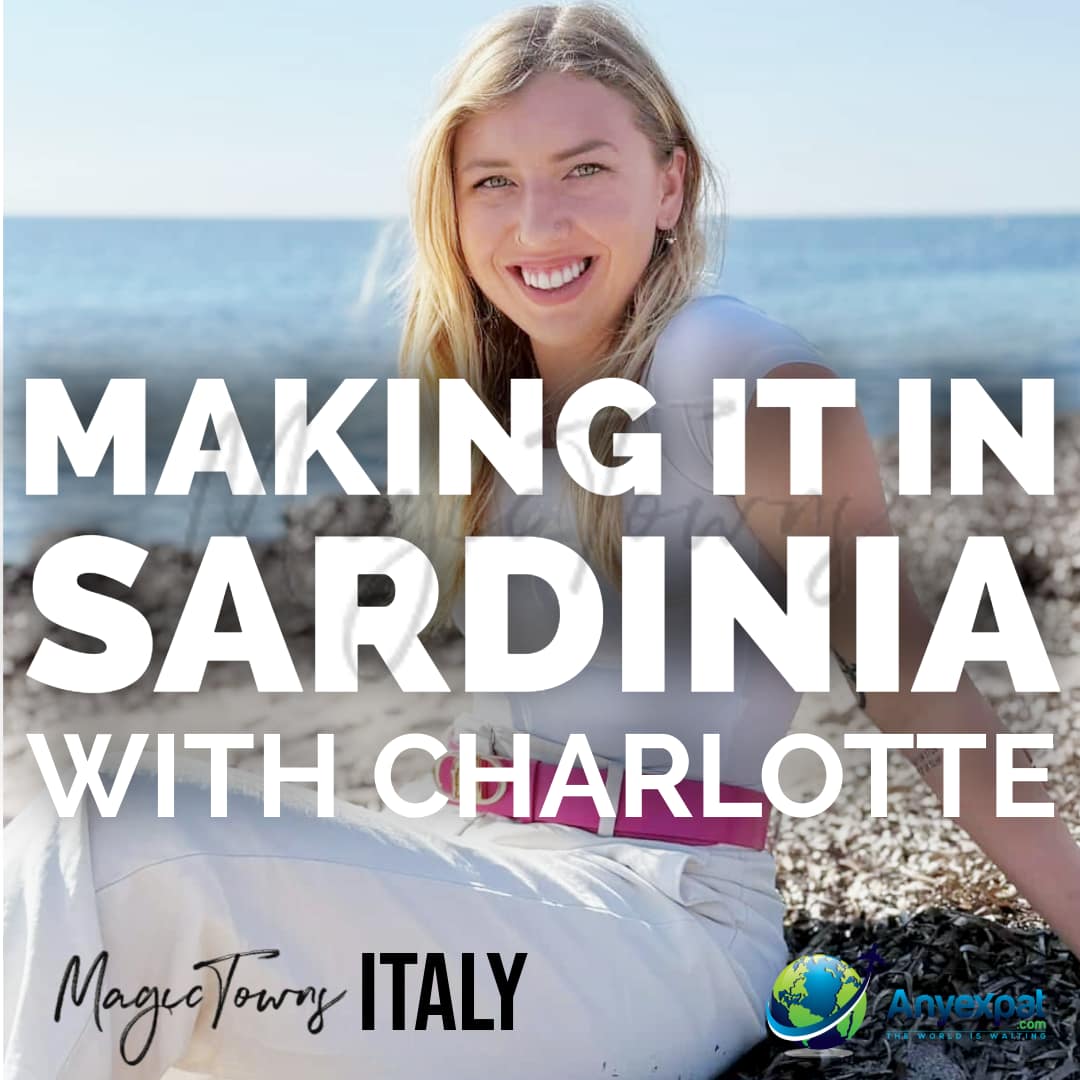
Today we’re heading to Sardinia, not as tourists, but through the eyes of someone who chose to build a life there from scratch.
Luca: You might have seen her on Instagram as @americanmominthemed, Charlotte Fortier-Mutzl. Charlotte, don’t kill me if I didn’t pronounce that perfectly, is originally from Quebec. She grew up in the US and eventually left everything behind to travel through Europe. In the next few years, there was a harrowing succession of moving to Rome on a working holiday visa, starting businesses, surviving COVID, and then relocating to Sardinia without ever having seen it.
Anna: So in this conversation we talk about risk, starting a business in Italy, learning the language from zero, raising children on the island, and what slow living [00:01:00] actually feels like when you’re living in every day.
Luca: If you’ve ever wondered about Sardinia’s slower pace of life, this episode offers a honest perspective from Charlotte.
Anna: Let’s get into it.
Hi, Charlotte, how are you? You’re in Cagliari in questo momento, giusto?
Charlotte: Yes, that’s correct.
Anna: Piacere di conoscerti finalmente. Due cose mi attirano di te e della tua storia. La prima è la dolcezza e la sincerità con cui condividi ciò che ti accade ogni giorno. Come se facessi davvero tanto mentre sei una mamma e un'imprenditrice. E ora, ancora, stai persino imparando il sardo. La seconda è che ti sei trasferita proprio in Sardegna, che è assolutamente uno dei miei posti preferiti in tutto il mondo.
Può raccontarmi qualcosa di più sulla sua storia?
Charlotte: I’m from Quebec, from Canada, the French part. And, uh, at 12 years old I moved with my family to the United States, to Florida. And then eventually, I moved to San Diego in California where I lived for a few years and I loved it [00:02:00] there. But yeah, I went through a bad breakup. I kind of felt for a long time that I was kind of out of place, you know, and I kind of grew up feeling like the United States, Canada is like the center of the world, and I knew that there was more out there, and so I, I had this, this need to go experience something else. And so I sold my car and I sold everything I had basically.
Ho preso un biglietto aereo per l'Europa e ho viaggiato da sola. Ho girato sette Paesi in due mesi e mi sono innamorata dell'Italia. Sono andata a Barcellona e ho ottenuto una certificazione per l'insegnamento dello yoga. E poi ho deciso di iniziare in Italia. Avevo un visto di vacanza-lavoro e insegnavo yoga nel parco, la sera lavoravo in un bar.
And then I met my husband, in Rome. We lived there for a few years, I think three years. [00:03:00] But we lived there through COVID and having our first son. Afterwards everything just became a bit too chaotic. And we lived in an agriturismo in Umbria for like six months. And we loved it there. We were actually looking for houses there ’cause we knew we didn’t wanna waste money on rent anymore. ‘Cause we had moved, I think, to 12 different apartments since my son had been born.
So we just wanted some stability. And then one day we were walking and we were freezing. We were in our boots and I’m looking at my husband, I’m like, what are we doing? Are we really gonna live here? It’s too cold for me. And I think having grown up, you know, in Florida, in California, I was really missing the beach.
And so I got online and started researching, some of the warmest places in Italy, scuba diving, snorkeling, all this stuff. And then I came across Sardinia. And in reality, I didn’t even know Sardinia existed. That’s how ignorant I [00:04:00] was. And my husband said, well, you’re crazy.
We can’t go live on an island. Like that’s way too nuts. And then within like a week I convinced him, I was like, look, it’s less than an hour flight from Rome. We can go back to our business all the time because we have a cocktail bar in Rome. And yeah, I found our house online before even, you know, ever having been to the island.
We packed up our car with all of our suitcases and got on the ferry with our son and our two cats at the time, and our dog. And we came over here. Neither of us had ever seen Sardinia, so we really took a big risk. And I have been so pleasantly surprised ever since we arrived. The location that we chose like near Cagliari turned out being perfect ’cause we’re right by all the beautiful beaches, but also near the city. And we found this amazing school where our kids go and that’s bilingual, so they’ve [00:05:00] been learning Italian very well. And, uh, our daughter was born here. Now we have two kids.
Ora abbiamo intenzione di rimanere qui, sai, a lungo termine.
Anna: Ha parlato di cocktail bar. Qual è stata la sua esperienza nell'avviare un'attività in Italia? Sappiamo che la burocrazia italiana ha una certa reputazione, quindi com'è stato davvero?
Charlotte: So the cocktail bar, actually my husband already owned when I met him, and that’s actually how we met. I went for an interview to work at his bar and I was the first employee ever. And then we ended up, getting together and then I hired everyone after me, I’ve added maybe a woman’s perspective and touch with the decor and, uh, some of the menus and things.
È di New York e si è trasferito in Italia a 18 anni, quindi ha una storia molto interessante. Era un agente immobiliare, ha risparmiato e poi ha aperto questo bar. La nostra prima avventura imprenditoriale insieme è stata a Roma. Abbiamo aperto un ristorante messicano insieme e ci è voluto molto lavoro.
All'epoca ero incinta di nostro figlio ed era proprio vicino al nostro bar, vicino al Vaticano. Eravamo così orgogliosi. Abbiamo ottenuto tutti i nostri menu. Abbiamo i fornitori di cibo, tutto. Avevamo aperto da meno di due mesi ed eravamo già quasi in attivo, ma poi è arrivato il COVID.
We are part of those people that experienced that in Rome. Our landlord didn’t give us any breaks or anything. We. Uh, had to stay shut for a whole year, paying the rent every month. And so we really struggled during that year. And we eventually had to sell because it was just such a big loss.
Fortunately the bar, we were able to survive a year paying the rent and being closed, but it’s my understanding that like 30% of [00:07:00] businesses in Rome went under during that time.
Anna: Sì.
Charlotte: So yeah, that was rough. Business wise, yeah. Here in Sardinia is, when we really started, I mean, when we moved here, we didn’t know what we were gonna do on the island.
And we quickly understood that working in tourism would make the most sense for us. Since, you know, combined we speak four languages and we have a lot of experience in customer service. Our first project here actually, we bought, our house and it was already a kind of predisposed for being two houses, like a bifamiliare so we closed up like the door with a wall downstairs, and we’ve been renting the other half of our house on Airbnb.
Almost as long as we’ve been here. I mean, a bit over three years now.
And that gave us a lot of knowledge and experience in the hospitality sector, especially with, people sleeping in your structures. So bureaucracy for that one wasn’t too [00:08:00] complicated.
We have like a commercialista here that helps us a lot. And a geometra. When we bought our house, we didn’t use a lawyer. I know a lot of expats don’t trust like the local people, so they’ll get often like a lawyer that speaks English and stuff.
A mio parere, può essere utile. Può anche essere uno spreco di denaro, a seconda dei casi, come se parlassimo italiano. E poi, dopo, il nostro progetto successivo è stato una grande casa abbandonata che si trovava proprio sul lungomare, sul mare. Ci passavamo davanti in continuazione, era così abbandonata e abbiamo visto che era in vendita e abbiamo sempre sognato a occhi aperti, come se potessimo trasformarla in A, B e B.
It would be so nice, and one day we finally decided, okay, let’s make an offer. And we got it for, you know, a great price. We spent two years with [00:09:00] the construction crew renovating. I did all the architecture. I had no experience in architecture, but I made all the, the plans for the inner walls and where, and it quickly turned into being so much more work than we had anticipated.
Because when you’re building a, what turned out to be a boutique hotel, so much goes into the plumbing and the electrical and where the outlets go and which way the doors open. Decisions never end.
Io mi occupavo più del design.
Anna: La cosa migliore.
Charlotte: Esattamente, sì. Il più creativo e poi abbiamo un altro bed and breakfast nella zona. Quindi rimaniamo, rimaniamo occupati.
Anna: E a un certo punto hai iniziato a postare video sulla tua esperienza e ora vedi migliaia di commenti di persone che stanno decidendo di trasferirsi in Italia o che ci sono già.
Era qualcosa di pianificato o si è sviluppato in modo organico? Come
Charlotte: Yeah, I didn’t expect it to, to gain so much popularity. I [00:10:00] started officially a year ago with, Instagram. At first, I was just kind of sharing, our experience living here in Sardinia and over time it evolved into this major tool that I’ve been using to learn more about the culture and the history of the island and even the language now with learning Sardo. I’ve really, really been enjoying being this bridge between Sardinians and foreigners. It has been very rewarding and I even have. Like, hundreds if not thousands of sardinians every week that are recommending me, like different places to go and different, cultural events.
And so it’s really been a huge help in making me feel more immersed in the island and like we belong, because our daughter’s born here and we’d like to stay, and I clearly don’t look Sardinian, [00:11:00] but you know, I would like to feel more and more like this is home.
Anna: You speak an excellent Italian. I saw some videos and definitely that helps even more. Did you already speak the language or was it something that you’ve learned along the way?
Charlotte: It is something I learned along the way. So me, myself, I have no ties to Italy whatsoever. I was just random chance that I met my husband here and decided to stay. But yeah, when I was living in Rome, I started, through hanging out with my husband and his friends that all spoke Italian, I kind of started absorbing like a sponge, but I wouldn’t speak ’cause I didn’t have the courage. I didn’t wanna make any mistakes.
Honestly watching Netflix is probably what helped me the most. I would watch, you know, like Italian movies on Netflix. In English. And then once I had ’em memorized, then I would watch them in Italian.
And then when we moved to Sardinia, I had to start speaking it because in [00:12:00] Rome you can get by, you know, you’re in Rome, right? So, you know, you can get by with English easily. Here it’s not the case. And with my kids in school and with the workers and with everything, I had to learn and kind of jump into the deep waters and go for it.
Anna: That’s probably the best, the best thing ever. Like when you’re just learning and you’re not practicing in daily life, it’s just it’s more difficult. Yeah. And what’s the biggest difference you’ve noticed in daily rhythm of life compared to the United States?
Charlotte: I would say the slower pace of living here, people say slow living and everything, but it’s true. It is noticeable in so many different ways.
When I was living in the States it is very much more work oriented and earning money and buying, materialistic things. And so often it feels like it’s just a never ending chase, you know, [00:13:00] for happiness.
In Sardinia specifically, I have noticed that people can be so happy with so little and there’s not so much this sense of competition, and it’s a lot more based on spending time with family and kind of things that money can’t buy and those very much line up with my values.
Now living here, like I’ve attained, happiness of course, like I, there’s things that I want or we have goals or I could these planned and stuff, but it feels like I’m not waiting to achieve something, be happy. Like, I look at my husband all the time and tell him like i’m so happy, like I couldn’t be happier,. And so I feel very lucky to have found that here.
Anna: That’s the best feeling ever. Um, but yeah, I completely understand what you’re saying. I think that Sardinia is, I mean even Rome is absolutely beautiful, but Sardinia is something different, compared to all the other [00:14:00] places in Italy.
The area is different. People are different. Like if you love the sea, if you love you, you mentioned scuba diving. You are a yoga teacher. You really feel connected to nature because that’s what matters the most there.
Charlotte: Oh sì, assolutamente.
I’m not someone that’s super like it, energies and stuff like that, but I, I do feel like here, like there’s just something about whenever I arrive on the island that I just, I feel good and I feel at home and I can tell that like people, ’cause we host a lot of travelers and they all tell me like, wow, like Sardinia had such a positive impact, on our experience.
The nature here is incredible, unlike anywhere I’ve ever seen because you get a little bit of everything in such a, relatively small space, from the incredible beaches that, actually I’ve, I’ve been learning a lot about why the beaches here are so nice, and for a long time, Sardinians were kind of held into the center of the island and they didn’t inhabit the coast, for [00:15:00] fear of being overtaken and things like that. So that’s also just fascinating to learn why the beaches have remained so pristine. But there’s also the mountains and there’s these beautiful caves. There are numerous caves here.
And so yeah, there, there’s mountain, like rock climbing and so there’s nature activities.
Anna: Probabilmente il sud dove vivete è la parte migliore.
Charlotte: I haven’t been to the north that much, but I have heard people tell me like the very north, where it’s like all these luxury hotels and everything is like super overpriced. Like a lot of people say, well, that’s not Sardinia anymore. It’s not like the real soul of Sardinia, let’s say.
But here in the south, yeah. It’s very much so like just driving to take my kids to school. Like very often there will be a whole pasture of sheep in the middle of the road. God, to like wait for them to get out. Yeah. Like we can go every single weekend, we go into a different nature spot with the kids and have a picnic, and go for a hike and we never run out of new places to [00:16:00] try, you know, so I feel like it’s a very nice place to grow children and very safe also.
Anna: If that’s something that I wanted to ask you, like how has been your experience so far, raising your children in Italy?
Charlotte: I mean, our children go to a private school here. I know for public schools that it very much depends on which school and which teachers you get ’cause there’s some that are excellent and there’s some maybe that are more mediocre. We, we have been only in the private system and we felt like that was the safest bet since we didn’t really know what to expect.
We really want our children to learn like English grammar as well and all these things in case they ever want to go live, in Canada or the states or, to give them, more opportunities. But the school that we have chosen, for example, has like an indoor pool. They have yoga class. They have musical therapy. They [00:17:00] have, and this is preschool. And they have a chef that cooks everything on the spot, like with fresh ingredients. And they do, like in elementary school next year, they start like philosophy class. And so they do all these things that in Canada, for example, or in the US would be like four times as expensive. So relatively, we find like that we’re getting a great educational system here for such an affordable price compared to what something like that would cost in the States. And safety wise also, like we feel very safe here. It’s never really a worry, especially going from somewhere like when I lived in Florida where everyone is kind of carrying guns and there’s a lot of incidents in schools and all these things.
That’s not something that ever crosses my mind here.
Anna: If you could give just one piece of advice to experts considering to move to Italy, what would it be? Or something that you would’ve recommended to yourself [00:18:00] at a time?
Charlotte: That’s a good question.
Definitely to come visit before moving because I think a lot of people they maybe plan a trip, but they’ll go and they’ll try to do too much in a short amount of time. Like they’ll do like Rome, Milan, Sorrento o altro, tutto in pochi giorni. Quindi direi di prendersi qualche mese per provarlo prima.
Because it’s not for everyone, it was for me, but it is quite an adjustment going from, having all these, materialistic things, very convenient. And here generally, unless you’re like in the north it’s very much, like the banks are closed at lunchtime and, there’s no Walmart where you can go buy everything.
You’ve gotta go to like different shops for every little thing. So I think it’s, , it’s something that you’ve gotta experience for yourself and really see if this likes slower pace of living is for you. I think, advice, I [00:19:00] would say to just do it, you know?
Because a lot of people, I think, plan and they wanna do it, and they never kind of, it’s never the right timing or it’s never feels like the right moment. It’s important to put yourself out there because if you want a change in your life, it’s not gonna happen for you.
Dovete fare in modo che accada.
Luca: That was interesting. And what stands out to me is Charlotte’s story which is not about optimization. She didn’t choose the best region based on data or incentives which, as you know, is my favorite approach. So she tried it by doing and she found the right mix of climate values, family rhythm, and pace of life.
Anna: Yeah, I think it’s also a story about resilience. You know, behind the beaches and the hotel, there were tough times struggling during COVID, renovation, stress, and lots of trial and error. So I really admire her.
Luca: She’s very [00:20:00] impressive. And, as a couple, she and her husband have really made it in Italy, as I like to say, and Sardinia clearly works for her. It really sounds like she found the right place for herself. But as she says, it is not for everyone. There’s the slower place of life. The services which are a bit fragmented and the seasonality, those are real trade offs.
Anna: So yeah, if you’re considering a move to Italy, take her advice seriously, spend real time here. Not just a long weekend in three cities, but enough time to experience daily life.
Luca: Assolutamente sì. E, sapete, devo dirlo, nel frattempo, se volete degli strumenti strutturati che vi aiutino a valutare dove in Italia potreste godervi di più la vita, potete usare le nostre guide alle città, e sentitevi liberi di ascoltare tutti gli altri nostri podcast. Questo è il nostro 43° podcast.
Anna: Yeah, thanks for listening guys. We’ll see you in the next episode.
Luca: Sì, grazie. A tutti. Vi auguro un buon fine settimana.
 English
 French
 German
 Italian
 Danish