

Vai al contenuto principale Scroll Top

What Italy’s Airport Map Tells You About Where to Live

From Milan to Sicily, Italy’s Airport Map reveals how air connectivity shapes the best places to live.

Most Italy relocation guides treat airports as a footnote. There is a list somewhere of the “nearest international airport,” usually measured in kilometres, and that is the end of it. The problem is that distance to an airport tells you almost nothing useful. A town forty minutes from a runway can be worse connected to the rest of the world than a town two hours away, and the data makes the gap clear.

To build Italy’s airport map, we scored all 42 of Italy’s commercial airports on a 1-to-10 scale, based on this:

  • how many passengers they move
  • how many places you can reach without changing planes
  • whether those connections are seasonal or year-round, and
  • whether any of them cross an ocean (crucial for American / Aussie / Canadian expats, among others).

Then we calculated, for every one of Italy’s 7,895 towns, which airports are realistically within reach by car and how good they are. The result is the airport filter in the Esploratore della città and, like the rail analysis before it, it rearranges the map in ways that should change how you think about a few regions.

The whole country is closer to a good airport than you’d guess

Here is the headline: 72% of Italian towns have a genuinely good airport (one scoring 7 or higher) within driving range, and 28% can reach one scoring 8 or above. Only 7% are stuck with nothing better than a 4.

That is a different shape from rail, where connectivity collapsed sharply once you left the high-speed spine. Aviation is more forgiving because a car closes the gap. You do not need the airport in your town; you need it within a sane drive a few times a year, and on that test most of Italy passes. The catch — and there is always a catch — is that “within driving range” sometimes means two and a half hours, and the airports that genuinely matter for an international life are far fewer than the count of forty-two suggests.

Italy's airport
Most of Italy is closer to a good airport than you’d think

Two airports do the work of the nation

Roma Fiumicino e Milano Malpensa are the only two airports in Italy that score a 10, and they are not close to being matched. Between them they handle over 82 million passengers a year and account for almost every direct intercontinental route the country offers. Fiumicino alone flies non-stop to 28 long-haul destinations year-round — New York, Tokyo, Buenos Aires, Perth, the lot. Malpensa adds another 40. Everywhere else in Italy, flying outside Europe means changing planes.

This is the single most important fact for anyone who needs to cross an ocean regularly — to see family in the States, to keep a business tie to Asia, to fly home to South Africa or Brazil twice a year. If that describes you, your shortlist is effectively Lazio or Lombardy, or somewhere close enough to drive to their airports. No amount of charm elsewhere changes the route map.

The middle tier is where the interesting choices live

Below the two giants sits a band of airports that will matter far more to the typical relocator, because almost nobody flies long-haul every week and almost everybody flies to northern Europe several times a year.

Bergamo e Venezia both score a 9 — Bergamo on the sheer breadth of Ryanair’s network (91 international destinations operating year-round), Venice on a more balanced mix that includes a handful of genuine long-haul routes. Napoli e Bologna score an 8, and Naples is the quiet revelation of the dataset: 13 million passengers, more competing airlines than Venice or Bologna, and the only serious international gateway anywhere south of Rome.

Then comes the broad 7-tier, the workhorses: Catania, Palermo, Bari, Pisa, Torino, Verona, Firenze, Treviso, Linate, Ciampino. These are dependable regional airports with reliable year-round service across Europe and limited or no long-haul. For most people, most of the time, a 7 is all you need. You can fly to London, Frankfurt, Paris, Amsterdam, Barcelona on a Tuesday in February without drama. What you cannot do is fly to Singapore without connecting.

A specific case worth pausing on, because it surprised us. Treviso scores a 7 despite being the kind of airport people dismiss as “just the Ryanair one near Venice.” It moves 3.2 million passengers a year, 99% of them international — the most internationalised airport in the country by share. It is, in raw connectivity terms, a more useful airport than several regional capitals. If you are looking at the Veneto, the Venice-plus-Treviso combination quietly gives you one of the strongest two-airport catchments in Italy.

Italy's airport
Italy’s Airports, and where they give you a choice

Winter is the test that separates real airports from holiday ones

The trap in airport data is seasonality. An airport can look magnificent in August and effectively close in February, and the August figure is the one that ends up in brochures. We built the winter test directly into the scores using twelve months of 2025 traffic data, and it reorders things sharply.

Olbia is the clearest example. In summer it serves 83 destinations and moves the Costa Smeralda’s holiday crowds on every leisure airline in Europe. In the depths of winter it runs at 8% of its peak — barely two year-round international routes. It scores a 4, not because it is a bad airport but because it is a seasonal one, and a second home you can only fly to directly for four months of the year is a different proposition from one you can reach all year. The same logic pulls down Rimini, Alghero, and the smaller Sicilian and Sardinian fields.

The mirror image is Linate, the only airport in Italy busier in winter than in summer. It carries no long-haul and a relatively modest 26 international destinations, but it does them relentlessly, all year, to the business capitals of Europe. It scores a 7 on pure dependability. If your flying is corporate rather than recreational, that profile is worth more than a flashier summer-skewed airport.

Italy's airport
Winter is the test that separates real airports from holiday ones

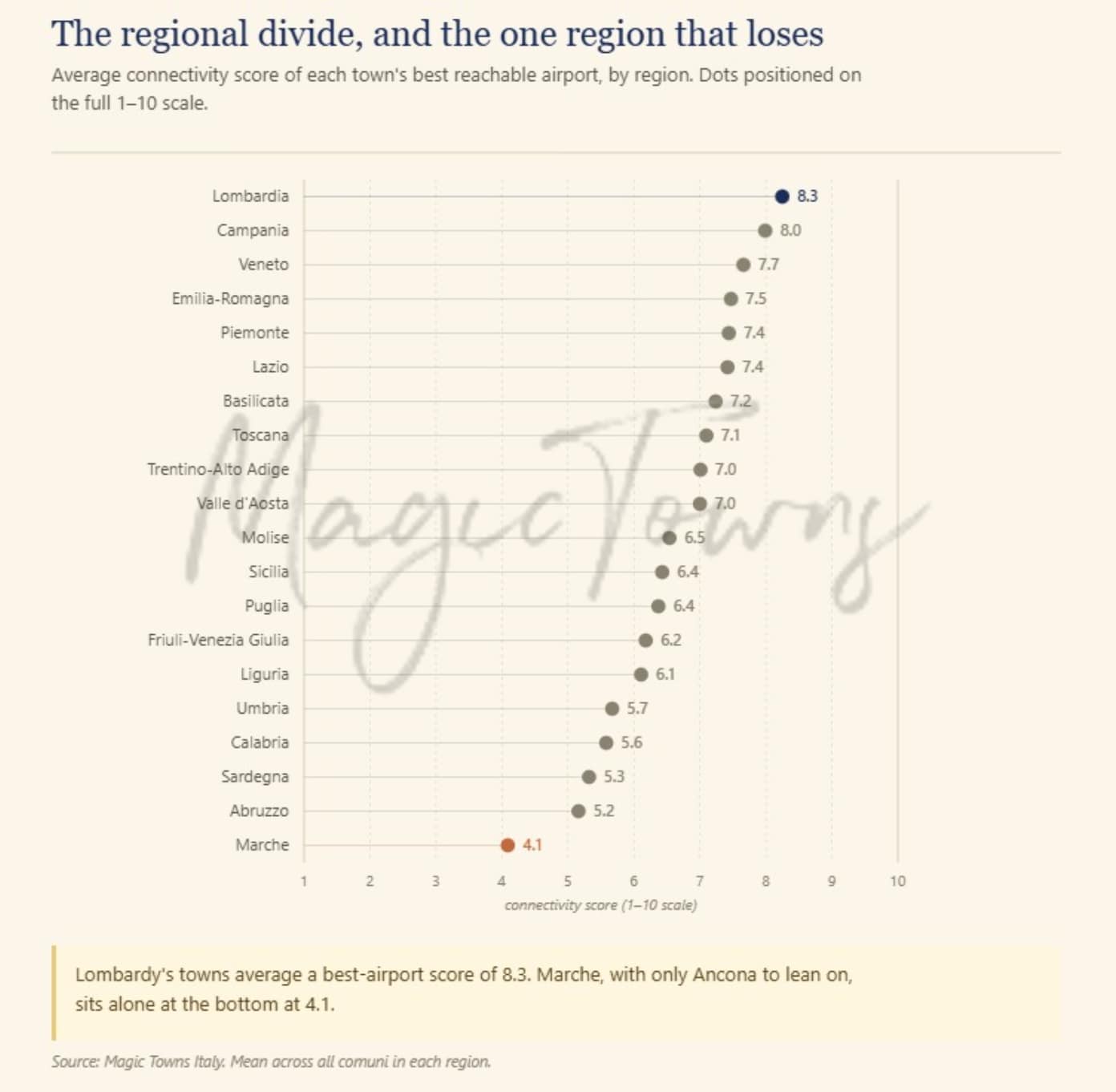
The regional divide, and the one region that loses

Group the towns by region and a familiar geography reappears, though less brutally than with rail. Lombardy sits clear at the top — a typical Lombard town’s best airport scores a 9, thanks to the Milan triangle of Malpensa, Linate and Bergamo. Campania and Emilia-Romagna follow at a median of 8, carried by Naples and Bologna respectively. Most of the rest of the country — Tuscany, Lazio, Piedmont, the Veneto, Umbria, even Sicily — clusters at a perfectly respectable median of 7.

The region that genuinely loses is Le Marche, with a median best-airport score of 4. Ancona is the only airport of consequence, it is small, and the towns of the interior are too far from Bologna or Rome to count them as easy options. If you are drawn to Le Marche — and many people are, for good reasons — go in knowing that air connectivity is the weakest part of the package, and that the train to Bologna will become a familiar ritual. Abruzzo (median 5, leaning on Pescara) and the deep south and islands (Calabria, Sardinia, Puglia all at 6) face softer versions of the same constraint.

Italy's airport
The regional divide, and the one region that loses

What this actually changes

The practical upshot is that “near an airport” is the wrong thing to optimise for. The right questions are sharper. Do you need long-haul, in which case you are choosing between the orbits of Rome and Milan? Do you fly mostly within Europe, in which case a 7-rated regional airport within two hours is plenty and the field opens up enormously? Do you only go in summer, in which case a seasonal 4 might be perfectly fine and frees you to live somewhere the year-round crowd can’t reach?

In the Esploratore della città you can now see, for any town, the three best airports within reach, how far each is by car, what each one scores, and where it actually flies. A town with a nearby 5 and a two-hour 9 is a different place from a town with a nearby 7 and nothing else behind it — and until you can see both, you are guessing.


Methodology: airport scores combine 2025 passenger traffic (Assaeroporti monthly data), year-round destination counts and long-haul reach (derived from published schedules), and a seasonality test based on the ratio of each airport’s quietest to busiest month. Town-to-airport driving times were computed for all 7,895 comuni up to a six-hour ceiling; the Town Explorer shows the three best-scoring airports within reach, promoting a stronger airport ahead of a closer weak one where the difference is meaningful. Scores run 1 (a barely-serviceable airstrip) to 10 (a world-class intercontinental gateway). Rome Fiumicino’s route data was compiled from official airport and schedule sources; all other airports from a full schedule scrape.

È stato utile?

✅ Sì

❌ No


Grazie per il tuo feedback!

Commenti? Domande? Unitevi alla discussione con i nostri autori sulla nostra pagina Facebook.

iscriviti alla nostra newsletter

Scoprire l'Italia? Chiedete a Magic AI.

Partite per la vostra avventura italiana con Magic AI, il cuore innovativo di Magic Towns Italia. La nostra tecnologia AI, integrata con un database completo, fornisce risposte alle vostre domande sulla vita, sulle leggi e sui tesori nascosti dell'Italia.

Grazie a un database curato da professionisti del settore viaggi, traslochi e legale, Magic AI vi offre consigli di esperti senza dover pagare un prezzo elevato.

 
Messaggi recenti
Cancella i filtri
I post più popolari