


In news yet under the general expat radar, but guaranteed to stir up much emotion, Italy is changing its minimum green energy requirements on a range of renovation types. Anyone planning to re-roof a farmhouse this autumn has until 3 August to lodge the paperwork under the old rules. After that, most renovations in Italy must cover a set share of the building’s energy use with renewable energy, and town hall can withhold the permit if they do not.
The reform sounds expensive, and for one particular kind of project it is. For most of our readers, it has silver linings.
The deadline is the day you file, not the day you build
The rules sit in D.Lgs. 9 January 2026 no. 5, which took effect on 4 February and gave the industry 180 days to adjust.
What counts is the date the paperwork reaches the comune, meaning the day a building permit is applied for. Anything filed before 3 August runs under the old regime, whenever the builders eventually turn up (just don’t let the planning permission expire). Anything filed on or after falls under the new quotas.
Why is Italy introducing this now?
First, because Brussels said so. The decree transposes the EU renewable energy directive known as RED III, which Italy was required to implement by 21 May 2025. It missed the deadline, collected an infringement procedure that July and a reasoned opinion in December, and was moving towards referral to the EU Court of Justice by the time the decree appeared in January. This is compliance rather than enthusiasm.
The other reason is that the underlying numbers are difficult to defend.
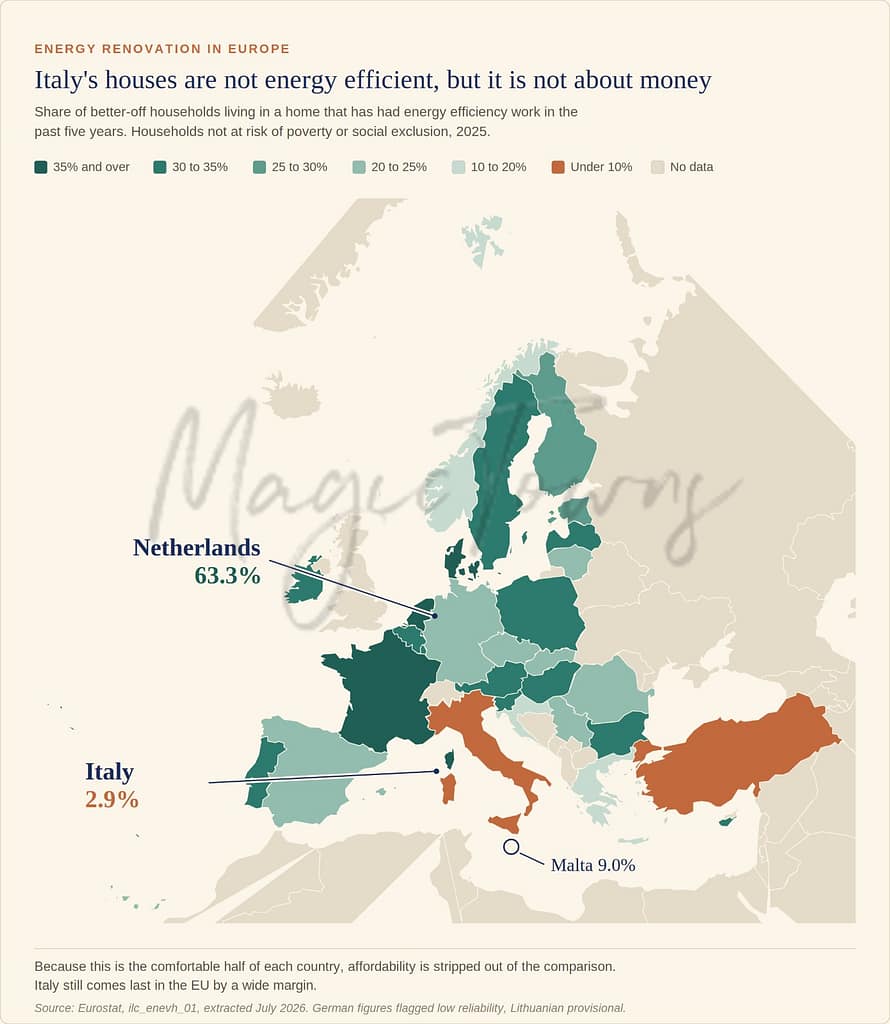
Eurostat asks households across Europe whether their home has had energy efficiency work done in the past five years, and reports the answers by income group. Taking only the comfortable half of each country, which strips affordability out of the comparison (the “Italians cannot afford A/C” – untrue, read below – you keep seeing in Facebook expat groups), Italy comes last in the Union at 2.9%. The EU average for the same group is 25.6%, and the Dutch figure is 63.3%.
Table: Share of households living in a home that had energy efficiency work done in the last five years (Eurostat, 2025)
| Paese | All households | At risk of poverty | Not at risk |
|---|---|---|---|
| Paesi Bassi | 60.5% | 45.3% | 63.3% |
| Danimarca | 34.0% | 22.9% | 36.4% |
| Francia | 33.3% | 26.6% | 35.0% |
| EU-27 | 23.9% | 17.4% | 25.6% |
| Spagna | 18.8% | 13.4% | 20.7% |
| Grecia | 9.5% | 7.9% | 10.1% |
| Malta | 7.8% | 2.9% | 9.0% |
| Italia | 2.6% | 1.5% | 2.9% |
Cooling tells the opposite story. Italian households got through roughly 7.3 TWh of energy on air conditioning in 2024, about a third of the EU total and more than double the 2019 figure. The familiar line that Italians cannot afford air conditioning does not survive contact with the data. They are buying it quickly and installing it in buildings that leak, which is more or less the problem the decree is aimed at.
A note on the Superbonus
Newcomers will hear this word constantly, usually in a tone of some bitterness.
Between 2020 and 2023 Italy reimbursed 110% of the cost of qualifying energy and earthquake work, which is to say rather more than the work cost. The credit could be sold to a bank or set against the builder’s invoice, so many owners paid nothing at all. It ran to well over €100 billion, took building prices with it, and has since been dismantled in stages.
It also reached fewer buildings than the spending suggests, on the order of 500,000 out of a stock of roughly 12 million. That is how Italy can have spent so much and still sit at 2.9%, and it goes some way towards explaining why the state has moved from paying people to renovate to obliging them.
Which renovations trigger the obligation?
The tests turn on how much of the building‘s outside shell you disturb, meaning the walls, roof, windows and ground floor. Neither floor area nor budget comes into it.
| Category | Test | What it looks like |
|---|---|---|
| Major renovation, first level | More than 50% of the outside shell, plus a rebuilt heating system | Full gut of a stone farmhouse: new roof, insulation, new windows, new heating |
| Major renovation, second level | More than 25% of the outside shell | Re-roofing plus new windows on a village house |
| Heating system renovation | Renovation of the heating system | Ripping out an old gas boiler and its pipework |
A re-roof on a compact two-storey house can clear 25% on its own, which surprises people.
Worth settling early: swapping one boiler for something similar is usually treated as a lighter category than renovating the heating system, and that is precisely where the arguments will be had. Ask your termotecnico, the heating engineer who signs off the calculations, to classify the work in writing before the budget is fixed.
How much renewable energy do you have to install?
The share is measured against the building‘s projected energy use rather than its floor area, and where two figures appear, both must be satisfied at once.
| Type of work | Renewable share required | Public buildings |
|---|---|---|
| New build, demolition and rebuild, or extension over 15% of volume or over 500 m³ | 60% of hot water, and 60% of hot water plus heating plus cooling combined | 65% |
| Major renovation, first level | 40% of hot water, and 40% of hot water plus heating plus cooling combined | 45% |
| Major renovation, second level | 15% of heating plus cooling combined | 20% |
| Heating system renovation | 15% of heating plus cooling combined | 20% |
How much solar do you actually need?
Alongside those percentages sits a minimum amount of generating capacity you have to physically install, which in practice means solar panels. The size follows the building’s footprint, the area it covers at ground level.
The arithmetic is friendlier than the decree makes it look. Take the footprint in square metres and divide by 40 for an existing building, o by 20 for a new build.
| Building | Footprint | Minimum solar |
|---|---|---|
| Village house, existing | 60 m² | 1.5 kW |
| Farmhouse, existing | 120 m² | 3 kW |
| Restored barn, existing | 200 m² | 5 kW |
| New build | 100 m² | 5 kW |
For most restored houses that is three to eight panels, which is not the expensive part of the job. Where they are allowed to go is the expensive part.
On a pitched roof the panels must lie flush with the slope or be built into it, following the same angle and orientation, so the discreet flat rack tilted towards the sun is out. On a flat roof they must sit below the parapet, or within 30 cm of the surface where there is no parapet. Solar electricity feeding plain electric heaters does not count towards the quota unless the property is already energy class B or better.
Can you put the panels on the ground instead?
Almost certainly not. This is bound to irk some property owners with land.
Two rules are at work here: under the new renovation regime, ground-mounted panels contribute nothing towards your obligation, which must be met on or in the building or on structures immediately around it.
More broadly, ground-mounted solar has been prohibited outright on land classified as agricultural in the local plan since July 2024, with narrow carve-outs for quarries and closed landfill. Most rural property in Italy carries agricultural zoning, and the test is the zoning rather than whether anyone is farming. The Constitutional Court upheld the ban on 16 July 2026, so the question is now closed. Raised agrivoltaic structures remain permitted, but those are a farming arrangement – if you are not a farmer, this does not apply to you.
What will the renovation reform add to your renovation budget?
Less than you might fear, for most people.
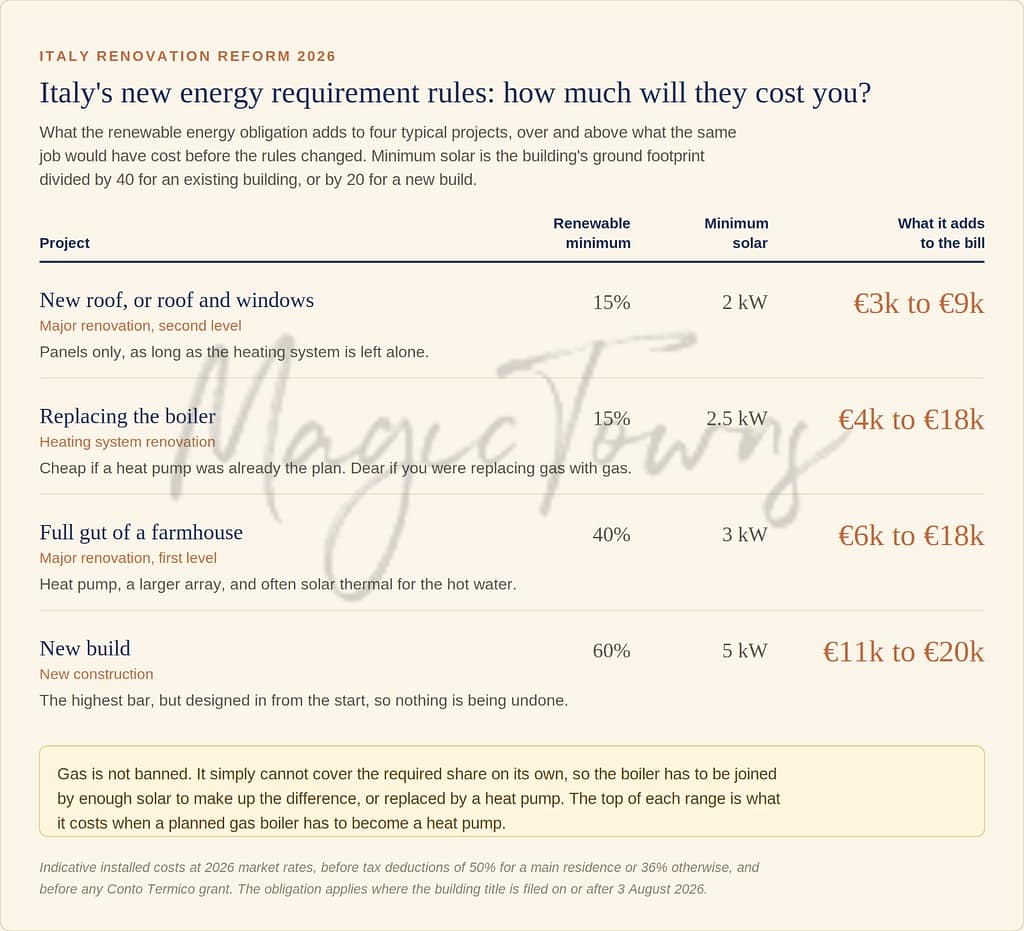
The reason is that a heat pump counts as renewable, since the ambient warmth it draws from the air or ground is itself renewable energy. Anyone who had already resolved to put one in is largely compliant before the first panel goes up. Clearing the 15% requirement bar is therefore very achievable with the heat pump alone, and clearing 40% generally needs the heat pump plus a modest solar panels array.
The bill hits hardest those who intended to keep a gas boiler or install a new one, for whom the decree is less a cost than a decision taken on their behalf.
| Item | Indicative range |
|---|---|
| Rooftop solar, 3 kW | €4,500 to €7,000 |
| Air-to-water heat pump, small house | €10,000 to €18,000 |
| Solar thermal for hot water | €3,000 to €5,000 |
| Extra design work and the technical report | €500 to €1,500 |
The cost that you might overlook is not the heat pump, but the radiators. Those sized for a gas boiler running at 70°C will not warm a room at the gentler temperatures a heat pump produces, so allow for larger ones, or for underfloor heating where the floor is coming up anyway.
What tax credits and grants are available for this in 2026?
Renovation tax credits generally run at 50% for a main residence and 36% otherwise, capped at €96,000 per unit, and the main residence rate is due to fall in 2027. We have covered this in depth elsewhere.
The catch for our readers is that these are deductions against Italian income tax, spread over ten years. A non-resident owner of a second home with little Italian tax to pay will find much of the benefit theoretical. Conto Termico 3.0 behaves quite differently, being a cash grant paid by the GSE, and for private homes it covers the equipment: heat pumps, solar thermal and biomass. Which route suits you is a question of tax position rather than technology, and it is worth settling before the system is chosen.
Who is exempt from the new requirements?
Few. Buildings on an efficient district heating or cooling network that covers the whole demand are outside the regime, as are temporary structures due for removal within 24 months where the permit says so, and certain military buildings.
Beyond that lies the infeasibility route, based on proof that it is not a viable investment: an investment that costs more than the energy it saves now qualifies. It requires lavoro d'ufficio (which, itself, will cost money). The designer has to demonstrate in the technical report why each available option fails, a copy goes to the GSE, and comuni are entitled to audit what they are sent.
Do the rules apply in historic centres?
They do, and for anyone buying in a medieval borgo this is crucial.
The obligation now reaches heritage and landscape-protected property, taking in villas, groups of buildings of traditional character, and historic centres. A vincolo used to amount to something close to an automatic exemption. The designer must now show that renewables would alter the building in a manner incompatible with its character, and only then does the energy target soften instead.
Expect the conversations with the Soprintendenza to run longer, and expect the answer to be: put it on the rear roof slope, the barn, or the courtyard.
Do the rules vary by region?
Only upwards. Regions may raise the minimums and Lombardy has already done so with effect from 1 January 2027, which others will follow. The national figures are a floor, and the whole framework is reviewed at least every five years.
What to do before 3 August 2026
If your application is close to ready, ask whether it can go in this month.
If it is not, stop treating renewables as a decision for later. Have your designer classify the work and run the coverage calculation now, because the roof layout, the radiator sizing and the plant room all follow from the answer.
And if you are still looking, add one question to the viewing list, somewhere between the damp and the neighbours: where on this building can panels legally go? It is worth checking the roof orientation and the zoning before you fall in love with a facade, which is the sort of thing our Town Explorer profiles for more than 1,500 Italian towns are there to help with.
How we did this
Renovation rates come from Eurostat’s survey of energy efficiency improvements in dwellings, 2025 release, using the column for households not at risk of poverty or social exclusion so that affordability is taken out of the comparison. German figures carry a low reliability flag and Lithuanian figures are provisional. Switzerland, the United Kingdom and most of the Western Balkans are not covered. Cooling consumption comes from Eurostat’s disaggregated household energy data.
The obligations are read from Allegato III to D.Lgs. 199/2021 as replaced by D.Lgs. 5/2026. Cost ranges are indicative market rates rather than quotations from any single supplier, and vary widely by region, access and the state of the building.
This is a guide rather than technical or tax advice. You will want to discuss this with a qualified termotecnico ahead of time (possibly, ahead of buying the property).







 English
  French
  German
  Italian
  Danish