

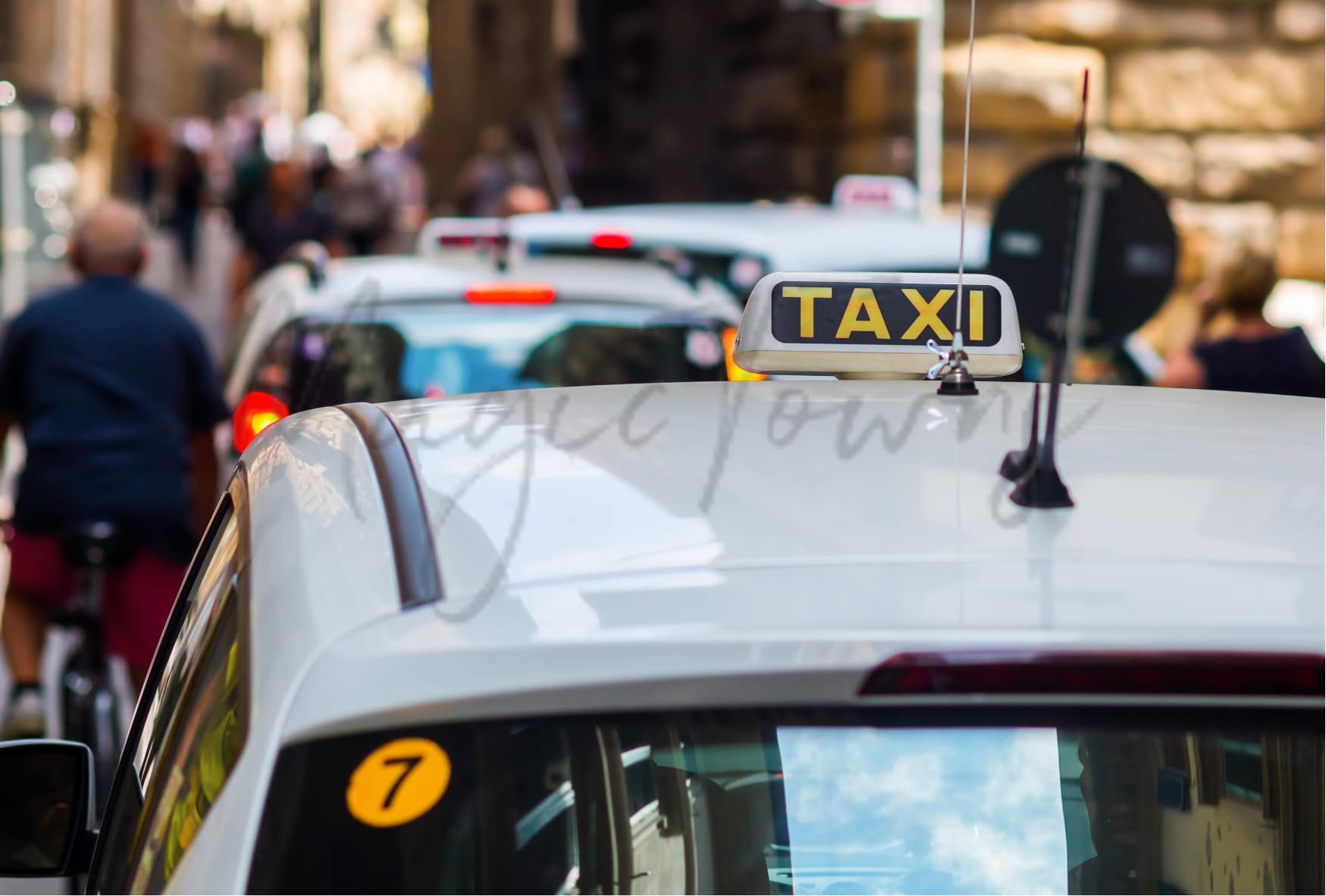
If you’ve spent any time in Italy – or even just read expat forums – you’ve probably come across the complaints. The taxi queues that snake around the block at Rome Termini. The Uber app that opens and then… does almost nothing. The €115 fixed fare from Malpensa to Milan city center that feels like a small robbery. The village you’re staying in where there’s simply no taxi to be found at all. It’s frustrating.
But why does taxi culture in Italy feel so different? In this article, we’ll see why fares are so expensive, why Uber barely exists, what apps to use, and most importantly, how to get yourself from a small town to an airport without losing your mind.
Why Italy Is Like This
In Italy, taxis are not a free market. They’re municipal concessions. Each city decides how many taxi licenses exist, who gets them, and what they cost. And for years – in some cities, for decades – those numbers barely moved.
Rome, for example, had around 7,800 licensed taxis for a city of nearly 3 million people. Paris, with a similar population, has almost three times as many. The last time Rome increased its taxi licenses before 2024 was 2005. Milan‘s last increase before recent reforms was 2003.
Why so few? Because a taxi license in Italy isn’t just a permit – it’s a valuable asset. Licenses have historically changed hands on the secondary market for well into six figures in cities like Rome, Milan, and Bologna – sometimes more. If you paid that much for a license, the last thing you want is more competition on the street. The result? Taxis are scarce, especially in smaller cities and at peak times. And in Rome, around 1.3 million taxi calls go unanswered every single month.
That said, things are slowly changing. Rome issued 1,000 new licenses in September 2024 – the first batch in roughly 20 years. Milan added 450. A lot of it was pushed by big upcoming events: the Jubilee 2025 in Rome and the 2026 Winter Olympics in Milan-Cortina. It’s progress, but not enough to actually fix the problem. So the shortage isn’t going away anytime soon.
And Why Isn’t Uber a Thing Here?
Under Italian law, there are only two types of for-hire transport: licensed taxis and NCC (noleggio con conducente, literally “rental with driver”). Taxis can pick people up on the street and use a meter. NCCs must be pre-booked, must return to their garage between rides, and charge fixed agreed prices.
UberX – the model most people think of when they think “Uber”, with regular people driving their own cars – doesn’t fit either category. Italian courts banned it definitively in 2017, ruling it constituted unfair competition against licensed taxi drivers. The logic was straightforward: Uber was organizing a transportation service without requiring drivers to hold the licenses, insurance, and professional certifications that taxi drivers are required to have.
So where does that leave the Uber app today? In Italy, Uber operates mainly as Uber Black – a premium pre-booked service using licensed NCC drivers. It’s available in cities like Rome and Milan, but it’s more expensive than a regular taxi, often significantly. An Uber from Rome’s Fiumicino airport to the city center through Uber Black can run over €100. A regular licensed taxi on the same route has a fixed fare of €55.
There’s one partial exception: in Rome, Uber has an agreement with the local taxi app itTaxi, so when you open the Uber app in Rome you might be offered a regular licensed taxi alongside the Uber Black option. If that option appears, you’re getting a normal metered taxi at normal rates, with a small app fee added. That’s the closest thing to a standard Uber experience in Italy, and it only works in Rome.
So don’t arrive in Italy counting on Uber to be your main transport option. It either won’t be available, or it’ll be considerably more expensive than just using a local taxi app.
How Italian Taxis Actually Work
Taxi fares in Italy depend on a lot of factors beyond just your destination: where you’re starting from, the day, the time. And unfortunately, there are also plenty of scammers out there, so always ask for the price before getting in.
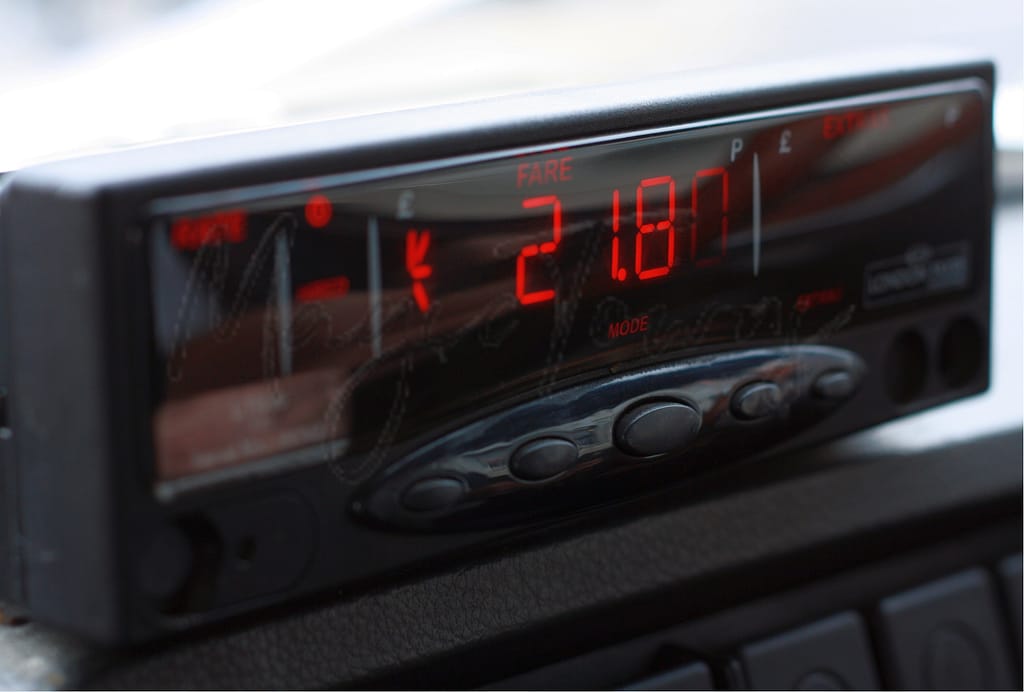
First, each official taxi has a meter (tassametro), which starts running the moment the taxi is dispatched to you, not when you get in. This is important. If you call for a taxi through a radio cooperative or app, the meter starts when the driver leaves to come and pick you up. That’s why sometimes you get in and the meter is already at €3 or €4.
The starting rate also varies by time of day and day of the week. In Rome, for example: weekday daytime starts around €3.50, Sunday and holiday daytime starts around €5, and nights start around €7.50. These higher starting rates exist because night shifts and holidays are simply harder for drivers. Once you understand this, a €15 short trip at midnight makes more sense.
Fixed fares exist for some routes, mainly airport transfers. In Rome, the fixed fare from Fiumicino airport to anywhere inside the Aurelian Walls is €50, and from Ciampino it’s €40. Milan’s Malpensa to Milan Central station has a fixed fare of €114 (yes, it’s a lot, but the airport is 50km from the city). Always confirm you’re getting the fixed fare before the driver starts the meter on these routes.
One more thing on payments: if you didn’t book the taxi through an app, expect to pay cash. Drivers are technically required to accept card payments, but in practice that’s often not the case – and you really don’t want to be stuck in a taxi arguing about it.
The Apps to Know
A lot of people picture the classic New York scene: walk out of your office, stick your hand out, taxi appears. In most Italian cities, that’s definitely not how it works. You either go to a designated taxi stand or you use an app. The main ones are:
- FreeNow works in Rome, Milan, Naples, Turin, and several other cities. It adds a small booking fee on top of the meter fare, but it’s reliable and easy to use if you’re already familiar with it from elsewhere in Europe. I personally always use it, and there are often discount codes floating around.
- itTaxi is the official app of the Italian taxi association, with coverage in about 95 cities including Rome, Milan, and Venice. If you’re in Florence, look for AppTaxi or TaxiMove instead.
- Uber – but as mentioned, in most cities it’s more expensive than a regular taxi, so it’s rarely the best option.
One thing I always tell people coming to Italy: look up the local radio taxi number for wherever you’re staying and save it in your phone. There have been a few times the app just didn’t work when I really needed it, and having that number saved made all the difference. Also, a phone call can actually get you a taxi faster than an app during peak times.one call gets you a taxi faster than waiting for an app booking during peak times.
What About Outside the Big Cities?
Outside the big cities, everything changes. Unless you’re in a well-known tourist town, you’re not going to find a taxi cruising around. You need to plan ahead. In many small towns, there are only one or two licensed drivers covering the whole area – and sometimes none at all after a certain hour. If you’re staying in a rural village in Tuscany, a beach town in Calabria, or somewhere in the Alps, “getting a taxi” might literally mean calling a driver from the nearest larger town and waiting 30–60 minutes.
The closest thing to a rural Uber in Italy is NCC services. A quick Google search for “NCC, your town/province, aeroporto” usually turns up options. Unlike taxis, these are booked in advance – usually by phone or WhatsApp – with a fixed agreed price, and they come to your door. The downside is that prices can be really, really high, especially for long airport transfers. A one-hour ride from a countryside village to a major airport can easily run €100–150 depending on the region and season.
This is part of why, if you’re choosing a place to live in Italy, having a proper train station in town matters so much. And as we wrote in our last article, it’s not just about having one – it’s about checking how many trains run per day and where they go. If you can reach a bigger city with an airport nearby that also runs shuttles (which is usually the case), you’re in a much better spot. By the way, you can check all of this using our Town Explorer and filter across thousands of towns in Italy.
But generally speaking, this is also part of why having a car matters so much in smaller Italian towns.

The Bottom Line
Italy has a lot of room to improve when it comes to taxis. The shortage of drivers, the high prices, the difficulty of finding a ride outside major cities, and the near absence of a real Uber-style alternative can make the whole thing feel unnecessarily complicated – especially if you’re coming from somewhere where on-demand transport is cheap and instant.
The key is adjusting your expectations. In Italy, transport works well when you plan ahead. Rely on trains for long distances, pre-book airport transfers when you need to, and don’t assume there’ll be an Uber available in five minutes. Do that, and you’ll avoid most of the frustration. In a strange way, that’s also part of the Italian experience. Things are often less optimized, less immediate, and sometimes less convenient than what you’re used to. But they usually still work… just on their own terms.









 English
  French
  German
  Italian
  Danish