
Skip to main content Scroll Top

What Italy’s Rail Map Tells You About Where to Live

Explore Italy’s railway network, where access varies greatly across regions. Discover the best-connected towns and navigate the country’s complex rail landscape.

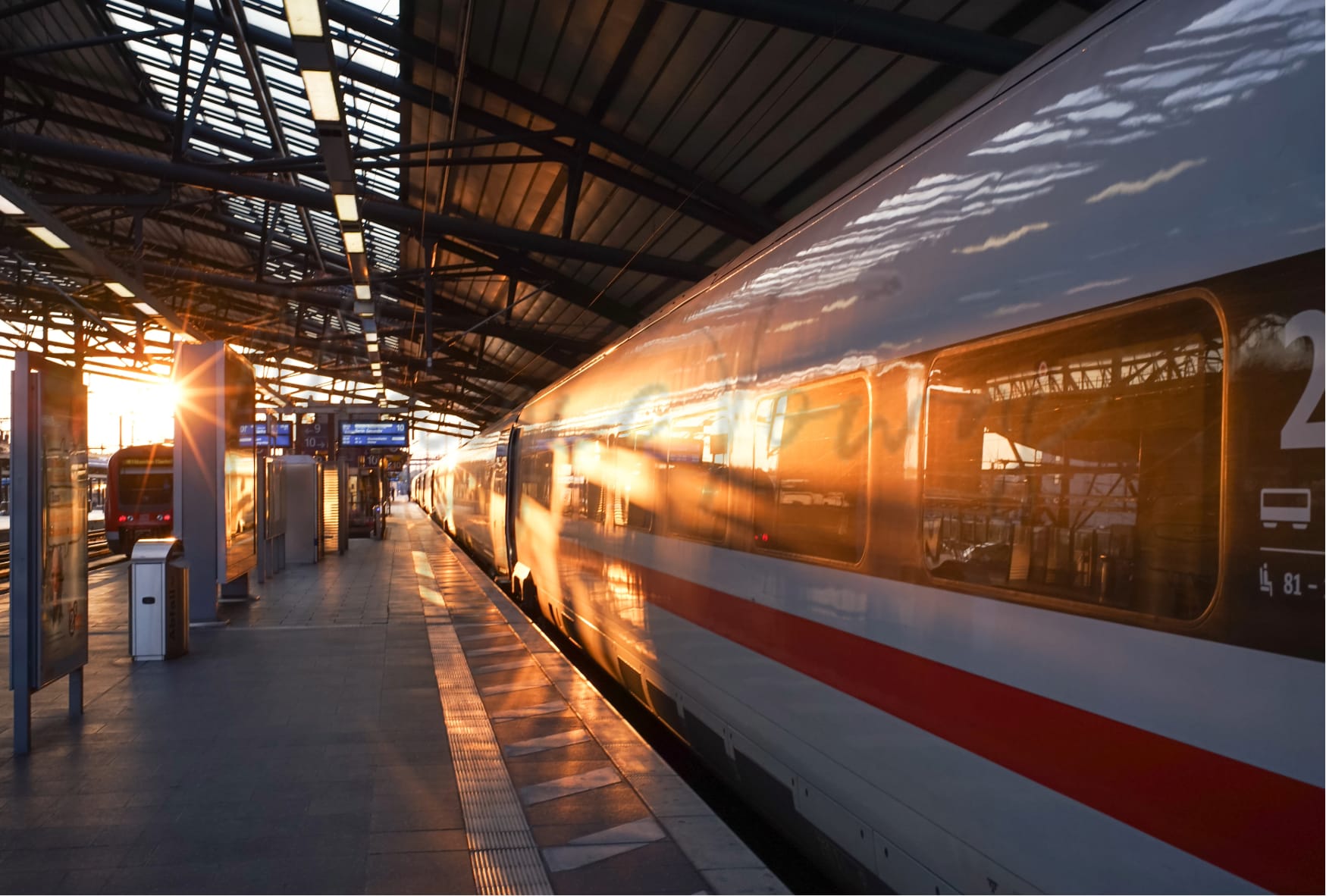
Italy is one of the best European countries in terms of railway availability, and one of the most unevenly served. We mapped every comune against its nearest stations to find out the best connected towns in Italy, and where the picture is more brochure than reality.

If you spend any time in Italy, you build up a mental image of the train network. Frecciarossa from Milano to Roma in three hours. Florence to Bologna in less than an hour. Quiet little stations in Umbrian villages where people read the paper while waiting for the local to Perugia. Most of that image is correct. The trouble is that what is wrong about rail in Italy is what matters most when you are choosing where to live.

We have spent the last few weeks doing for rail what we did earlier for healthcare: we built a comprehensive picture of every Italian comune’s actual access to the train, station by station, drive time by drive time. The result is 7,795 municipalities, 107 provinces, and a country that turns out to be more complex than most people imagine. Coverage is almost universal (fewer than 3% of Italian comuni are more than 45 minutes from any station) but the quality varies enormously. About 40% percent of comuni sit within a ten-minute drive of a station. Only one in fifty has a station within ten minutes that also connects to the wider national network with any speed.

That gap between near and useful is the whole story.

How We Analysed Italy’s Railways, In A Nutshell

Italy’s largest rail operator (RFI) classifies its stations on a scale that runs roughly from major national hubs at the top down through regional capitals, important secondary towns, and so on to small village halts where two or three trains a day stop on a single track. We have further improved that rating to reach a 1–10 connectivity score that runs alongside the drive time to each town’s centre to its nearest stations. For the several hundred stations that sit outside the main Italian network, we based the connectivity score exclusively on frequency and level of service.

Finally, we have made both connectivity scores, descriptions of each station including the main destinations, and driving times, available in the Town Explorer for the many hundreds of towns we cover.

Throughout this piece, when we describe a station as “national hub level” we mean the top tier (Roma Termini, Milano Centrale, Bologna Centrale, and roughly a dozen others); “strong regional” means roughly the next two tiers down, the level at which a town typically has direct trains to several major cities; “local” and “basic local” describe stations served only by regional trains, often hourly at best, sometimes only a handful of times a day.

Italy's rail map
Coverage is wide. Depth is narrow.

Italy Is Connected By Train, But Not Evenly

The headline finding can be put in one sentence: about four in ten Italian comuni have a station within ten minutes of the town centre, but only one in two hundred has a station with easy connection to a true national hub. The vast Italian middle is towns that are close to a small or middling station, Often, that station is the gate to a slow regional service that mostly takes you to the nearest provincial capital and back. Italy invested heavily in regional capillarity in the postwar decades and then built a high-speed spine on top of it from the 1980s onwards. The two layers do not always meet.

For someone choosing where to live, this matters in a specific way. If your idea of Italian life involves taking the train to Florence for a doctor’s appointment, to Milan for a meeting, to Rome for a weekend with friends, you need to know whether the station near your house actually opens the country up or just gets you to the next town over. Those are very different propositions.

Italy's rail map
Italian rail quality by province

The Po Valley Is In Its Own League

The first thing the data makes obvious is that one part of Italy has rail access unparalleled elsewhere in the country. The Po Valley spine – running from Turin through Milan, Brescia, Verona, Padua and on to Venice, with a southern arm through Piacenza, Parma, Modena, Reggio Emilia and Bologna – is the only place in Italy where you can live in a smallish town and reach two or three other major cities by direct, frequent, fast train without a car.

The numbers behind this are stark. Of the 38 Italian comuni that sit within ten minutes of a top-tier national hub station, more than half are in Emilia-Romagna and Veneto. Reggio Emilia, Treviso, Brescia, Piacenza, Bologna, Padova, Parma all place their centroids inside seven minutes of a high-speed stop. This is the only part of Italy where a properly car-free retirement is a serious option without giving up Italian-city access. Veneto’s lifestyle favourites – Bassano del Grappa (which we cover this week in detail), Castelfranco, Conegliano, Cittadella, Vicenza – all sit on the same well-served regional network feeding into that spine.

Italy's rail map
20 regions, ranked by rail

There are several surprises. The Marche region beats Tuscany on connectivity, Lombardy beats Trentino-Alto Adige, Friuli-Venezia Giulia beats Piemonte, and – perhaps most surprising – Liguria leads the country. The Ligurian advantage is the same one the Cinque Terre brochures imply: the coastal mainline runs the entire length of the region, and almost every village from Ventimiglia to La Spezia sits on it. The result is the cleanest “lovely Italian coast plus frequent rail connections” combination in the country. Does this mean that a small town in Liguria is better placed train-wise than Milan? Clearly not. It means that Liguria, as a whole, outperforms in the balance of connectivity and access.

The Puglia Paradox

The South is more layered than the usual North-South stereotypes allow. The headline finding from our dataset is that Puglia has the country’s best rail coverage by walkability, and one of its worst by usefulness. Nearly two-thirds of Puglian comuni sit within ten minutes of a station, the highest share in Italy. But the average Puglian station scores below the national mean. The Ferrovie del Sud Est network is dense and slow. Almost every Salento town has its own halt; few of those halts go anywhere quickly.

Italy's rail map
The Puglia paradox

In practical terms, this means a retiree planning a life in Otranto, Galatina or Tricase should not assume that being close to a station equals being well-connected. For travel north – to Roma, to Bologna, to Milano – the practical departure point is Lecce, or for the upper Salento, Brindisi. Both score at national-hub level. The Puglian template, as we wrote about Lecce and Ostuni in our 7% tax piece, is hub-and-spoke: live within thirty minutes of Lecce or Brindisi and you have functional national rail. Beyond that, you are on a beautifully scenic but practically narrow local network that gets you to the nearest market town and stops.

The same pattern, at lower coverage, applies to Sicily and to coastal Calabria. The coastal mainlines work; the interiors do not. Reggio Calabria, Lamezia, Catania, Palermo, Cagliari, Sassari and Cosenza function as the rail anchors of the South. Move thirty minutes inland from any of them and the score drops sharply.

Italy's rail map
Inside the regions

The provincial view shows what the regional averages hide. Brindisi and Barletta-Andria-Trani both place inside Italy’s top fifteen provinces for rail; Foggia and Taranto sit in the bottom fifteen. Same region, two entirely different rail experiences. The same internal split applies to Emilia-Romagna at the top, where Rimini, Bologna, Forlì-Cesena and Ravenna all rank exceptionally well and Ferrara trails noticeably. Piemonte too: Torino province ranks strongly, but Biella and Vercelli sit near the bottom of the national table. Province matters at least as much as region.

The Italian Lakes: Railways Fast And Slow

We made the same observation about Italian healthcare last month: the lifestyle brand of a place and the underlying public service it delivers often diverge sharply. Lake Como was the cleanest example then, and it repeats here.

Italy's rail map
The lakes

Como the city has excellent rail access – the suburban belt down to Milan operates at near-metro frequency. The romantic middle and northern lake, however, where most foreign buyers actually fantasise about living, is car country. Bellagio is over twenty minutes from any station. Tremezzina, Argegno, Menaggio, Dongo, Gravedona – the postcard towns – all sit between twenty and forty minutes from a useful train. The famous lake is two lakes, and only the southern one runs on rails.

Lake Garda repeats the pattern more sharply. The south shore – Sirmione, Desenzano, Peschiera, Lazise – sits on the Milan-Venice mainline, with Frecciarossa stops and trains every fifteen minutes. The west shore (Salò, Gardone Riviera, Limone, Gargnano) and the north (Riva del Garda, Malcesine) average over half an hour to any rail. The eastern (Veronese) shore is in between.

The under-discussed lake winner is Iseo. The entire perimeter (Iseo, Sulzano, Sale Marasino, Lovere, Pisogne) sits on a single Trenord regional line connecting to Brescia. Every town on the lake has rail; every station scores in the upper tier. It is the only major Italian lake where you can move along the whole shoreline by train.

Around Rome: Picking The Best Train Lines

The same brand-versus-data mismatch surfaces around Rome. The Castelli Romani – Frascati, Grottaferrata, Albano, Ariccia, Velletri, Nemi – are the classic Roman commuter lifestyle towns, famous for wine and weekend trips. Their rail experience is more layered than the brand suggests, and the layering favours places most readers have not heard of.

Italy's rail map
Castelli Romani

All three of the famous wine-country branches (Frascati, Albano Laziale, and Velletri) share a single regional designation, the FL4. The line splits three ways at Ciampino, and each branch runs an hourly clock-face service with rush-hour additions. Frascati is the shortest of the three branches, terminating at Frascati itself, with the fastest direct run to Termini at about thirty minutes; Albano and Velletri sit deeper down their branches and run closer to forty-five and fifty minutes respectively.

The interesting comparison is not within the FL4 but with the neighbouring FL6 – the Roma–Cassino mainline, which runs at twice the frequency of any FL4 branch and reaches Rome in less than half an hour. Two Castelli sit on it: Zagarolo and Colonna. Neither is a wine-tourism name; we should nickname them the railway Castelli. For a retiree who plans to do without a car, the difference between an FL4 branch and the FL6 mainline is the difference between an hourly service to Rome and a service that rarely makes you check the timetable. The Town Explorer pages for each of these places carry the specific drive time and connectivity score, so the comparison is visible at the comune level.

The Borghi And The Rail Trade-Off

The single biggest geographical pattern in the data is the Apennine spine running down the centre of Italy. Train planners in the 1800s, and every government since, routed around the Apennines rather than through them. The result is that the most photographed Italian villages are systematically excluded from useful rail.

Italy's rail map
The borghi

Pitigliano in the Tuscan Maremma sits nearly fifty minutes from a useful station. Volterra is over half an hour. Sorano, Pienza, the Chianti core villages (Greve, Radda, Gaiole), the Crete Senesi: all between half an hour and an hour from any rail, and the rail in question is small-station regional service at best.

The Abruzzo mountain villages are more extreme still. Santo Stefano di Sessanio, the famous albergo-diffuso restoration project near the Gran Sasso, is over half an hour from a small station with minimal service. Pescasseroli, the gateway to the Parco Nazionale d’Abruzzo, is nearly forty minutes from any train. Calascio with its famous rocca is similar. The albergo-diffuso lifestyle and rail-based living are, in Abruzzo, mutually exclusive.

Inland Basilicata is the most extreme part of the country for rail. Aliano – where Carlo Levi was exiled in 1935 and wrote Cristo si è fermato a Eboli – gets a second, unfortunate mention two weeks in a row, after showing up in our healthcare overview last week. The town sits forty minutes from a small coastal station. Castelmezzano and Pietrapertosa, the Dolomiti Lucane villages, both sit twenty to thirty-six minutes from one of the country’s lowest-scored regional stops. These are towns of extraordinary cultural value. They are not towns for a car-free life.

Sardinia is the broadest version of the same problem. Coastal cities work: Cagliari, Sassari, Oristano all have functioning stations near their centres. The interior, including Nuoro itself and the entire Barbagia and Gallura, sits on a narrow-gauge tourist line and a thin set of regional services. The Sardinian interior has Italy’s lowest provincial composite anywhere: Nuoro province scores 4.40 against a national leader (Livorno) at 7.64.n there expectations should be set against Calabria rather than against the Po Valley.

The Elite Thirty-Eight

At the opposite end of the distribution sit thirty-eight Italian municipalities whose nearest station is a true high-speed national hub: a Frecciarossa or Italo stop, a major InterCity terminal. Of those thirty-eight, only thirteen lie within a ten-minute drive of the hub itself; the rest sit out in the hub’s commuter belt, between ten minutes and an hour away. But all thirty-eight share the same kind of station as their nearest. The list is small enough to print in full.

Half of these are in Emilia-Romagna and Veneto, on the Po Valley high-speed spine: Reggio nell’Emilia, Bologna, Brescia, Piacenza, Padova, Treviso, Parma, Rimini’s catchment via Ravenna and Forlì-Cesena. The Tyrrhenian and Adriatic coasts add Pesaro, Brindisi, Lecce, Salerno, Pisa, Livorno. Milano, Roma, Firenze, Torino and Napoli appear too. A handful of larger central cities (Modena, Verona, Bergamo, Vicenza) score 9 rather than 10, just short of the very best, but offering very strong intercity service in their own right.

For a retiree or remote worker who wants Italian life and the ability to be in Milan, Florence or Rome by lunchtime, the Po Valley spine is where to look. It is also, perhaps not coincidentally, part of the best-scoring Italy in our healthcare analysis.

What This Means For Choosing A Town

Five practical patterns emerged from the data:

  1. If you plan to live without a car, stay on the high-speed spine. Reggio Emilia, Bologna, Brescia, Piacenza, Parma, Padova, Treviso, Pesaro, Salerno, Brindisi. These cities give you both walkability inside and direct national reach outside.
  2. Lake life and rail life are not the same thing. The famous shorelines of Como, Garda and Maggiore are car-dependent in their most romantic stretches. The under-marketed alternatives are the southern shores (Sirmione, Desenzano, Como city, Lecco, Arona, Stresa) and Lake Iseo across its entire perimeter.
  3. The borghi-and-rail trade-off is real. The most photogenic Italian villages are the country’s rail periphery by definition. The geography that makes them stunning is the geography that excluded them from the rail network. If you insist on borgo life, look for villages within twenty-five minutes of a real station: Cortona, Bassano del Grappa, Asolo, Spello, Anghiari, Sansepolcro, Montalcino via Buonconvento.
  4. Don’t pick the Roman Castelli on brand alone. The faster connection to Rome runs east on the FL6 mainline, which is twice as frequent and serves the under-marketed Zagarolo and Colonna in twenty to twenty-five minutes.
  5. The South works as a hub-and-spoke system. Lecce, Brindisi, Bari, Salerno, Catania, Cagliari are the only practical departure points for travel out of their respective regions. Living within thirty minutes of one of these is the southern-Italy formula for keeping a car-light life viable; living farther in is a commitment to driving.

Methodology Note

The dataset behind this article covers all 7,795 Italian comuni and was built from the Italian rail operator’s station classifications, drive-time matrices, and operational status as of early 2026. Each town’s nearest three stations, drive times, and connectivity scores are published in the Magic Towns Italy Town Explorer. Over 1,500 of our most-requested town profiles now carry specific rail proximity and connectivity ratings, alongside the healthcare, schools, services and lifestyle indicators we have been building over the past year.

A few editorial caveats worth knowing. A major intercity stop scores higher than a small regional halt. It is a proxy for service quality, not a frequency measure: the underlying Italian timetabling data is patchy and the score should be read as “this is the kind of station you are near”, not “this many trains run per hour”. Second, we measure the rail network only, not the private long-distance bus operators (Itabus, Flixbus) that increasingly substitute for rail on certain southern axes. Third, the very smallest comuni occasionally sit close to a station that scores higher than the rest of the line warrants, because of a high-speed stop landing in an otherwise quiet area; the data flags these.

The Italian rail experience is wider than people realise, and narrower than the brand suggests. Choose accordingly.


Sources: Magic Towns Italy rail dataset, 7,795 Italian municipalities classified against RFI station tiering and Maptitude-modelled drive-time data. Composite score = mean station connectivity score (0–10) of each comune’s nearest station + share of comuni with a station within ten minutes’ drive (0–1). All charts use the same underlying dataset. Province geometry: openpolis. GIS analysis based on HERE Maps, 2023.

Was this helpful?

✅ Yes

❌ No


Thanks for your feedback!

Comments? Questions? Join the discussion with our authors on our Facebook page.

subscribe to our newsletter

Discovering Italy? Ask Magic AI.

Embark on your Italian adventure with Magic AI, the innovative heart of Magic Towns Italy. Our AI technology, integrated with a comprehensive database, provides answers to your queries about life, legalities, and the hidden treasures of Italy.

Powered by a database curated by travel, relocation and legal pros, Magic AI gives you expert advice without the premium price tag.

 
Recent Posts
Clear Filters
Most Popular Posts