


Speaker: It’s Saturday morning in Italy, and you’re listening to the Magic Towns Italy podcast.
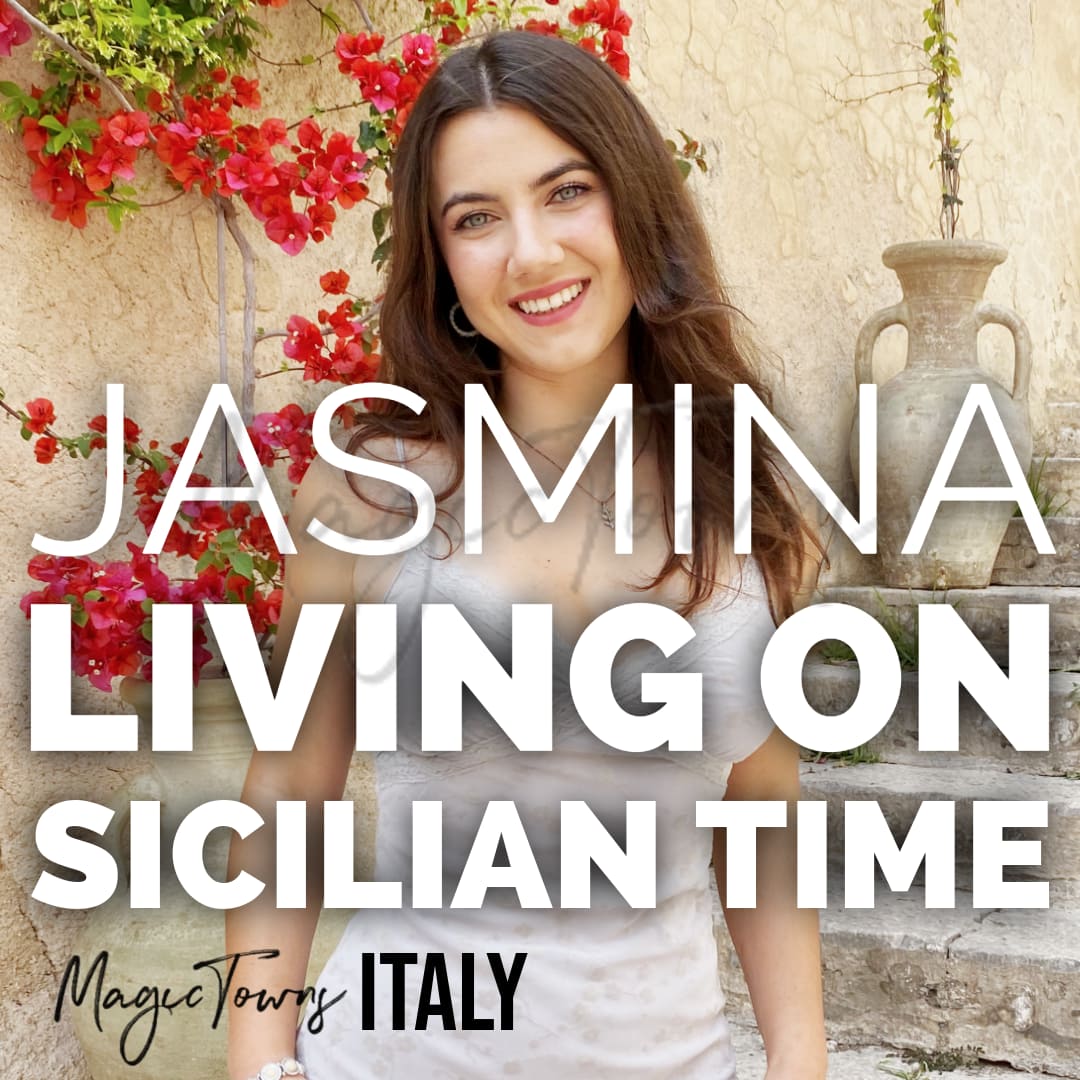
Anna: Happy Saturday, everyone, and welcome back to The Magic Towns Italy podcast! This week we have a special guest, Jasmina Wanders. She’s just 24, from the UK, and at some point decided to pack up her life and move to Italy – first to Mantua to study architecture, and now to Noto in Sicily, where she works as an architect and shares her journey online along the way.
I’m 24 as well, and I really think Jasmina is a great example of what our generation is about. This kind of, you know, revolution we are going through, the new values shaping the choices we make. So in this episode, she tells us how it all started, what pushed her to leave everything behind, what it took to find work in southern Italy, and how things are going for her now. So yeah, enjoy the conversation.
Anna: [00:01:00] Hi Jasmina!
Jasmina: Hello, nice to meet you.
Anna: You know, what drew my attention is that you completely changed your life at such a young age, and also you basically started a new career there in Sicily. So how was the process? Like, tell me a bit about your story. Who was Jasmina before Italy?
Jasmina: So I first moved to Italy, in North Italy to Mantova because I moved there to study my master’s degree there, at the Politecnico di Mailand. And well, I’ve always dreamed of Italy. I’ve been on many holidays with my family, and I always loved it. I felt happiest there, but I never thought it would be a possibility, largely because of the stereotypes with Italy, thinking, you know, it’s difficult to make such a big move. I didn’t dream of a possibility of that. But I did an Erasmus exchange in Paris, when I was 20 years old, so during my bachelor’s degree from England. And there I met lots of international students. It was my first time living abroad. I gained a lot of confidence during that experience. I had a lot of self-development in that [00:02:00] time, and I think I realized my own capabilities in that period and what I could do if I dreamed big enough.
And also, I met students from Italy who were there, and so I heard from them about their university, and it started giving me these ideas of links of how I could make this life possible for myself. So when I was graduating from my bachelor’s, I applied for my master’s, and I got accepted, and so I moved to Mantova, because my course was specialized in historic architecture renovation, and the campus was there. So I lived there for two years, and yeah, it was also an experiment for me because everyone always says, “Oh, Italy on holiday is different to the reality of living there. It’s not the same. It’s over-romanticized.” But after those two years, I loved it more than ever, so I knew I wanted to stay, but I didn’t know where. So I was very open-minded and thought, where I find work, that’s where I’ll go. And I just sent my architecture portfolio all across the country. And in the end, yeah, I got accepted in a studio in Sicily, which even that is very strange because that’s the stereotype within Italy of there not being work. [00:03:00] So in the end, that’s where I got accepted by a studio where I felt most connected to the people, ’cause we did interviews, and I just liked their way of thinking, working the best their projects, and the lifestyle. So everything came together. And yeah, I moved here nine months ago, so I’ve not been in Sicily for that long.
Anna: Nine months ago? Wow.
Jasmina: Ja, ja.
Anna: You’re still in your new adventure, basically.
Jasmina: Exactly. So it was two years in Mantova, and now nine months here, so almost three years in Italy in total. Wow. It’s quite long.
Anna: Yeah. Wow. I completely agree with you because I did an Erasmus exchange in Lyon, in France, and I had the same exact feeling. I don’t know why, but when you’re abroad and you do such an experience, you realize that, yeah, you’re capable of doing whatever you want because you’re already doing something big. Moving to a new city takes a lot of courage, having to make new friends, settle into a new university, I mean, it’s a lot. But it’s nice because it gives you a chance to discover a new side of yourself.
Jasmina: Yeah, [00:04:00] I think when you’re put outside of your comfort zone and you’re in a place where you have no prior connections, nothing to bias who you are, you really rediscover yourself. It’s the first time you are alone, and who you are in that moment is who you are. It’s not based on your school or based on your friends or based on whatever connections you have in your hometown growing up. So you have the space to grow and move forward, which you wouldn’t have otherwise considered. Also, like, the taste for adventure and speaking a foreign language and those things I love in my life and I wanted to continue having, so…
Anna: I saw some videos of you speaking French and Italian as well. How many languages do you speak?
Jasmina: So French, Italian, Polish, because I’m half Polish. Half Polish. And I’m learning Spanish, a bit of Spanish, but not much.
Anna: And did you move here knowing the language or without?
Jasmina: Well, during COVID I had started learning Italian because of the free time, and I was thinking far in the future maybe one day I’d be able to move, but with Duolingo. So my knowledge was very beginner level. I could understand quite a lot because to learn in my own free time in England as a hobby, I would follow [00:05:00] Italian recipes, listen to Italian music. I started watching some TV series and things. So it’s like, my understanding was okay, but my communication was awful. But I think those two years studying… Well, the degree itself, I should clarify, was in English, because lots of universities in Italy offer university degrees in English to attract an international range of students. But living there allowed me to pick it up gradually. When you go to the shops or making Italian friends and things like that, slowly, slowly it soaks in. So it was useful to have that time to learn without pressure so that by the time I wanted to actually start my life in Italian, let’s say moving here, working in an office where everyone speaks Italian, like, I was ready by that point. So yeah, I had those two years to learn.
Anna: No, no, but I absolutely agree. I mean, you learn by doing, by talking. And also I think that Italians in this sense are pretty open. Like, you can talk to anyone and they’ll be happy to talk with you.
Jasmina: I think, yeah, Italians are very, very happy when someone makes an effort to speak Italian. If you, even if you don’t know much, they’re just… It’s [00:06:00] rarer for foreigners to learn Italian. I think that’s why. So if there’s someone who’s choosing to and making the effort, they’re always very happy and encouraging. So it’s nice.
Anna: And how was your experience in Mantova in the north of Italy compared to Sicily?
Jasmina: It’s funny ’cause I left England thinking, “Oh, I’m leaving behind the rain and the cold,” and I arrive in north Italy to the foggiest part of Italy, because Mantova is in the Pianura Padana, which is a very flat plain between two mountain ranges. So all through the winter it’s foggy and cold and humid, and it was interesting. So even just the weather, in the south obviously much better, sunnier. I thrive in hot weather, so I am happy here.
And again, interestingly, ’cause moving from England to north Italy, I felt like Italians are much friendlier, opener, warmer than English people. I’m not saying English people aren’t kind, they’re very kind, but they keep themselves to themselves more. They’re more reserved. There’s more distance. I find it harder to make connections. In Italy, people, in the street you pass someone, they start a conversation. It’s a lot more, I don’t know, feeling of community, [00:07:00] and that’s even more extreme in the south. So it’s like a scale where the further south you go, the more open people are. So I think, yeah, just, the openness of people, the community, the attitude that’s more laid back here. For example, opening times, here everything closes for three hours in the middle of the day. The whole rhythm of life is different that I’m not used to. I arrived and I wanted to go to the supermarket and it was always closed. So things like that, that you get used to with time.
Anna: And how difficult was to start working professionally in Italy? Like, I don’t know if you noticed some differences compared to the UK, for example.
Jasmina: I would say here coming to work I feel like I’m coming to hang out with my family or friends. In England it’s very much you clock in, it’s very strict and professional, and people, like, might make some small talk, but you never build real connections with people that… obviously I can only talk from my personal experience, ’cause whenever I talk about this people start to get annoyed and say, “Oh, it’s not like this, it’s not like that.”
Anna: Oh, yeah.
Jasmina: In [00:08:00] general from my experience. In England it was like that. It was, much stricter, less flexible in terms of, like, the rules are the rules and they always apply. Here, obviously we have our hours, but if you come a bit later or you need to leave to do something important, I don’t know. For example, I’ve recently moved and I need to go to sort out my Wi-Fi, sort out some things, I’m allowed to leave work if I need to and do what I want because they have more respect for the balance between personal life and work life, and they don’t want you to get stressed or suffer because you have to be there. It’s like as long as you get the work done when it’s needs to be done, it’s fine. And we’re always chatting. We have music on in the office and we know all about each other’s personal lives. It’s much, I don’t know, especially for someone who lives here without family, I moved here alone, I didn’t know anyone in the town. It’s very important for me to come and feel like I have people who look after me and care for me, and it makes a big difference to me feeling at home here, and I appreciate that about life here.
And the coffee breaks as well compared to England. In England, okay, maybe [00:09:00] sometimes they go make a cup of tea, bring it to the desk. Here, in the morning and in the afternoon we have a coffee break where we physically leave the office and go to the bar. Now that it’s summer it’s more of a gelato break, which is also great. And granita as well. Maybe not great for the bikini body, but great for… Yeah. Yeah.
Anna: Gelato and granita, Sicily is the paradise for all these kind of things. And from a bureaucratic point of view, what was the process like for you? Which visa did you apply for?
Jasmina: So since I came initially to study, I came with a study visa, the student one, which when you arrive in Italy, you don’t need a visa anymore. You convert it into a residence permit, permesso di soggiorno, and then that needs to be renewed regularly. So I came with the student visa, got the student residence permit, and that’s renewed every year. Currently, because I am just starting to work after graduating, I have an internship contract, so I’m still doing that with my student permit, because when you graduate architecture, you still need to take a state exam to be able to [00:10:00] be a practicing architect to sign projects myself and able to work freely. So I’m yet to take that exam. But I’m in the process of converting my student permit to a work permit. So it’s possible once you arrive and have the student permesso di soggiorno to go through a conversion process, which has several stages. So I’ve sent my documents through the immigration portal online, and I need to wait to receive the nulla osta. And when I get that, I can then apply normally at the questura. And then once I get the work residence permit, then as I understand, I’m not the most informed person on these. Always confusing. But once I get that, that’s renewed every five years as opposed to the student one, which is every year. So it’s something that lasts longer. So I’m in the process of doing all of this, and fingers crossed it all goes well, because after Brexit, it’s not easy for me to be here.
Anna: Absolutely. I mean, there’s already plenty of stuff that you’re doing. You moved to another country. You started a new work. I imagine that also finding an apartment, all these kind of things must, have [00:11:00] been pretty tough. So one thing at a time.
Jasmina: Yeah, yeah. I mean, I have to convert it soon because it needs to be converted before the student permit expires. My student permit expires in August, so I have, like, a deadline now that’s stressful and I need to get it done. Oh. So I’m in the first stage waiting for the reply. So it’s, like, in process, and it’s something that stresses me out. But I think living in Italy, you learn that sometimes you just have to let go because there’s a lot of things in the bureaucracy that you can’t control, and you just have to wait and hope. And things always seem to work out, so just, yeah.
Anna: I think it’s about waiting and asking a lot of the time, like, the same questions to the same people because sometimes they forget.
Jasmina: And it’s one of those things that seems very overwhelming and is overwhelming when you go through it, but you just have to think one step at a time, one document at a time even in the process. ‘Cause I had to pull together so many different documents to make the application, and each one seems impossible when you think of the big picture. Yeah. But just thinking one at a time, taking it step by step, then eventually you get through it [00:12:00] and it’s okay.
Anna: Yes. And how did you find your apartment in Noto?
Jasmina: I’m very lucky in the sense that my apartment here is provided in my work contract. So my boss sorted it out for me, which is a big lifesaver, because in Noto, in recent years it’s changed a lot. It used to be very quiet, empty. Property prices were very low, but there’s been a boom in tourism. It’s becoming very elegant. Even this year there are several palaces that are being, renovated to be turned into luxury hotels. So it’s going through a really big economic shift, especially because of the foreign market that’s been attracted here for the low prices. So now property prices have just risen up dramatically because of the international investment. All of the apartments now are becoming holiday homes, holiday apartments, Airbnbs. And so to find a long-term rental apartment is very difficult, because obviously for the locals it makes sense. They earn a lot more money charging, tourists for short-term rentals as opposed to long-term rentals. So I’m lucky that I didn’t have to look and I got it through [00:13:00] work.
Anna: Yeah, especially now that Noto is one of the towns in Italy where retirees can pay just 7% in taxes, so I imagine there are more and more people interested in buying property there. And what’s the cost of living like there?
Jasmina: For me, Noto is still cheaper than, well, definitely than England, and also compared to North Italy, but the people here say it is more expensive. And compared to other towns in Sicily it is, ’cause if you travel even to just Avola, which is a, don’t know, 15-minute drive away, already you can see a difference in small things like the coffee price, granita price, things like that, supermarkets. So here it is slightly higher, but in general, considering my salary is quite low. Yeah. I still live very comfortably, and I would say the quality of life you get with value for money is very high compared to how I would be living in the UK.
Anna: And you said that you applied for many jobs, waiting for your perfect match, let’s say. What do you like the most about Noto? As an architect as well, what fascinates you [00:14:00] most of all Sicilian architecture?
Jasmina: In terms of the architecture, I feel very inspired by the cultural context, the richness and the history of Sicily because it’s gone through so many occupations. So it’s been under Norman, Arab, ancient Greek, Spanish rule, obviously Italian as well. So there’s all of these different cultural influences, each place with its own architecture. That means when you look at Sicily, it’s like you can read through walking the street how it’s been influenced over time. And for me, that’s really fascinating because a big inspiration for me as an architect is what I see in my travels, going around Europe, around the world, and seeing different styles and how they link to people, how connection between places and people and how you can read that in the physical buildings. And so here you see that everywhere. In Palermo, there’s a lot of Arab architecture, Norman architecture. In fact, there’s a specific Arab-Norman fusion style that’s recognized. It’s, by UNESCO as being very unique, that doesn’t exist anywhere else. Or here in Noto, it’s a very baroque town that has influence from the 17th to 18th [00:15:00] century architects who built after the earthquake and reconstructed the city, but also inspiration from the Spanish rule and their ornamentation. So I like the richness and diversity and how the island is shaped by the people here through the centuries. It’s a mix of everything. And for me as well, because I was born and raised in England, but my mom is Polish and my dad is Albanian, so I don’t see myself as having one cultural identity or being one specific thing. And in a very abstract way, I relate to the island, so I like to see that reflected in the place as well. So I feel connected to it in that way.
Anna: I didn’t ask you where you’re from in the UK.
Jasmina: Even this is complicated because I’ve lived in several different towns in my life. So first in Luton, which, is not a very special town. It’s mainly known for the airport. Then I grew up, in secondary school in Leigh-on-Sea, which is quite close to London. And then the last four years I lived in England was in Bath, which was my favorite town out of all of them because it’s also very historic, and it was a beautiful place for me to start studying architecture, [00:16:00] and yeah, I loved, I loved living there.
Anna: And what brought you to Italy to continue your path in architecture? Like, what were you expecting before coming here, if there was something specific? I don’t know.
Jasmina: I think, yeah, I was looking for a lifestyle that when I was in England, I was never satisfied with my life. I was always… I survived through escapism. Like, I would get through what I had to do, whether it was work or studies or day-to-day life, by dreaming of something else, whether it was, like, a trip that I had, and I would plan it and research it and be constantly living outside of my current reality because I was never satisfied. It was like I was just waiting all the time, but I didn’t know what for. And when I came here, I was looking for a life doing things that I… like, here I can go to the sea on the weekend with my friends, to the beach. The weather allows for a second sunbathe in my… I have three-hour lunch breaks, and I go for walks, and I go and sunbathe. And like I said, people here are very relaxed, so we go out for coffee, and it’s slow, and it’s just living in the moment a lot more. I don’t [00:17:00] survive by daydreaming anymore. I survive in the moment. I’m doing things I like.
The sense of community here is also something I was looking for. In England, it’s rare to even know your neighbors, from my experience. So, like, there’s this lack of feeling connected to other people, and I never felt like I belonged. Here, I’ve been living here for nine months and have more friends than I ever did at living anywhere else. I know so many people. I can’t… I don’t even have the time to see all of the friends that I’ve made. Yes. Keep up all of the social connections.
Anna: Yeah, full social calendar.
Jasmina: Yeah, exactly. So it’s just I feel like people, I don’t know, make more of an effort to make you feel welcome, and there are genuine connections that you build very quickly with people. It feels more human. I think I was looking for that. I’m trying to find a way to express myself well. It’s hard to describe in words. It’s just a feeling you have when you’re here that it’s human, and things are raw and not always polished and perfect.
Sicily is a very chaotic, raw country. It’s not… people complain about the mess and the dirtiness. I think it’s a side to the island that comes from its realness, and that’s something that I enjoy [00:18:00] here. Like I said, my salary’s lower than it would be in the UK, yet I feel more satisfied because I’m not living to buy 10 Chanel bags. I’m living to have the experiences day to day that I have here. The landscape is beautiful. It’s a different way of living that’s more about quality of life and having good food, good company, enjoying being outside, outdoors, free experiences, going to the mountains, the sea, than looking to just make money to be able to travel somewhere else.
Anna: Yeah. I think this is something really important that’s changing, like a kind of revolution our generation in particular is going through. That in the end, the thing that matters most in life beyond everything, you know, beyond all those routines they drill into us, is that you are truly living your life, having experiences that enrich you, because that’s the reason we are here in this world. And when you said you stopped daydreaming and started living in the present, it means you are definitely in the right place for you in this [00:19:00] moment. So yeah, what’s better than that feeling?
Jasmina: Yes, for sure. Which actually is something I didn’t really think about until now saying it, that I’m kind of talking through my thoughts and realizing them as I’m saying them there. Yeah.
Anna: And, given that we mentioned social media, when did you start talking to social media, when did you feel the urge to express yourself, and talk about your journey in Italy?
Jasmina: This is kind of an interesting topic because I started when I did my Erasmus in Paris many years ago, but with YouTube. So I started vlogging because this was at the very end of COVID, so travel was limited. You needed to have a health pass and we were wearing masks. So I, during my six months in Paris, was not able to go home, see my family, and I was basically making video diaries that I put on YouTube for my friends and family to see, also for myself to remember the experience. But it was more of a personal thing. I wasn’t thinking of an audience as such at that time. And I had the Instagram account connected to it that was at the time a photography account that when I traveled, went on holiday, did things, I [00:20:00] would, I love taking pictures, I always have. And so I’d just put some photos on there. But again, it wasn’t really thinking of sharing a specific story or growth or building community. It was just me putting things somewhere. And then, and then when I moved to Mantova to do my master’s, I just stopped doing it because there was so much happening in my life that I put it to a side. I didn’t have time, and I didn’t really think or feel the need to do it, so it was something that was on pause. And then I moved to Sicily very, very end of August, and in September I was living my life, sharing things to my private Instagram account and showing my close friends my life here, and they were saying, “Oh, you should start sharing it with more people again because you’re doing so many fun things, it’s so beautiful, and you have so much that people would be interested to see.”
And so that’s when in October, I revived my Instagram account. I refreshed it, got rid of all my old stuff and was like, “Okay, now I’m going to start properly and show people the real Sicily.” And this was very important to me also because there are [00:21:00] so many stereotypes that are just wrong. Or false. I get the weirdest messages from people living, like now through this account, where people ask me like, “Do you have medical services in Sicily?” Or like they say to me, “Oh, it’s way more civilized than I realized.”
Anna: Oh mein Gott!.
Jasmina: Or things like, the, the strangest things people send me because they have a distorted view of what Sicily is like that isn’t the reality. And so I love sharing my life here to show people, the authentic experience that I have living here and what is possible. Also, again, because of the stereotype that there’s nothing to do, especially the north Italians. When I said I’m moving after my studies to Sicily, I found a job. Why? There’s nothing there. There’s nothing to do. It’s boring. It’s, why would you go there? And here I’m always doing, going to fun events, meeting people, organizing trips and doing things, and I think more than I don’t know, they would expect. So showing them the reality, what is possible for someone who wants to build their life here.
And, I’ve realized it’s very important for the Sicilians who’ve left Sicily, ’cause there was a time when people had to [00:22:00] leave years ago because they couldn’t find work and the economic situation was different here. And I get so many messages of people thanking me every day, who live in Germany and the UK and the States, who left for work and miss Sicily. And so they’re kind of living it and, curing their nostalgia for it by seeing it through my eyes again and having that connection to their land. So I think when I started, there was all these different factors that started coming in that I didn’t account for at first, but then gave importance to my profile and made me want to share more and continue. And yeah, I was very lucky that my community grew very quickly. I think because I care about the people who follow and I’m looking for real connections with people. That’s what helped my account grow, ’cause people feel the authenticity through what I share, I hope. That’s my goal. To show people from far away, but to make them experience it at a closer level, and that’s important to me, and I think that that’s, yeah, a beautiful thing that’s come out of my account.
Anna: No, no, I assure you. You can really feel the authenticity in it, the fact that you genuinely care. I think it must [00:23:00] be one of the hardest things being in front of the camera and just being yourself, bringing your own personality without any filter, you know?
Jasmina: For sure. And interestingly, I think that my years of doing YouTube as a personal level without an audience helped me prepare for that, because I didn’t think that I would have an audience one day, but I became very comfortable in front of the camera because I was used to it by that point when I started sharing on Instagram. Even on Instagram though, at first, if you look back to my first posts, they’re very impersonal because I was scared, and I remember the first video- Yeah … posted where I was sitting down and talking. I was terrified. But it’s the kind of thing that you just, once you do it once, you get used to it, and now I post without thinking. And I think not caring too much is also an important part of it, because if you seem like you’re detached and people can’t get a real sense of you, then they connect less with what you’re saying. So I think you need to kind of overcome that boundary, and once you do, you can become more connected to the people who watch your content.
Anna: And now you have a great community of both locals and potential expats wanting to move there.
Jasmina: Ja.
Anna: And [00:24:00] are there many expats in Noto?
Jasmina: There’s a big Argentinian community actually, which I didn’t expect. Because lots of Argentinians come here and get citizenship through their Italian heritage, which I think the laws have changed recently, so it’s more difficult now, but there are loads who came during the period when it was very easy and I think they had to work for six months and they could get their, citizenship. So I have lots of Argentinian friends, which is another interesting cultural connections I’ve made since coming here, because I’ve learnt a lot about the Argentinian culture and tried different foods and things, and yeah, that’s been fun.
Anna: Okay. Well, you also speak the language, so that’s great.
Jasmina: Learning. Yeah, that’s a good thing. I can start learning Spanish with them now as well, so.
Anna: And how do you move around? Like, do you need a car living in Noto?
Jasmina: That’s my difficulty right now. That is giving me a headache because in Mantova, I appreciated very much the fact that it’s very easy to get around by train. I traveled a lot in northern Italy to Cinque Terre, to Rome, Milan, Vicenza, Verona, [00:25:00] everywhere by train, and the connections are very easy and the tickets are relatively cheap to get around, so it’s very convenient.
In Sicily, it’s a whole other story, because there are some buses and trains, but they’re not very reliable. The hours are very limited, and the connections are not very good at all, even by car. There are very few motorways in Sicily. So for example, for me to get from Noto to the Palermo side, I have to go all the way up to Catania, and then around the… so you have to go around the whole island to get where you want to go. It’s something… It’s very difficult to drive, and I don’t have a car because i’ve been a resident in Italy for over a year, and after a year passes, you need to convert your driving license to the Italian one to be able to drive. And so I’m trying to sort this out, but the bureaucracy is always full of problems. Say, in the office in Siracusa that deals with this, my local one, the lady who does it has been pregnant. So it’s been closed, and people are waiting for over a year. And so when I want to apply, they say, “Oh, we’re not taking new applications because we have a backlog” and it’s a whole [00:26:00] ordeal. But, it’s something that can be resolved and will be resolved. And yeah, for now I need to ask. Luckily, I have lots of friends who are happy to do things together, and so I can get around by car with them. But I would say in Sicily, a car is essential because there’s not really many other ways to get around.
Anna: Is the sea far away?
Jasmina: From where I live now, you can’t get there without a car, let’s say. With car, it’s like a 15-minute drive, so it’s not bad. And in the summer they have a bus service that they do for tourists to get there, but it’s not started yet. So I can’t get to the beach now without a friend.
Anna: You’ll be the passenger princess!
Jasmina: Exactly. And that’s fine because I mean, I know that it’s just me starting out and building myself here, so I’m not… At least I hope next year I’ll have a car, and I’ll be able to be more independent.
Anna: Yeah, sure. And is there anything from the UK you miss, and on the other hand, something about life in Noto that now you couldn’t imagine, like, giving up?
Jasmina: In general, I think [00:27:00] there’s not something I specifically miss that would make me want to go back. My family I miss very dearly, but like I said, my family is also kind of a mix. I don’t have all of my family in one city in England. They’re spread out, so it’s not that I have one place that feels like home there. But if I could just bring them all here, that would make me happy. But in terms of the country, I will say the one thing that I miss recently more is the parks, the green spaces that they have that are more integrated in the cities because you feel a, more of a connection to nature, or I did, living in England, and I would love to go to the park to read and sit outside. Here, they have piazzas where you can go. But within the cities, there’s not many green spaces, or at least in Noto where I can go to. So you have to drive outside to the countryside or the, the sea. And like I said, without a car at the moment, I feel more that disconnect from nature, which is kind of difficult, but it’s not a deal-breaker for me. I can live with that.
And in Noto, I think something I would miss if I left would be the feeling of community [00:28:00] because it’s a small town where everyone knows each other. And I feel like there are so many people looking out for me, like I have family here, even though I haven’t been here for long. And I think if I lived somewhere else, I would miss the spontaneous conversations you have with people when you’re out and about, and just, people who feel genuine warmth towards you, and you can feel that when you talk to them.
Anna: And that’s rare.
Jasmina: Yes. Yeah, I feel very lucky to have that. ‘Cause as a foreigner living here, moving here and trying to build my life, I just feel, that’s something that’s very important, that makes a big difference in feeling at home, and I’m very grateful for.
Anna: Absolutely, especially at a young age. I mean, it’s always good to know that you’re involved in a community and with people that care about you. And do you think Sicily changed you as a person, and if so, in what way?
Jasmina: I used to be a very uptight person. I suffered from anxiety for many years, and I used to be too stressed about everything. And I think living here has taught me to just let go and [00:29:00] relax and not worry. Like, before I used to have a problem with productivity where I felt like I had to fill every single second of the day doing something. If I didn’t, I wasted my time, and I would feel guilty. Here, I feel like time in itself is a luxury, and letting yourself do nothing is a gift to yourself. So now you see Sicilians all the time, you go for a walk, and they’re just sitting on the benches in the piazzas doing nothing. They go for a coffee. They let themselves live. And I think I also now let myself to just live and not feel the need to be over-productive, and yeah, I let go of that stress that I carried for so many years. Things like, for example, maybe it’s a bad habit I’ve picked up, that I’m not necessarily always perfectly on time. I used to arrive early to things because I was worried about that. Now I’m much more chill. I know if other people will be late, and I’m also taking my time doing things more slowly.
Anna: Do you think that this is that different compared to the north of Italy? Like, even your lifestyle. You lived there for, like, two years, so maybe you noticed some differences.
Jasmina: Yeah. I think [00:30:00] even with that, people live life more slowly here, in a more relaxed way. There’s a Sicilian phrase, in fact, that’s “comu veni, si cunta” Which is, “As it comes, that’s how I will tell it.” And it’s basically them saying that they accept whatever life throws at them, whatever is going to come their way, and they don’t worry about the future because you can’t control it. And as it comes, that’s how then they’ll recount it to others, and that’s how they will live it. Right. And I think that’s a beautiful way of summarizing that Sicilian concept, that it’s like there’s no point stressing about something that you can’t control, because it’s just going to have a negative impact on you. You’ve got to just take it as it comes and go with the flow, and however it will come, you’ll resolve it, and you will carry on, and you will live, and it will be fine.
And I think in the north, people are, yeah, slightly more English in their mindset, that they do stress a bit more. Places like Milan specifically are more city lifestyle, more urban, and they do move faster. Here it’s just, focusing more on living in the present and enjoying it, and the future will come as it comes.
Anna: Yeah, that’s true. I lived in Milan for [00:31:00] three years for my bachelor’s degree, before that I lived in a small town in the Veneto. And yeah, when people say, “Oh, in Italy everyone takes it easy, and blah, blah, blah” I always say, “It depends. It depends on where you are” because that’s not always the case. Like, in the north, very often it’s not like that at all. Like, I grew up in a family that was always rushing to work, always on the go, and sometimes I catch myself falling into that same pattern. I’m always like, “Okay, I have to fill out my schedule. Am I wasting time?” But yeah, when I travel to the south… I love Sardinia a lot. I really notice how things are just slower, and that’s beautiful.
Jasmina: Yeah. I think it’s when there’s something you’ve not grown up with, you appreciate it more as well, ’cause I think as well local people here don’t necessarily always realize it, and, talking to them, comparing experiences is always interesting to see that side as well, and yeah.
Anna: What [00:32:00] advice would you give to someone in their 20s who dreams of completely changing their lives and moving to Italy?
Jasmina: I would say … life is temporary, which is kind of like a scary thing to say, but it’s going to end one day, and you don’t want to… Like I said, I used to live my reality somewhere else. I would always be in my head dreaming of a different version of my life that I didn’t have yet, just that I wanted so much. And coming here, I don’t do that anymore. Now I live that life, and I think that you, if you have a certain amount of time on Earth, you want to spend it doing, being in a place that you love, doing something you want to do, and not just getting through your day-to-day to get to the next day without being where you want to be or doing what you want to do.
So just remember that it’s limited, and I feel like you’ll have more regrets if you never try something than if you try and it doesn’t work out. Because if it doesn’t work out, as it comes, you will recount it and you will move on and you will find another path to follow. But at least you tried and you won’t have the regret.
Anna: Absolutely. Sometimes I [00:33:00] always say it’s good to play, in a good sense of course, with life. Just you’re making choices, you’re following a route, and that you can change whenever you want. Yeah. But it’s difficult to realize that if you’ve lived, like, a different life before, so…
Jasmina: And I think as well that I believe that opportunities won’t present themselves to you. So if I just sat and waited, the possibility for me to move to Italy wouldn’t have just fallen into my lap. You have to put yourself out there. You have to search for it. I applied, I found a job here, but I think I applied to, like, 80, 90 jobs before coming here, and I made the choice to study in Italy ’cause I knew I wanted to move there. It’s like every small step, every small action you take may seem small at the time, but it’s a stepping stone, a, a building block to eventually build the life that you want. Starting to learn Italian many, many years ago, even slowly on Duolingo, it’s not that that in itself allowed me to move, but it was something that means now I’m able to talk in Italian at the office.
So I think even if you think that the things you’re doing, “Oh, it’s not important, it won’t make a difference,” [00:34:00] every small thing does, and eventually it will come together and all of the small actions will accumulate to allow you to move forward and for you to find the opportunities. So just remember to put yourself out there and actively look and try, and I think when you have enough ambition, life rewards you and that things will, you will find the path eventually.
Anna: I absolutely agree with you. I feel like when you’re doing the action, you’re actually gaining confidence for the next step, always. And then you’re sending, like, good energies to the universe while doing stuff.
Jasmina: And I think also being open-minded, ’cause what you think you want isn’t necessarily always what you need in life as well. So I think that even if you think, for example, going all the way back to my Erasmus in Paris, that in that moment I didn’t necessarily have a clear idea of what I wanted in the future or the path I would follow, but I didn’t even plan to go to Paris. It’s one of those things that when they asked who was interested, I was like, “Yeah, maybe,” and I just kind of kept going through the steps until eventually one day I was in Paris and it- Yeah … it was unexpected. And if I never [00:35:00] went, I wouldn’t be in Italy right now. So I think life is always unexpected and full of twists and turns that are part of the character development you need to end up in the right destination. So just always being open to it and not… Whatever opportunities present themselves, accept them, like, take them all, because they’re always something that serves you in that moment that you won’t realize until later, and you look back and realize how everything connects.
Anna: Absolutely. It’s all about following our instinct and then see what the world, like, is telling us, basically. Thank you so much, Jasmina!

 English
 French
 German
 Italian
 Danish