

One of the first things people ask when they’re planning a move to Italy – or even just a trip – is whether they can get by on card alone. It’s a fair question. In most Western countries, you can go weeks without touching actual cash. But as you might probably know, Italy has its own rules.
That doesn’t mean it’s some cash-only economy frozen in the 1990s. Rom, Milano, Firenze, Bologna – in any major city, you’ll barely notice a difference from home. Contactless is everywhere, Apple Pay works at most supermarkets, and even a lot of taxis now have POS terminals. But leave the big cities, start spending your mornings at a local bar, wander into the weekly market in a small town in Puglia, or hire a plumber in Calabria, and the story gets a bit more complicated.
In this article, we’ll break down when you actually need cash in Italy, when credit cards work and what the law says about it.
Thinking about where to settle in Italy? Use our Byopdagere to filter cities and towns by the things that matter to you – healthcare, schools, internet connectivity, proximity to the sea or mountains, and much more.
What the Law Actually Says
Technically, businesses are required by law to accept card payments.
Under Article 15 of Decree 179/2012, all merchants, professionals, and businesses that deal with the public are obligated to accept electronic payments of any amount. No minimum. No exceptions for small sums. This applies to shops, restaurants, bars, craftsmen, freelancers, doctors, lawyers – pretty much anyone offering a product or service. Since 2022, there are also actual fines for non-compliance: €30 plus 4% of the refused transaction amount.
So why does any of this happen in practice? Because enforcement is another matter entirely.
The authority responsible for enforcing card acceptance rules is the Guardia di Finanza, Italy’s financial police. Technically, if a business refuses your card, you can report it by calling their free number (117) or going to the nearest station. In reality, very few people do this over a €1.20 coffee. And many businesses – particularly smaller ones – have operated this way for years without consequence.
There’s also the question of cash acceptance. Interestingly, the law cuts both ways: businesses are also legally required to accept cash, under Article 693 of the Criminal Code and European Commission guidelines. So a business that insists on card only – which does happen occasionally, especially in restaurant chains in bigger cities – is technically also in violation. Both parties are supposed to have a choice.
How Card Payments Actually Work Day-to-Day
Supermarkeder, apoteker, department stores, restaurants in tourist areas, hotels, petrol stations – all of these will accept card without any issue, almost anywhere in Italy. If you’re living in a city like Milano, Torino, eller Rom, you could probably get through an entire week without cash and nobody would bat an eye.
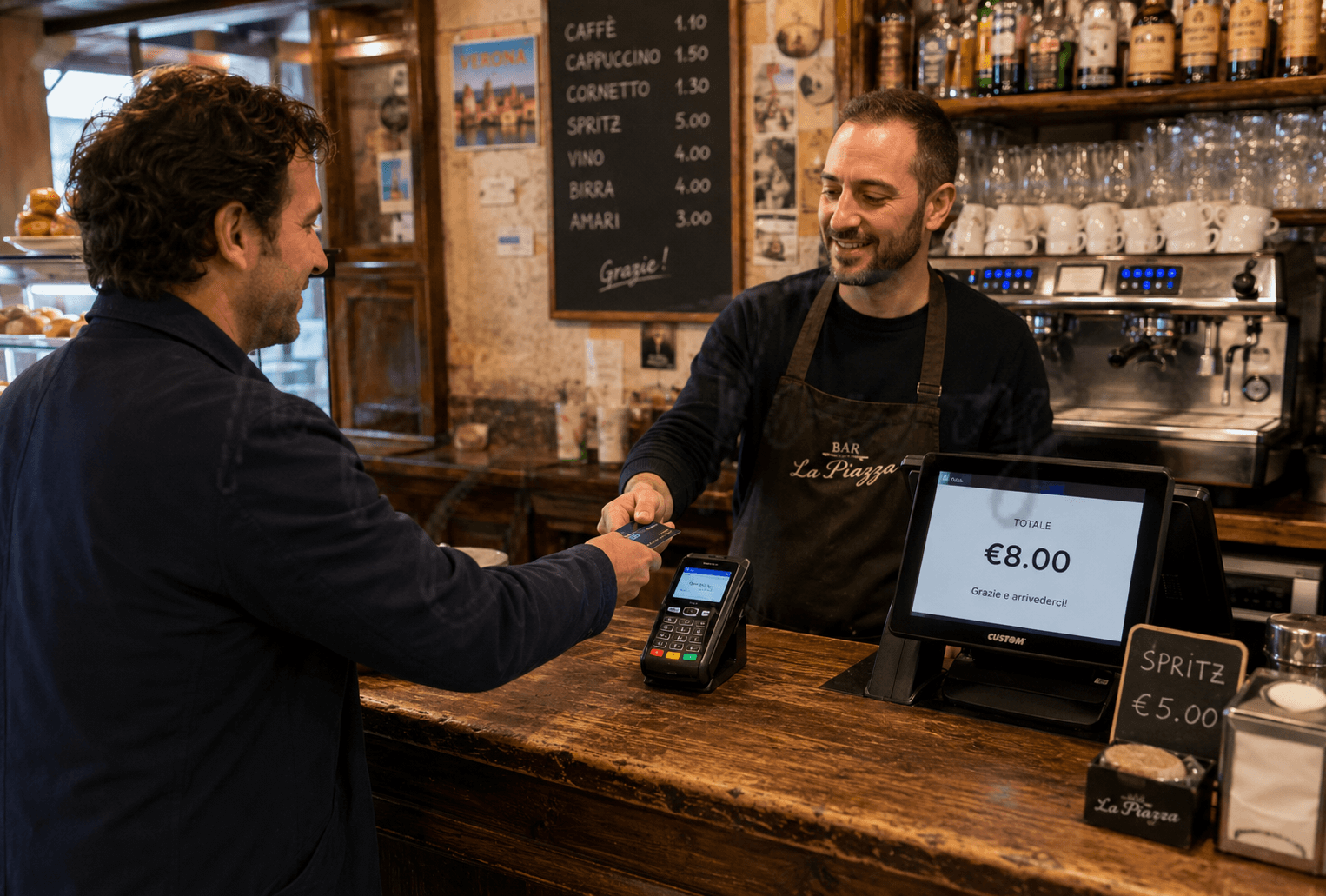
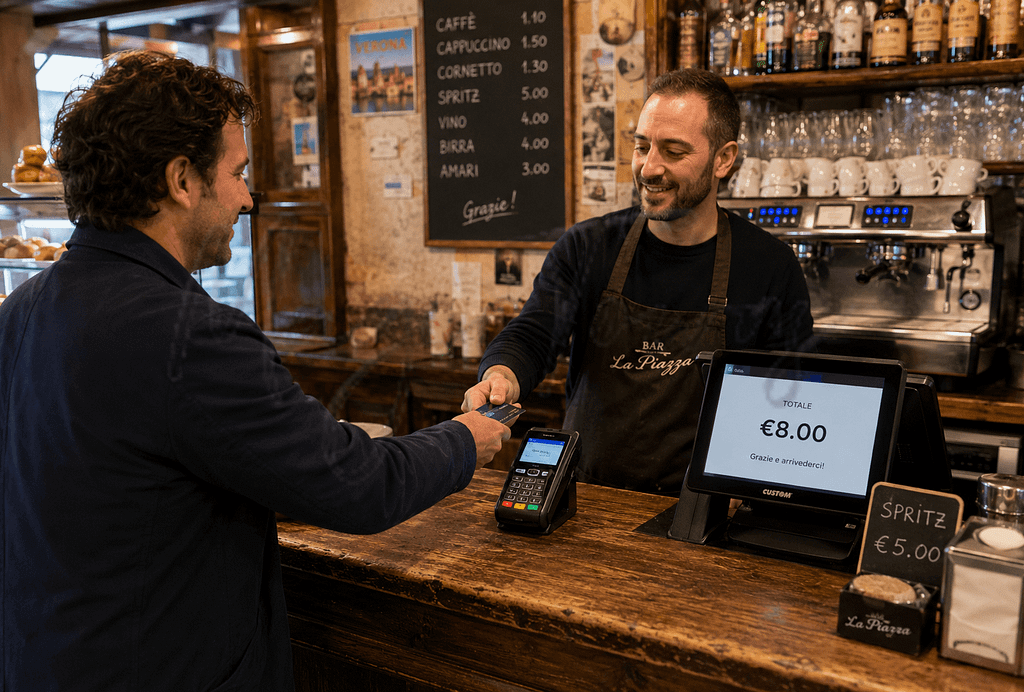
Things change in smaller towns. Take the bar. Paying for a coffee with a card is technically accepted in most places these days, but culturally it feels a little odd – Italians just don’t do it. You walk up, order your espresso (€1.10, maybe €1.50 in a tourist area), pay cash, done. Handing over a card for a single coffee will often earn you a slightly pained look, and depending on where you are, the cashier might point to a small sign saying the POS is broken (‘il POS è rotto‘), set a minimum of €5 or €10, or simply not have a terminal at all.
Some businesses use this as a convenient out, particularly for smaller transactions where card fees eat into margins and cash disappears more easily from the books. The Italian state loses tens of billions of euros a year to tax evasion, and cash is a significant part of how that happens – the introduction of mandatory card acceptance was, in large part, an anti-evasion measure. This isn’t a judgment, just useful context. When someone tells you the POS is broken, it might be true. It might not be. Either way, the practical answer is the same: have cash on you.
Den weekly market is another one. Those outdoor markets you’ll find in almost every Italian town, where locals buy vegetables, cheese, clothes, housewares – that’s traditionally a cash environment. In some cities certain vendors do accept card, but often with a minimum purchase.
Using Cash, ATMs, Wise and Revolut in Italy
If you need cash, you’ll generally find an ATM without much trouble, even in smaller towns. But a few things are worth knowing before you start withdrawing.
First, prioritise ATMs inside or directly attached to bank branches rather than standalone machines on the street or in tourist areas. Card skimming does happen in Italy, particularly at exposed, unmonitored machines. A terminal inside a bank branch is usually a much safer option.
Second, most foreign bank cards will work fine in Italian ATMs, but you’ll almost certainly pay some kind of fee. For daily life, we usually suggest using Wise or Revolut, especially if you’re not ready to open an Italian bank account yet. Both give you a European IBAN, work well for everyday card payments, and usually allow a certain number of cash withdrawals without fees, depending on your plan and limits.
For most day-to-day things (groceries, restaurants, shops etc.), Wise or Revolut will usually be enough. Where people often get confused is with bills and official payments. Italy uses a government payment platform called PagoPA for many public administration payments, including things like municipal taxes, residency fees, and some utility-related bills. The good news is that PagoPA usually gives you several ways to pay: online, through participating banking apps, at a tabaccheria, at Poste Italiane, or by scanning the QR code or barcode on the bill.
So no, you don’t automatically need an Italian bank account the moment you arrive. But if you plan to live here long term, it can become useful – and sometimes necessary – for things like applying for a pant, paying certain taxes via F24, or setting up direct debits with providers who are picky about foreign IBANs.
As a general rule, keep at least €50 in cash on you. Not because you’ll necessarily need it every day, but because the one time you don’t have it is usually when the POS is broken, the market is cash-only, or the taxi driver has conveniently forgotten the card reader.
What About Larger Cash Payments?
For normal daily life, this probably won’t affect you much. You’re not going to hit Italy’s cash limit by paying for coffee, groceries, or dinner. But let’s say that you’re renting a furnished apartment and the landlord asks for a three-month deposit of €5,500 in cash. You have the money. He says cash is fine. It isn’t – not legally. Same goes for paying a contractor for renoveringsarbejde, or buying a second-hand car from a private seller, for example.
In Italy, cash transfers of €5,000 or more between two different parties are prohibited under anti-money laundering rules (Article 49 of Legislative Decree 231/2007). In practice, you can pay in cash up to €4,999.99. Once the payment reaches €5,000, it needs to be made through a traceable method, such as a bank transfer, card payment, or cheque.
And you can’t get around the rule by artificially splitting the payment. Paying €3,000 now and €3,000 later for the same job or product can still be treated as one transaction. So the practical rule is simple: for small everyday things, cash is useful. For larger payments, keep everything traceable.
Cash and Real Estate: What Expats Need to Know
The cash limit becomes particularly relevant if you’re Køb af ejendom i Italien. I know some of you might be thinking: “Who would buy a house in cash?!” But I’ve seen this kind of question come up a lot in expat groups, especially when people are talking about cheap properties in remote villages, where you can sometimes buy a house for as little as €20,000.
The short answer is no: you cannot buy a house in cash. Not in the way you might imagine, anyway. Property transactions in Italy always go through a notary (notaio), a public official who is legally responsible for the deed (rogito notarile). The notary is also responsible for ensuring the transaction complies with anti-money laundering rules, which means all significant amounts – the purchase price, certainly – must be transferred via traceable means. In practice, this means a bank transfer or a certified bank cheque (assegno circolare).
Even if you have the entire amount sitting somewhere, you cannot hand over a suitcase of euros and walk out with the keys. The money needs a documented origin and must move through a traceable channel. Deposits at the preliminary contract stage (compromesso) are typically around 10% of the purchase price, and these too need to be transferred formally. If you’re selling a property abroad to fund an Italian purchase, make sure you have clear documentation showing where the money comes from. It sounds bureaucratic, and it is, but it’s standard and non-negotiable.

Afsluttende tanker
Italy has come a long way on electronic payments in recent years. In 2024, for the first time, the value of digital payments in Italy surpassed that of cash – a genuine milestone for a country that has historically been one of the most cash-reliant in Europe. That trend is continuing.
Still, that doesn’t mean you should arrive with an empty wallet. Cards work in most places, especially in cities, supermarkets, hotels, restaurants, and larger shops. But cash is still useful in everyday situations: small bars, local markets, older businesses, rural areas, taxis, or simply those moments when the POS mysteriously stops working.
So the best approach is simple: use your card for most things, but keep a small amount of cash on you. Around €50 is usually enough for daily emergencies. And when you need to withdraw, choose an ATM inside or attached to a bank branch rather than a standalone machine on the street.
Italy is more card-friendly than it used to be, but cash still has its place. Not for everything, not for large payments, and definitely not for buying a house – but for daily life, it’s still worth having.






 English
 French
 German
 Italian
 Danish