In these last few years, Tuscany is probably one of the main regions that comes to people’s minds when thinking of Italy, and Arezzo is probably one of the first cities that expats consider.
This city counts around 96,500 inhabitants and is located in the hills of eastern Tuscany, not far from Siena and Perugia. In fact, this area is pretty accessible: you can drive from one end of the province to the other in about 2 hours, and from anywhere in the province, you’ll reach the city center in 20-30 minutes or one hour maximum.
But the real question is: is its popularity justified? What’s it actually like living in Arezzo all year round? To find out, we combined our data with the experiences of the people who actually live here.
Life in Arezzo: What People Say
According to residents, Arezzo is a really livable town, perfect for those who don’t need to rely on the local job market and are looking for a quiet place, without the chaos of larger cities:
“It’s like any other mid-sized town in the area. Comfortable if you already have a good job and don’t need the entertainment and diversity of a large city. There are many trains to Florence, Bologna and Rome, and the rest of Tuscany a little further away. There’s also the Appennines close by for some nature. Housing is reasonably affordable. Little crime to speak of. Some gentrification/touristification going on but nowhere near the scale of Florence or Siena.
Speaking of Siena and its famous Palio tradition, Arezzo also has a strong sense of community. In fact, even nowadays people take genuinely part in local traditions like the Giostra del Saracino, an equestrian tournament that is held two times per year. But apart from it, there are many cultural initiatives, making it easier to integrate and build connections (considering also that there’s a large expat community here).
If you’re looking for a base to explore Tuscany with easy access to nature, history, and neighboring cities, Arezzo offers a great location. The weather is warm and dry in summer (you’ll definitely need air conditioning), while winters can be surprisingly cold and foggy.

Transport and Connectivity in Arezzo
The most convenient airports to reach Arezzo in terms of variety of flights and connections are Amerigo Vespucci in Florence, about 50 minutes drive away, Pisa Airport (about 2 hours), and Rome Fiumicino (around 2h 40 min).
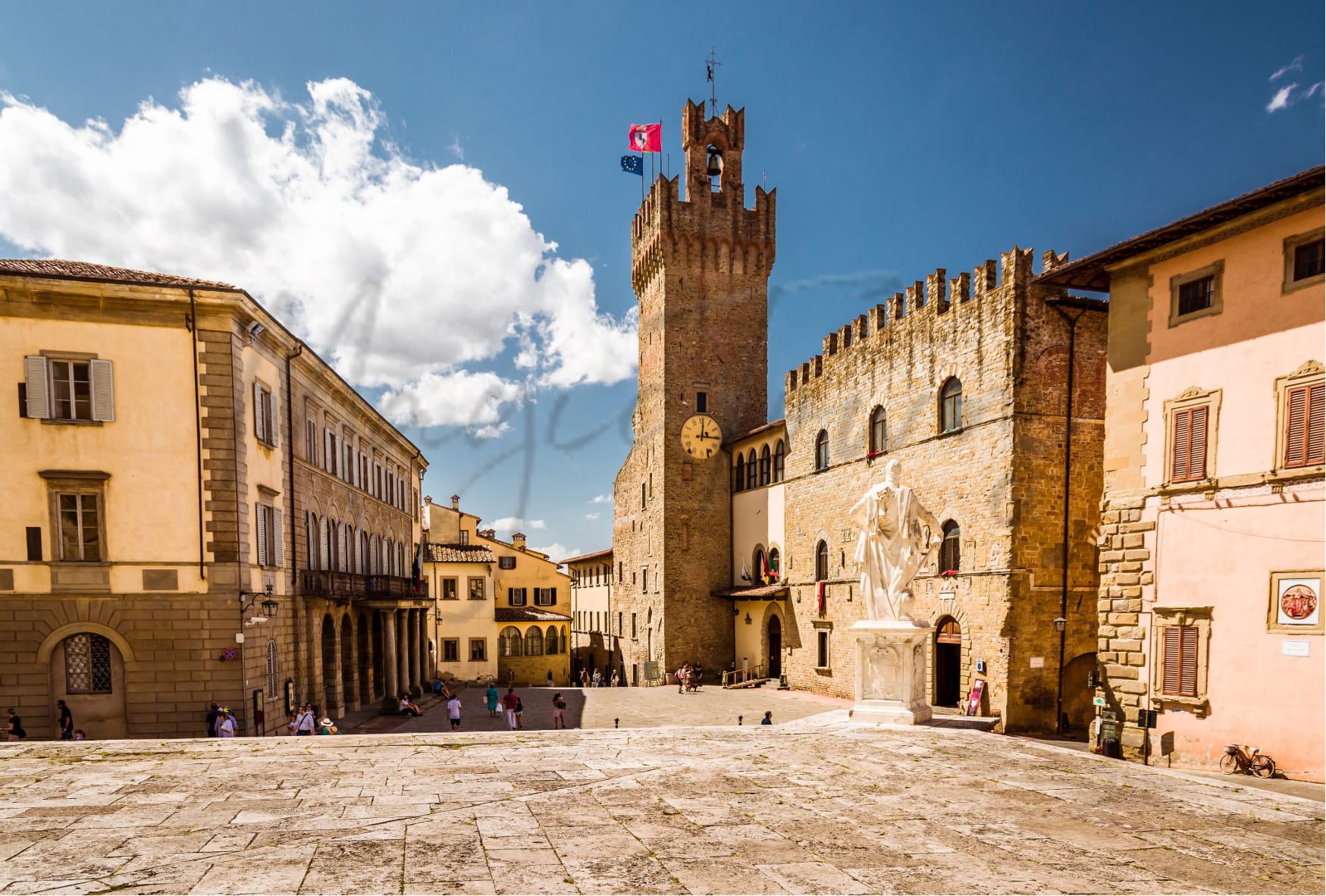
The historic center of Arezzo is definitely walkable and very suggestive, full of these narrow stone streets that connect medieval palaces and picturesque corners. However, finding parking in the center during weekends can be quite challenging, though the city isn’t large and you can reach most places on foot.
For day-to-day life within the city, public transportation is available, though buses can be infrequent during off-peak hours. If you want to explore the beautiful surrounding province – including the Casentino mountains, Val di Chiana valley, or the Tiber and Arno river valleys – having a car is essential:
“The travel time by car from one end of the province to the other is about 2 hours, from wherever you are it is likely that you will arrive in the city in 20-30 minutes (1 hour maximum).”
But the bright side of all this tourism, is that the city is definitely well organized: in fact, it offers some options of both car and bike sharing, so you don’t necessarily need to buy one.
Plus, apart from a few destinations, it’s pretty well-connected by train, making it easy to reach other major cities like: Florence (40 min.), Perugia (1h) Bologna (1h 20 min.), and Rome (just over 2 hours).
Where to Live in Arezzo: Housing & Cost of Living
As previously said, Arezzo has been one of the most popular destinations among expats, and this obviously results in higher property prices. In fact, the average between the city center and the surrounding areas is almost about 1.900 €/m². definitely higher compared to other cities of the same size in other areas.
| Area | Sale Price (€/m²) | Sale Price 70m² (€) | Rent Price (€/m²) | Rent 70m² (€ / month) |
|---|---|---|---|---|
| Historic Center | €2,443 | ~€171,000 | €9.16 | ~€640 |
| Prima Periferia | €1,982 | ~€139,000 | €9.10 | ~€640 |
| Antria, Molin Nuovo, San Firenze | €1,849 | ~€129,000 | €8.73 | ~€610 |
| Chiassa Superiore, Giovi, Quarata | €1,557 | ~€109,000 | €9.60 | ~€670 |
| San Zeno, Puliciano, Rigutino | €1,406 | ~€98,000 | €6.44 | ~€450 |
| Indicatore, San Giuliano, Via Fiorentina | €1,503 | ~€105,000 | €8.60 | ~€600 |
| Agazzi, Santa Firmina, Tortaia | €1,923 | ~€135,000 | €7.46 | ~€520 |
| Palazzo del Pero, Santa Maria alla Rassinata | €818 | ~€57,000 | €6.98 | ~€490 |
Data elaborated from Immobiliare.it
Besides the city center, the most popular and well-connected areas are Saione, or a little bit further, Giotto and Pescaiola, where you can find all necessary services just steps away, so it’s a great option for both families and professionals.
Otherwise, if what you’re after is a place all your own, far from the noise and wrapped in greenery, you should check out the hillside spots like Antria, Ceciliano, or San Polo.
“Housing in Arezzo is reasonably affordable compared to larger Tuscan cities, though costs can still be significant. Expect the cost of living to be comparable to much larger cities like Florence or Bologna, perhaps 10% less overall.“
Challenges of Living in Arezzo
Among the challenges of living in Arezzo are, as just mentioned, property prices. Although they are accessible, you must be aware of the fact that you’re paying way more than another less known, yet still beautiful option in another region. And this applies both for the city center and the province itself.
If you want to explore further, we’ve written lots of articles about beautiful areas to live in in regions like Veneto, Abruzzo, Umbria, Emilia-Romagna etc. Alternatively, you can just filter your maximum budget in the Town Explorer section, on our website.
Plus, according to some people, services aren’t always the best, mostly to reach other cities of the area, both for train connections (often require to do a stop along the way, even if near, take Siena for example), and proximity to airports. Florence’s one is nearby, but if you need more options and coming from the US, for example, Rome Fiumicino Airports will likely be your choice (and it’s around 2h 40 min. away). So, in a long-term vision, especially if you’re considering it for retirement, ask yourself: “Am I willing to do all those hours to reach the airport every time?”
“If you’re choosing between Arezzo and Pisa, I’ll definitely choose Arezzo because it’s quiet and more livable. However, it has less services and comfort. I give you an example: it takes more to reach other cities or even the airport, something that for me matters a lot when choosing a city to live in“
For what concerns healthcare facilities, according to our data, it excels in some areas (heart attack readmissions, bone fracture treatment) but needs big improvement in others (acute heart attack interventions and readmissions after heart failure).

Arezzo by the Numbers: Key Data
- Quality of Life: Good (87/100) – taking into account air quality, amenities, economy, and infrastructure
- Air Quality: Excellent (96/100)
- Safety: Moderate Earthquake Risk
- Healthcare: San Donato-Pronto Soccorso (6 min.)
- Internet Speed: Good (average of 126 Mbps)
- Transport: Adequate for city life, but a car is essential for exploring the province; public transport can be infrequent during off-peak hours
- Airport: Amerigo Vespucci, Florence (51 min.), Perugia-San Francesco d’Assisi, Perugia (55 min.), Ampugnano, Siena (64 min.)
- Train Stations: Stazione di Bagnoro (4 min), Stazione di Arezzo (7 min.), Stazione di Gragnone (8 min.)
For more detailed information about Arezzo and its services and infrastructure, visit the Magic Towns city profile.
Is Arezzo right for you?
✅ Choose Arezzo if:
- You want to live in a quiet mid-sized Tuscan town with strong local traditions
- You already have a stable income or job and don’t need to rely on the local job market
- You value clean air, low crime, and a walkable historic center
- You appreciate a slower pace of life without the overwhelming tourism of Florence or Siena
- You’re comfortable with car and bike-sharing services or owning a car for exploring the province
- You’re looking for a place near nature (Appennines, valleys) while living in a city
❌ Think twice if:
- You’re seeking a very affordable option – property prices are significantly higher than similar-sized towns in other regions (averaging around €1,900/m²)
- You need frequent, direct access to major international airports without long drives (Rome Fiumicino is 2h40 min away)
- You rely heavily on public transport – train connections to nearby cities often require stops, and buses can be infrequent
- You prefer the entertainment, nightlife, and diversity of a large city

Final thoughts
So, is Arezzo worth it? If you’re looking for authentic Tuscan life without the crowds of Florence or Siena, and you’ve got a stable income that doesn’t depend on the local job market, then yes – Arezzo could be a great fit. You get the charm, the history, some train connections to major cities, and a growing expat community that makes settling in easier.
However, you should be aware that this popularity comes at a cost. Property prices are quite high for a town this size, and while services are generally good, they’re not always the most convenient. If budget is a major concern, or if you need frequent international travel, there are other beautiful Italian towns worth considering.
If you’re experiencing difficulties with your relocation process, become a member and get a one-hour FREE private consultation to help you navigate it smoothly.
Want to explore more options?
If Arezzo hasn’t fully convinced you and you’d like to explore other options, use our search tools to explore over 1,500 towns and cities in Italy. You can filter by cost of living, transport, healthcare, and other lifestyle factors – making it easy to find the perfect place for you.
Discover our article on the 7% tax town benefit, and sign up for our newsletter to get our guide to every town covered by this incentive.