When people think of central Italy, Florence and Rome are usually the first cities that come to mind. Both are magnificent, of course..but they’re also packed with tourists, expensive, and can feel overwhelming if you’re actually trying to build a life there.
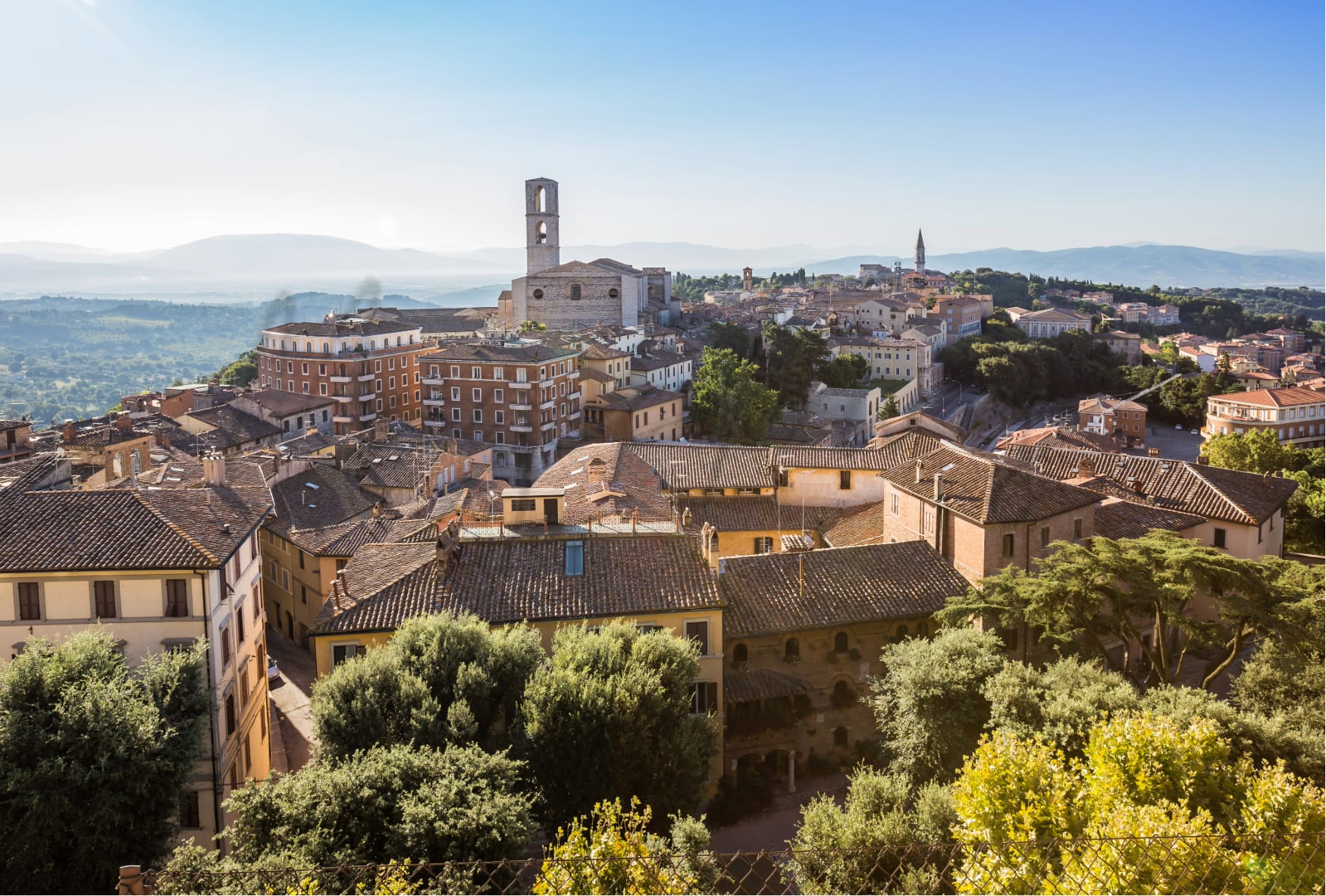
What many people don’t realize is that nestled right between these two big cities sits Perugia – a hilltop city of around 165,000 residents in the heart of Umbria. Living here means embracing quietness, being surrounded by rolling green hills, forests and plenty of good restaurants, but at the same time breathing in a young atmosphere, as thanks to the university it’s full of students.
Some locals joke it’s “the real Italy” – authentic, beautiful, and quiet..is that really true? To answer that, we’ve combined our own data with feedback from people who have been living in Perugia for years.
Life in Perugia: What People Say
People who live in Perugia often describe it as a place with a great quality of life: the pace is relaxed, the locals are welcoming, and most of all, for those who love outdoor activities, there are plenty of things to do nearby:
“Living in Perugia (and Umbria in general) is really pleasant. The locals are friendly, the vibe is super chill, the food is incredible, and even though it’s peaceful, there’s a young atmosphere with lots of students. Plus, the surrounding nature is absolutely stunning, full of forests everywhere.”
Indeed, Umbria is often called “the green heart of Italy”, which surprises people because there’s tons of ancient architecture, making the contrast with the green landscape even more beautiful. All of this compensates for what, as we’ll see later, are the drawbacks of living here. For some, it’s a great alternative to Tuscany – less crowded and cheaper:
“If you love being outdoors, this is a fantastic place to live with plenty to do. The nature trails, hills, and cycling paths more than make up for the limited nightlife. All of Umbria is gorgeous – for me it’s like Tuscany but more ‘Roman’ in character. Plus, it’s not overrun with tourists at all”

Transport and Connectivity in Perugia
Near Perugia, there are several small airports, among them “Perugia-San Francesco d’Assisi”, just a 15-minute drive away. However, for more frequent or intercontinental flights, the nearest ones are Florence and Rome (Fiumicino) airports, both around a 2-hour drive. Indeed, one of the pros of living here is that you can live in a quieter area while still being super close to those big cities.
The city center, instead, is pretty well organized: the city has a Minimetrò – a small metro that connects the historic center to the lower parts of town, including the train station and Pian di Massiano:
“Parking is limited, but you can do everything on foot or by public transport. There’s also the Minimetrò that runs from the historic center down to Pian di Massiano – a huge green park with everything sports-related: running tracks, walking paths, soccer fields, rugby, baseball, tennis, padel courts, and even 2-3 climbing gyms.”
Driving in Perugia itself is manageable, though like any Italian city, rush hour can be tricky. However, while you can live car-free in the historic center, having a car becomes pretty essential once you want to explore the surrounding areas:
“If you live in the center, you don’t need a car. But you’ll want one because as soon as you step outside Perugia’s municipality, everything becomes more spread out and isolated. For example, the Collestrada shopping center is 10 minutes by car, but you’d lose about an hour on the bus with at least 2 transfers.”
The train station offers decent regional connections: you can reach Assisi in just 20 minutes, Spoleto and Arezzo in around an hour, and Florence and Rome in around 2 hours, making weekend trips super easy.
Where to Live in Perugia: Housing & Cost of Living
One of the pros of living in Perugia is real estate. In fact, although prices have increased compared to a few years ago, rent and sale prices are still relatively affordable compared to other Italian cities:
| Area | Avg. sale price (€/m²) | Approx. price for 70 m² home (€) | Avg. rent price (€/m²/month) | Approx. monthly rent for 70 m² home (€) |
|---|---|---|---|---|
| Centre, Elce | €1,654 /m² | ~€115,780 | €10.92 /m² | ~€765 |
| Semicentre, Stazione, Madonna Alta, Prepo | €1,398 /m² | ~€97,860 | €8.90 /m² | ~€620 |
| Santa Lucia, Ferro di Cavallo, Olmo, Città della Domenica, Monte Malbe | €1,279 /m² | ~€89,530 | €8.61 /m² | ~€600 |
| San Sisto, Lacugnano, San Mariano, Santa Sabina | €1,589 /m² | ~€111,230 | €8.46 /m² | ~€590 |
| Ponte San Giovanni, Balanzano, Montebello, Collestrada | €1,295 /m² | ~€90,650 | €8.35 /m² | ~€585 |
| San Marco, Oliveto, Montegrillo | €1,212 /m² | ~€84,840 | €8.76 /m² | ~€610 |
| Castel del Piano, Pila, Mugnano, Fontignano | €1,218 /m² | ~€85,260 | €8.13 /m² | ~€570 |
| Sant’Egidio, Aeroporto, Pianello | €1,158 /m² | ~€81,060 | €8.28 /m² | ~€580 |
Data elaborated from Immobiliare.it
As usual, where you choose to live depends on your personal needs, so how often you’ll need to go to the city center. As one local suggests, there are lots of areas within 10km that are absolutely livable but cheaper, like Ponte San Giovanni, Ponte Felcino, Ponte Valleceppi, and Ponte Pattoli:
“Up to about 10 km from the historic center (think Ponte San Giovanni, Corciano, Ponte Felcino, Prepo) it’s all very livable and doesn’t change much. The obvious difference is whether you’re in the historic center or not. If you think you’ll be going to the center during the day, you need to figure out if it’s better to find an apartment with parking that’s an easy walk, or invest in passes for transport and parking. If it’s only occasional and maybe in the evening, no problem – you can find free parking after dinner (though keep in mind there’s an uphill walk to reach the center).”
But if you need to be really close to the historic center but have fewer problems finding parking, then you should consider the areas served by the Minimetrò, like Cortonese, Parco Mendez, Madonna Alta, or Prepo:
“I live in the outskirts and I’m well-served by buses I use to commute to work. If you need to go to the historic center for work, I’d suggest looking for any accommodation in areas served by the Minimetrò – with a pass for €120 you’re set for 3 months (and you can use it on buses too). As for neighborhoods, I’d say Cortonese, Parco Mendez, Madonna Alta, or Prepo if you want to be close to the center but in an area that’s still car-friendly as well as walkable and well-connected by transit. If you want to be further out, choose one of the ‘Ponte’ areas – Ponte San Giovanni, Ponte Felcino, Ponte Valleceppi, or Ponte Pattoli.”
Challenges of Living in Perugia
Although Perugia seems like a good city to live in for retirees or students, it’s probably not the best choice for young professionals in search of opportunities. In fact, one of the most common complaints is the limited job opportunities:
“Umbria is a beautiful region and Perugia is an incredibly underrated gem. How you experience living here really depends on your age and what you’re looking for. If you’re a student, the nightlife is decent – not super varied but okay. As an adult, the job market is limited and frankly pretty terrible, and not much happens beyond a couple of big festivals during the year. That said, if you are a retiree and you’re happy living somewhere quiet, it’s a perfect spot.”
Another thing to consider is its location; in fact, although the city is definitely walkable, the connections to the rest of Italy are poor and you can’t really rely on public transport outside the center or after hours because buses stop running early:
“The city is poorly connected to the rest of Italy, making it difficult to travel outside the city, especially if you don’t have a car since buses stop running early. Another downside is that winter is very windy, and getting around by bike is challenging since everything is uphill with basically no bike lanes, so you end up having to walk everywhere.”
Moreover, taking a look at our data, hospital care and treatment speed are below average compared to Italy’s national standards. While some areas like heart attack management perform well, treatment times for procedures such as bone fractures and breast cancer tend to take longer, with patients staying in hospital longer than you’d see elsewhere in Italy.

Perugia by the Numbers: Key Data
- Quality of Life: Pretty good (79/100) – taking into account air quality, amenities, walkability, population, and environmental risks
- Air Quality: Excellent (96/100)
- Safety: Moderate Earthquake Risk
- Healthcare: S.M. della Misericordia-P. Soc (19 min.)
- Internet Speed: Good (average of 214 Mbps)
- Rent: ~€570– €765 (70 m²)
- Transport: Sufficient
- Airport: Perugia-San Francesco d’Assisi, Perugia (15 min.), Raffaello Sanzio, Ancona (65 min.), Ampugnano, Siena (75 min.)
- Train Stations: Stazione di Perugia Sant’Anna (12 min), Stazione di Perugia (13 min), Stazione di Perugia Capitini (15 min.)
For more detailed information about Perugia and its services and infrastructure, visit the Magic Towns city profile.
Is Perugia Right for You?
✅ Choose Perugia if:
- You want affordable rent without sacrificing quality of life
- You love the outdoors – hiking, cycling, and exploring medieval hill towns
- You’re looking for an authentic Italian experience without tourist crowds
- Excellent air quality matters to you (it’s one of the best in Italy)
- You value living in a human-scale city where everything feels accessible
- You’re happy with a quieter pace of life and don’t need constant entertainment
❌ Think twice if:
- You’re craving big-city nightlife and entertainment – Perugia is pretty quiet in the evenings
- You’re on a tight job hunt – the local market is quite limited, especially for young professionals
- You need a car-free lifestyle – while the center is walkable, you’ll want a car to explore the region. Plus, connections outside the city can be challenging
- You can’t handle hills – seriously, everything is uphill here

Final Thoughts
In short, Perugia works best for people who prioritize quality of life over career opportunities – retirees, remote workers, or students who can appreciate affordable housing, excellent air quality, and access to nature without depending on the limited job market. Just make sure “quiet and authentic” sounds relaxing rather than isolating to you, because the city won’t offer constant stimulation or entertainment.
That said, you’ll realistically need a car – not so much for everyday life, but even just to reach the airport. And be aware that healthcare services are below national standards.
If you’re interested in exploring other towns in Umbria where you can benefit from the 7% flat tax, read our latest article on what we think are the most interesting options. If instead you’re experiencing difficulties with your relocation process, become a member and get a one-hour free private consultation to help you navigate it smoothly.
Want to explore more options?
If Perugia hasn’t fully convinced you and you’d like to explore other options, use our search tools to explore over 1,500 towns and cities in Italy. You can filter by cost of living, transport, healthcare, and other lifestyle factors – making it easy to find the perfect place for you. Discover our article on the 7% tax town benefit, and sign up for our newsletter to get our guide to every town covered by this incentive.