


Italy’s villages have always captured the world’s imagination – yet behind the postcard views lies a more complex story. As the country faces a demographic crisis that rivals Japan’s, entire regions risk emptying out while others quietly reinvent themselves.
At Magic Towns Italy, our mission is to look beyond the headlines — combining data, on-the-ground insight, and the lived experience of expats — to understand where Italy’s next chapters will unfold. This deep dive brings together ISTAT population forecasts, town-level migration data, and years of fieldwork to answer a pressing question for anyone dreaming of a life here: which parts of Italy still have a living future — and which are slowly fading away?
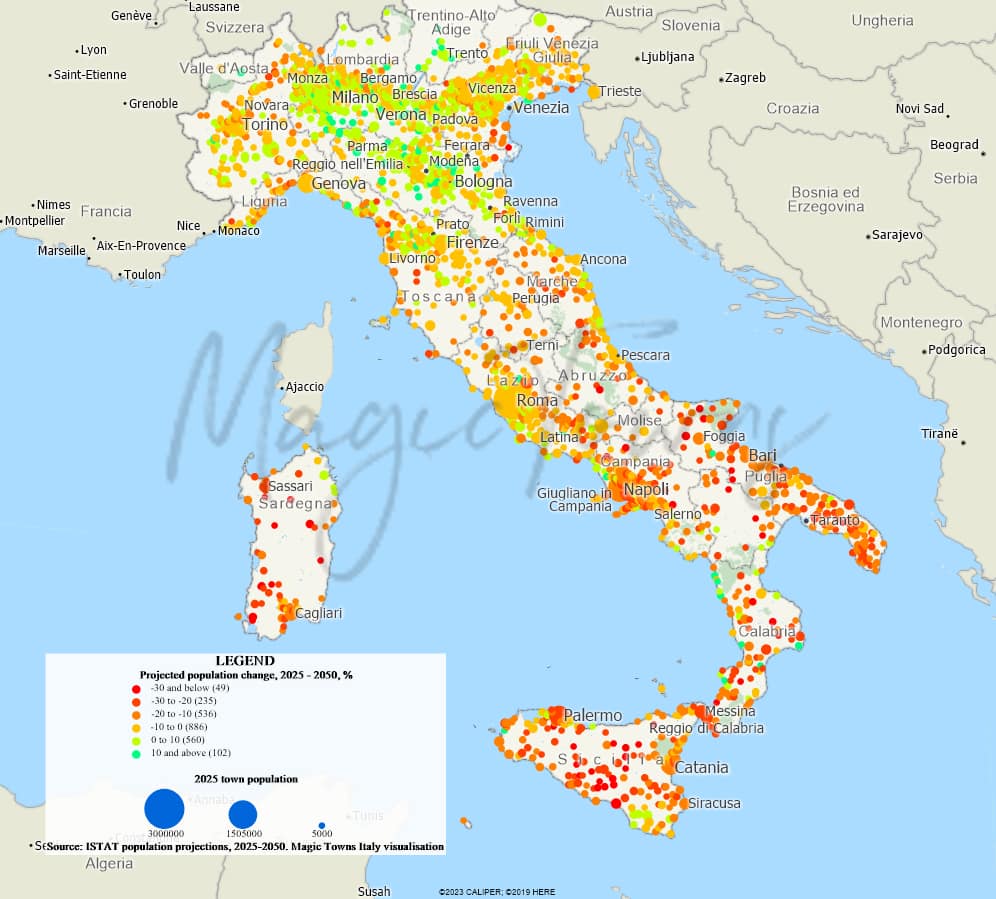
Italy: The Oldest Country in Europe
Italy is grappling with a looming demographic crisis. Birth rates have plummeted and life expectancy remains high, making Italy one of the world’s oldest societies. In fact, about 24.5% of Italians are aged 65+, a share second only to Japan (29%). Fewer babies are being born each year (fertility is only ~1.21 children per woman) while people live longer – Italy’s median age is nearly 49 years, the highest in Europe. This mirrors Japan’s trajectory, with a swelling elderly population and a shrinking youth base. Nearly one-third of Italians could be over 65 by 2050, up from 24% today. Such extreme ageing strains the pension system, healthcare, and the working-age labor force.
These trends have pushed Italy into what demographers call a “natural population decline”. Births have been fewer than deaths for over a decade. Immigration used to offset this imbalance, but even immigration can no longer fully reverse the trend. The result: Italy’s total population has started falling after peaking around 60 million. It’s now firmly on a downward path unless something changes.
Italy in 2050: A Smaller and Divided Nation
Official ISTAT projections paint a sobering picture for the coming decades. Italy’s resident population, ~59 million today, is expected to drop to about 54.7 million by 2050 – a loss of over 4 million people in just 25 years. By 2080 it could fall even further to ~46 million. The age structure will skew dramatically older: by mid-century over 34% of Italians will be 65+, with ever fewer children and workers to support them.
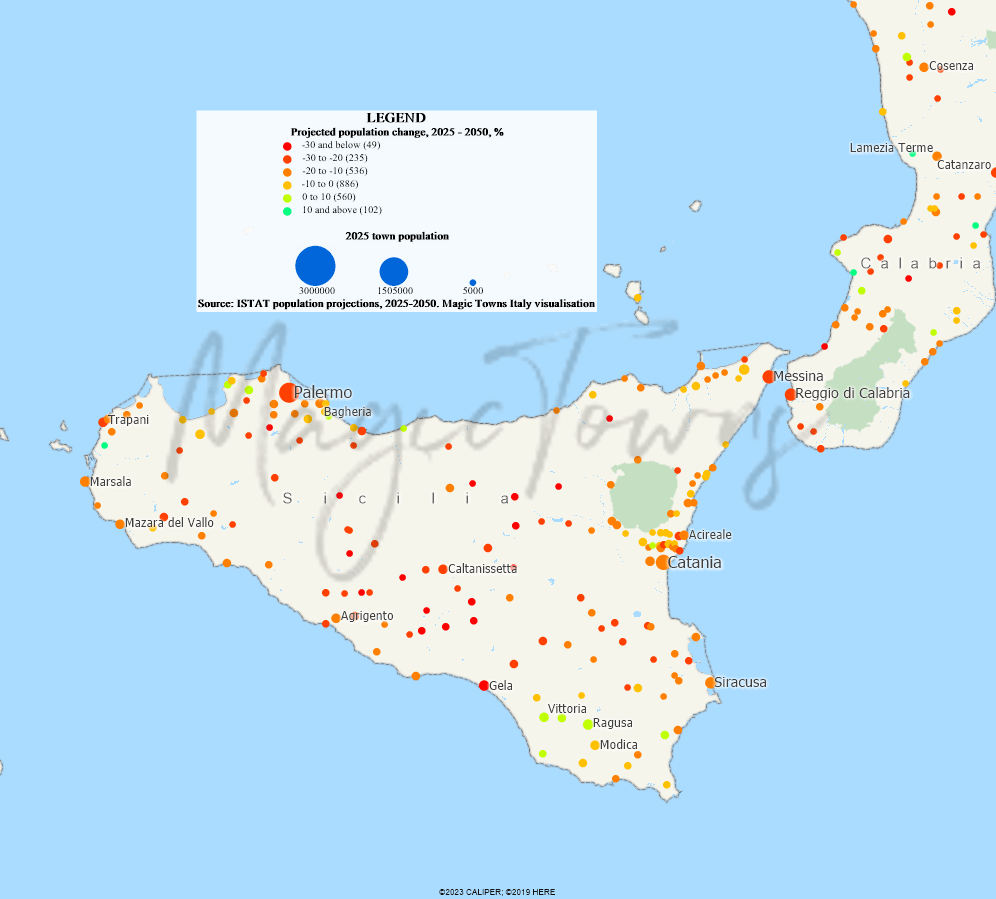
Notably, the decline won’t be uniform across the country. Southern Italy will pay the highest price in terms of depopulation. In the short term, northern regions still have a bit of demographic momentum (the North’s population may even rise slightly until 2030), whereas the South is already seeing steep losses. Over 2025–2050, ISTAT’s median scenario shows the South’s population shrinking by roughly –15% (losing ~3.5 million people), while the North stays almost flat (-1% by 2050). The Center will be in between (around –5%). In other words, the South accounts for the bulk of Italy’s coming population drop. The chart below illustrates this stark contrast between a relatively resilient North and a rapidly emptying South:
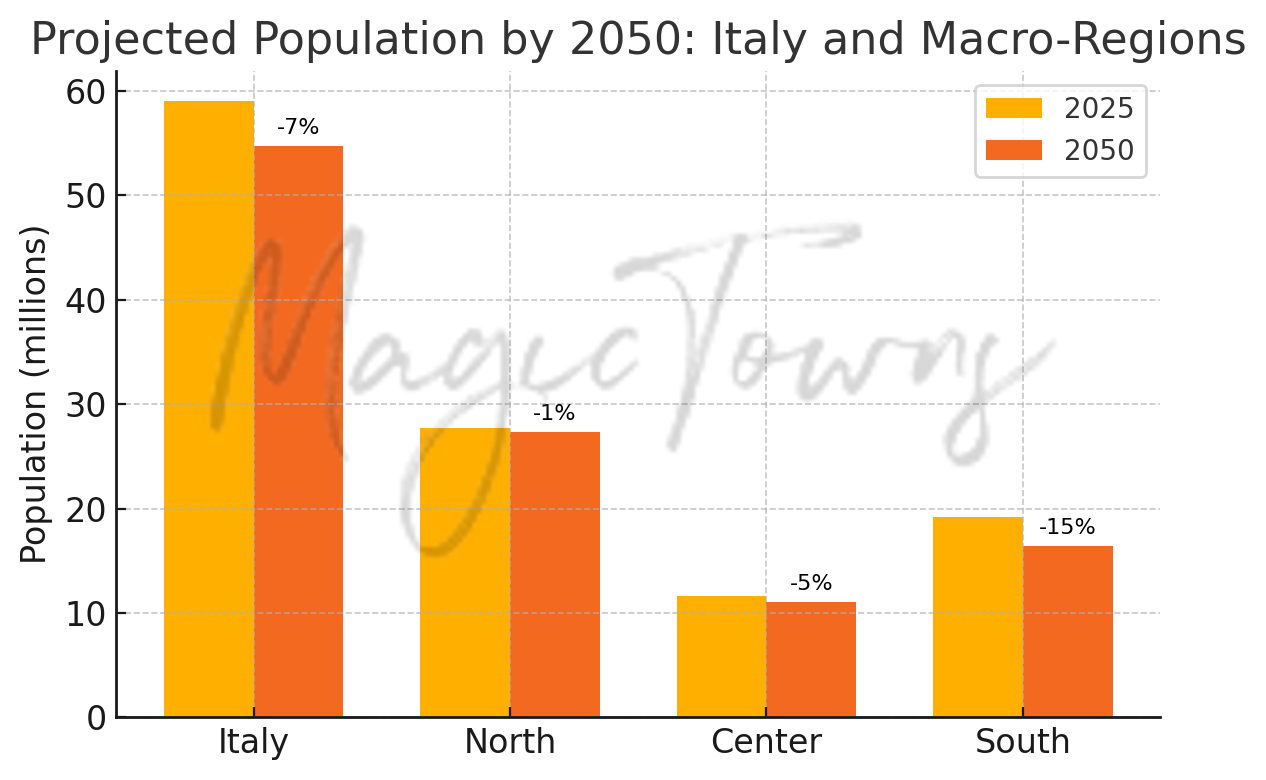
Projected population by 2050 (median scenario) – Italy vs macro-regions. The South is set to lose around 15% of residents by 2050, while the North remains roughly stable. Magic Towns Italy visualisation of ISTAT forecasts.
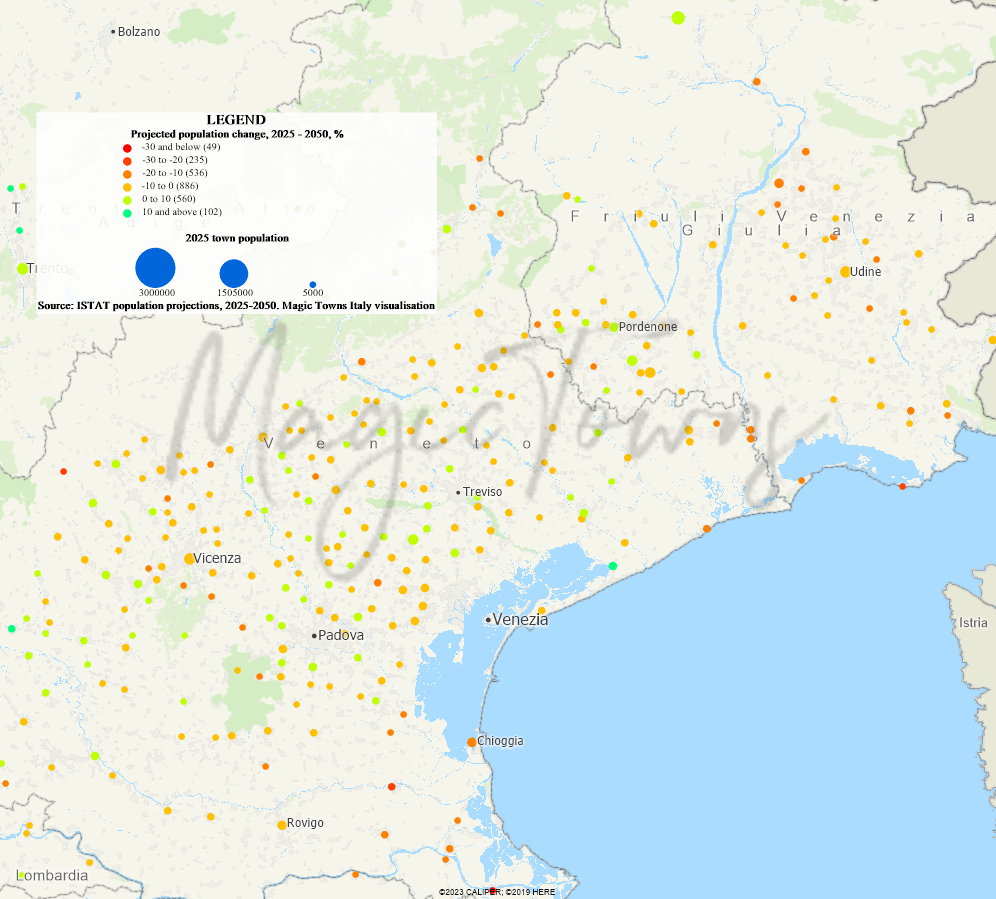
The “surprising resilience” of some northern areas comes from a mix of slightly higher birth rates and stronger inflows of young migrants (both from within Italy and abroad). For example, cities like Milan, Bologna or Bolzano still attract workers and families, tempering their demographic decline. In fact, ISTAT allows for an optimistic scenario where the North could even gain population through mid-century. All that said, significant areas, especially mountain areas in the Alps, as well as some coastal areas in the North East, stand to lose residents as well.
By contrast, no realistic scenario shows any southern region growing – even in the best case they simply lose a bit less. Regions like Molise, Basilicata, Calabria, and Sardinia are projected to see the sharpest drops, continuing the “apparent spiral of no return” from decades of youth out-migration. Larger southern regions like Campania and Sicily, which traditionally had higher fertility, will also age rapidly and suffer declines, albeit starting from bigger populations.
In short, Italy faces a demographic double whammy: overall decline and internal divergence. For foreign retirees considering Italy, this context matters – the town or region you choose will influence the community and services around you in 20 years’ time. An idyllic southern village may lose a huge chunk of its populace, while a northern town might hold steadier.
Can Tax Breaks and €1 Homes Save Italy’s Villages?
Aware of these trends, Italy has rolled out eye-catching schemes to lure new residents – especially to the depopulating South. Two of the most publicized measures are the 7% flat tax regime for foreign retirees and the famous “€1 homes” initiative. Both aim to rejuvenate struggling areas by attracting foreigners (and expatriate Italians) to settle and invest.
The 7% retirement tax break (introduced in 2019) lets retirees who move their tax residence to certain southern towns pay just 7% income tax on all their foreign-sourced income, including pensions. This generous incentive is available for up to 10 years, and it applies to dozens of small municipalities (under 20,000 people) across regions like Sicily, Calabria, Sardinia, Campania, Basilicata, Abruzzo, Molise, and Puglia.
The goal, as stated by lawmakers, was explicit: to attract people to regions that have suffered the greatest population loss. Essentially, it’s a fiscal carrot to repopulate ghost towns with foreign gray hair and pocketbooks. For a pensioner living off, say, $30,000 a year, Italy’s offer of a 7% flat tax (instead of normal rates up to 43%) is extremely enticing. Dozens of villages from mountain hamlets in Molise to coastal towns in Calabria began marketing themselves to UK, US, and Northern European retirees on the back of this policy.
At the same time, many local councils launched “Case a 1 €” programs – selling abandoned houses for the token price of one euro. The idea here is more symbolic but equally aimed at reversing decline. Towns like Gangi and Salemi in Sicily, or Sambuca, Troina, Mussomeli, and many others, put dilapidated old houses on the market for €1 (plus renovation commitments) to attract new blood. This scheme directly addresses rural depopulation by offering empty homes for virtually free in hopes that buyers will invest in renovations and put down roots.
These initiatives, combined with Italy’s undeniable lifestyle appeal, have started drawing foreigners into areas that haven’t seen influx in decades. You can now find British and American retirees in hilltop Calabrian villages, a sprinkle of Germans and Swedes restoring Sicilian cottages, digital nomads buying €1 houses in remote Abruzzo, etc. Local mayors often tout these newcomers as a lifeline for dying communities. But how much difference are they really making?
Tax Breaks and €1 Home Schemes: The Numbers Don’t Add Up (Yet)
Despite a lot of buzz, the hard data shows that foreign in-migration still only scratches the surface of Italy’s depopulation problem. Natural decline (more deaths than births) remains so large that a few dozen newcomers a year can’t offset the loss of native residents in most towns. Let’s look at some concrete examples from recent ISTAT figures:
- Taormina (Sicily) – the famed seaside town had a natural population loss of about 35 people in late 2024 (more deaths than births). In that same period, it attracted 41 foreign immigrants. In other words, new arrivals barely outnumbered the local losses – a small positive bump, but not enough to markedly change the trajectory. Taormina’s total population is around 10,400, and like most Italian towns it is ageing and gradually shrinking.
- Ischia (Naples) – on the island of Ischia, the main comune saw a natural decline of ~21 people in the second half of 2024, versus 47 foreign arrivals. Again, foreigners did outpace births deficit for a short span, but the margins are thin. One good year of immigration doesn’t reverse decades of youth outflow and low birth rates.
- Gangi (Sicily) – often cited as the poster child of €1 homes after a media blitz years ago, Gangi is a small town of ~6,000 in the mountains. It welcomed 28 foreigners in late 2024, compared to a natural decrease of 24 in the same period. That’s basically a wash – a handful of new residents kept the population flat for a few months. Gangi’s longer-term trend is still downward (the town’s population was over 7,000 in 2001, so it has shrunk ~15% despite the house scheme).
- Salemi (Sicily) – another €1 house town, population ~9,800, saw 49 foreign in-migrants in late 2024, against a natural loss of 21. Here we actually see a net gain: foreigners more than doubled the number lost to deaths, a short-term boost. But 50 new people a year is still only ~0.5% of the town’s population. To truly revitalize Salemi, those numbers would need to compound every year – which so far, they haven’t.
For data lovers, here is a quick overview of how some €1 towns are faring against similar sized towns in the same provinces. The takeaway is that some of them attract more foreign residents per head, but it is not universal.
| €1 town | New foreign residents per 1,000 residents | Peer median (same province, ±20% pop) | Net difference per 1,000 residents |
|---|---|---|---|
| Salemi | 12.22 | 7.68 | +5.50 |
| Gangi | 10.85 | 4.94 | −1.34 |
| Cuglieri | 9.82 | 2.00 | −4.09 |
| Mussomeli | 5.50 | 2.05 | −0.81 |
| Regalbuto | 4.72 | 3.52 | +1.83 |
| Troina | 5.53 | 4.10 | −1.92 |
| Sambuca di Sicilia | 3.43 | 3.70 | −2.29 |
| Nulvi | 3.11 | 2.67 | −1.94 |
| Ollolai | 2.63 | 3.44 | −9.63 |
| Cinquefrondi | 3.53 | 9.54 | +3.05 |
On the other hand, some towns show a spike in foreign arrivals that isn’t what it seems. A case in point is San Lucido in Calabria. This little coastal town (~7,500 residents) registered a whopping 400+ people moving in from abroad over just 6 months of 2024 – seemingly an influx big enough to increase the population by 5% in one swoop. However, this was not a wave of eager retirees buying villas by the sea. In reality, it was largely due to refugee resettlement programs. While these humanitarian arrivals do help offset numbers on paper, they often don’t translate to long-term community growth – many refugees move on to bigger cities or other EU countries, and they’re not filling the local school with new babies, so to speak.
On the other hand, anecdotally, the 7% scheme does appear to be bringing in foreign residents into smaller towns. Let us look at the towns in the prized island of Ischia:
| Comune | Pop. | Foreign in‑movers | New foreign residents per 1,000 inhabitants | Natural population change per 1,000 inhabitants | Offset of loss | Net per 1,000 inhabitants |
|---|---|---|---|---|---|---|
| Forio | 17,539 | 81 | 4.62 | −3.20 | 145% | +1.43 |
| Ischia | 19,499 | 84 | 4.31 | −3.03 | 142% | +1.28 |
| Serrara Fontana | 3,057 | 15 | 4.91 | −0.98 | 500% | +3.93 |
| Casamicciola Terme | 7,432 | 16 | 2.16 | −6.06 | 36% | −3.91 |
| Lacco Ameno | 4,483 | 12 | 2.68 | −3.13 | 86% | −0.45 |
The broader pattern is this: foreigners are indeed moving into Italy’s smaller towns at higher rates than before, but still not in volumes sufficient to overcome the natural decline in most cases. Nationally in the past year, net foreign immigration slightly exceeded the excess of deaths over births, meaning Italy’s population would have dropped even faster without immigration. But at the local level, many villages continue to empty out. Young Italians keep leaving for cities or abroad (an ongoing “brain drain”), and the trickle of new foreign retirees or home-buyers isn’t yet enough to fill the gap.
To quantify this, consider aggregated data for 2024: towns under 20k people saw about 7 foreign arrivals per 1,000 residents on average, whereas larger towns (≥20k) saw about 7.7 per 1,000. In both cases, those incoming foreigners slightly outnumbered the natural decrease (nationwide, there were roughly 7.5 immigrants per 1,000 residents versus 5.5 deaths-above-births per 1,000). The chart below compares small vs large towns:
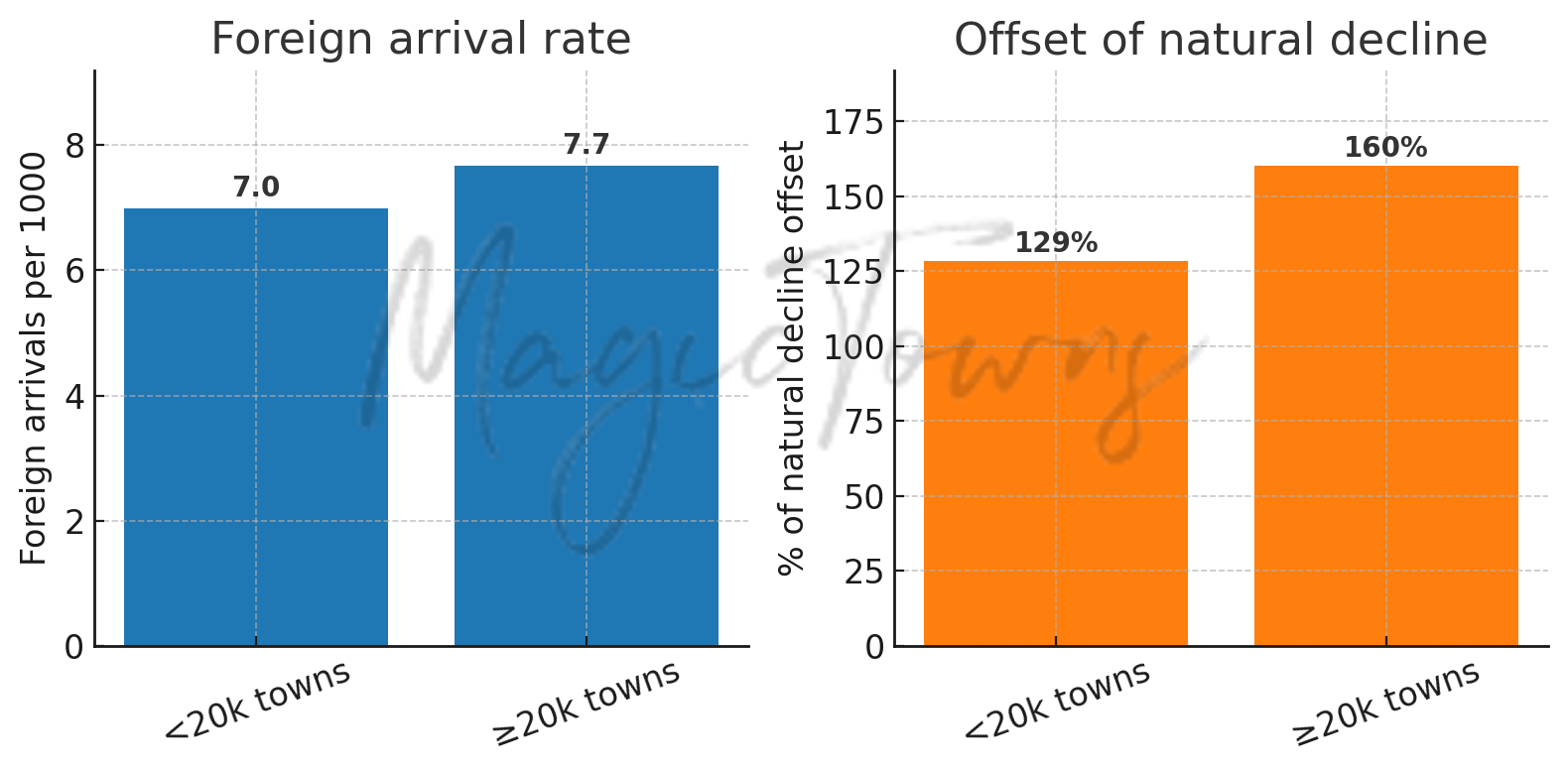
Foreign arrival rates and contribution to population balance (Jul 2024–Jun 2025). Per 1,000 residents, inflows of foreign migrants were similar in small towns and big cities (around 7–8‰). In aggregate, this was enough to offset ~129% of the natural population loss in <20k towns, and ~160% in ≥20k towns. However, many individual villages still see net declines or only slight gains.
Why do larger towns perform better? They tend to attract more immigrants (jobs, universities, established expat communities) and also often have slightly higher birth rates due to younger populations. Small rural towns, even with tax incentives, struggle to draw sufficient numbers of newcomers. The 7% flat tax has a catch-22: it targets very small communities, but many foreign retirees prefer to live in larger towns for amenities. An elderly couple from abroad might love the idea of a quiet village, but they also worry about isolation, lack of healthcare facilities, or simply the practical hassles of village life.
Likewise, €1 home schemes generated lots of press and tourist interest – and some genuine new residents – but not yet the scale to repopulate whole towns. Many buyers treat them as holiday homes or renovation projects rather than full-time moves. The initiatives are certainly not failures (they’ve saved architectural heritage and injected money into local trades), but from a pure demographic perspective their impact is modest so far.
Beyond Taxes: The Real Obstacles To Moving To Italy
If fiscal incentives alone aren’t flipping the trend, what’s missing? In a word: bureaucracy. Ask any expat in Italy and they’ll tell you the tax break was the easy part – the hard parts are visas, permits, and practical integration.
- For one, non-EU retirees must obtain an Elective Residence Visa, which has strict requirements. You need to demonstrate stable high income (around €31,000 per year for an individual) and substantial savings, show a long-term housing contract or ownership, and purchase private health insurance upfront. The paperwork can be daunting and approval isn’t guaranteed. Then upon arrival, you face the macabre dance of obtaining a permesso di soggiorno (residence permit), registering with the local city hall, and navigating language barriers throughout. Italy’s bureaucratic processes are infamous – multiple office visits, official stamps, and a lot of patience are usually required. For an older person who doesn’t speak Italian, this can be a major deterrent.
- Daily life logistics add to the friction. Take driver’s licenses: Italy does not recognize licenses from many countries (e.g. the U.S.) after one year of residency. So, foreign retirees often must pass the Italian driving exam – in Italian – to continue driving legally. It’s a challenge that has caused some expats to give up on having a car, which in a rural village is practically a necessity. Healthcare, while excellent in Italy, also requires navigating the public system enrollment or paying for private care until you qualify. And integrating into the community – making Italian friends, learning the language – is a whole other challenge, especially in areas where little English is spoken.
In short, structural and practical barriers are a big reason these repopulation efforts haven’t fully succeeded. Tax breaks and €1 homes might get people in the door, but keeping them is another matter if everyday life is too complicated. Italy’s government has started to realize that fixing the non-tax issues (streamlining visas, offering English assistance in healthcare, bilateral driver’s license agreements, etc.) may be just as important as financial incentives in attracting retirees.
Key Takeaways for Expats and Property Investors in Italy
That’s certainly a lot of data we tried to summarise here, and we hope is shed some light into what is happening with Italy’s population, and into whether these schemes to attract foreigners are working. But, practically speaking, what are the takeaways for you?
- Don’t count on the 7% tax deal lasting forever – seize the window. Generous as it is, the flat 7% regime for foreign pensioners may not be permanent. While politicians do not seem to have it on their radar, Italy’s successive government have shown that decade-old precedent can be broken with zero warning – to wit, the May 2025 draconian restrictions on citizenship. If retiring to Italy appeals to you, it could be wise to act sooner rather than later while this tax break is available (it currently can be locked in for up to 10 years). In any case, taxation is just one piece of the puzzle – factor it into your finances, but don’t let it be the only reason you move.
- Depopulation isn’t just a Southern problem – many northern and central towns are also greying out. Yes, the South is in crisis, but look beyond the headlines: even in Tuscany, Umbria, Piedmont, etc., plenty of towns are losing people. An Alpine village or an Apennine hilltown can be just as “at risk” as a Sicilian one. So if you’re eyeing a tranquil Italian community to relocate to, check its demographic trends. A shrinking town might still offer a lovely lifestyle, but be aware that local services (hospitals, transport, shops) could diminish over time if the population does.
- Visas and red tape outweigh tax perks. For non-EU folks, the biggest hurdles to retiring in Italy are administrative, not financial. The process to obtain residency, register for healthcare, and simply settle in can be arduous. These are structural barriers that Italy will need to continue addressing to truly compete as a retirement destination. In practical terms, be prepared for bureaucracy: consider hiring bilingual lawyers or relocation experts, join expat forums for tips, and approach it with patience. The 7% tax incentive won’t help you get a driver’s license or a visa – those require old-fashioned legwork. Besides, there are plenty other tax breaks what apply nationwide.
- Think long-term: check the vitality and plans of any town you invest in. If you’re seduced by a €1 house or a postcard village, research its trajectory. How many people live there year-round? Is the population half what it was 30 years ago? Are there efforts to revitalize it (e.g. a tourism plan, new infrastructure) beyond gimmicks? Depopulation can affect your quality of life – a town that loses residents might see its school close, then the only pharmacy, then the weekly market… Your property’s value and utility depend on a living community around it. It’s not all doom and gloom – many villages are innovating to survive, but as a buyer, go in with eyes open about a place’s future, not just its past charm. Use our Town Explorer to weed our towns with few amenities, supermarkets, poor infrastructure.
Italy’s demographic story is far from written. Across the country, mayors, families, and newcomers are testing ways to breathe life back into places that once seemed doomed to decline. At Magic Towns, we’ll continue to track those efforts and, frankly, we try to turn thinks around too.
If you value clear-eyed, evidence-based reporting on where Italy is heading — and where it’s still worth settling, consider subscribing to support our independent research and access our full town profiles, data tools, and relocation guides. Together, we can keep discovering the Italy that’s still very much alive.







 English
 French
 German
 Italian
 Danish