

Recent data from the Italian Ministry of Finance has poured cold water on the effectiveness of the 7% tax scheme, a headline-grabbing deal for foreign pensioners looking at settling down in Italy. The scheme, created in 2019 with the goal to repopulate sleepy southern towns, has reportedly been taken up by less than 1,000 foreign claimants – a figure that, while growing fast over the past 12 months, must fall well short of the legislator’s best hopes.
While we wait to see if the recent changes to the 7% tax scheme manage to bring in large amounts of foreign pensioners to Italy, we set out in this original analysis to understand where and how the 7% tax scheme has been effective, which nationalities have been most drawn to it, and which towns have benefitted the most from the influx of retirees.
Why should this matter to you if you’re looking at retiring in Italy? First, it is critical to understand which pockets of the South are managing to attract foreign residents – and there are quite a few. Second, if the measure, which is seen with hostility by some Italians as a tax giveaway to foreigners only, proves decidedly unsuccessful, it may be reconsidered or powered down by the government. This may have an impact, and perhaps quicken, your timeline to relocate to Italy.
Methodology note: For this analysis, we looked at comune-level foreign resident data from 2019 to 2025 across the southern regions covered by Italy’s 7% pensioner tax regime. Rather than trying to count tax claimants directly, which the resident data cannot do, we asked a more practical question: are eligible towns actually seeing the kind of foreign-resident growth one might expect if the scheme were changing behaviour? We compared towns below the 20,000-resident eligibility threshold with larger non-eligible towns in the same regions, then looked more closely at growth among Western nationalities often associated with lifestyle and retirement moves. This is not a perfect measure of the scheme’s direct impact, but it does show where foreign settlement patterns have shifted.
The 7% Tax Scheme: Quick Background
Instituted in 2019, the 7% tax scheme allows recipients of a foreign pension to benefit from a 7% flat tax on all their foreign income (not just their pension!), for up to 10 years, if they take up residency in a Southern Italian town with fewer than 30,000 inhabitants (the limit was increased from 20,000 in April 2026). Over the years, the scheme has been extended to a handful of earthquake-stricken towns in Central Italy, with the intention to bring in a gentle tide of retirees to restore life to the Mezzogiorno, one stone farmhouse at a time.
It is worth saying plainly that this is only one sliver of Italy’s foreign-resident story. ISTAT estimates that at the start of 2026 the Mezzogiorno had about 986,000 foreign residents, representing 17.7% of all foreign residents in Italy and just 5.0% of the South’s own population, far below the Centre’s 11.5%. That broader picture is shaped by very different kinds of migration. This analysis therefore narrows the lens to a “western proxy” of American, Australian, and Western European nationalities, precisely because the 7% regime is trying to attract a much smaller, lifestyle-driven segment of movers rather than explain foreign settlement in Italy as a whole.
Did The 7% Tax Scheme Work? Our Key Findings
Based on our findings, the 7% tax scheme is more of a lovely theory than fact. However, the town-level evidence is more complex, and much more interesting.
- Between 2019 and 2025, eligible towns grew total foreign residents by 7.0% versus 11.8% in non-eligible towns from the same southern regions. Yes, fewer foreigners moved to 7% towns than non-eligible towns.
- However, 7% eligible towns performed better when we only look at Western expats: +12.9% versus +4.3% in non-eligible towns.
- Looking at towns near the 20,000 population limit (which hadn’t yet been increased to 30,000 as of end 2025), we do not see a very clear effect from the policy: towns in the 15k-20k eligible band grew western-proxy residents by 10.4% versus 10.5% just above the threshold.
- Puglia, Sicilia and Abruzzo together account for 91.9% of net western-proxy growth across eligible towns.
- Campania is the weakest regional story on the scheme proxy: eligible Campania towns posted net western-proxy decline (-6.6%).
- The strongest eligible-town success corridor is in Puglia, especially Brindisi and Lecce provinces.
- The towns of Carovigno, Ceglie Messapica, Terrasini and Introdacqua stand out as successful pockets.
The safest conclusion is that the 7% regime appears to be helping in distinct pockets, but not producing a broad small-town foreign-resident boom across the eligible South.
7% Towns Edge Ahead in the Western Expats Game
Let’s start with the bluntest numbers. Across the analysed 2019–2025 panel, eligible towns increased total foreign residents by 7.0%, while non-eligible towns in the same southern regions rose by 11.8%. Only 56.2% of eligible towns recorded any foreign-resident growth at all, against 74.1% of larger southern peers. The median eligible town added only three foreign residents over the period, while the median non-eligible town added 110. So if our benchmark for “working” is broad-based foreign settlement, the scheme is not working.
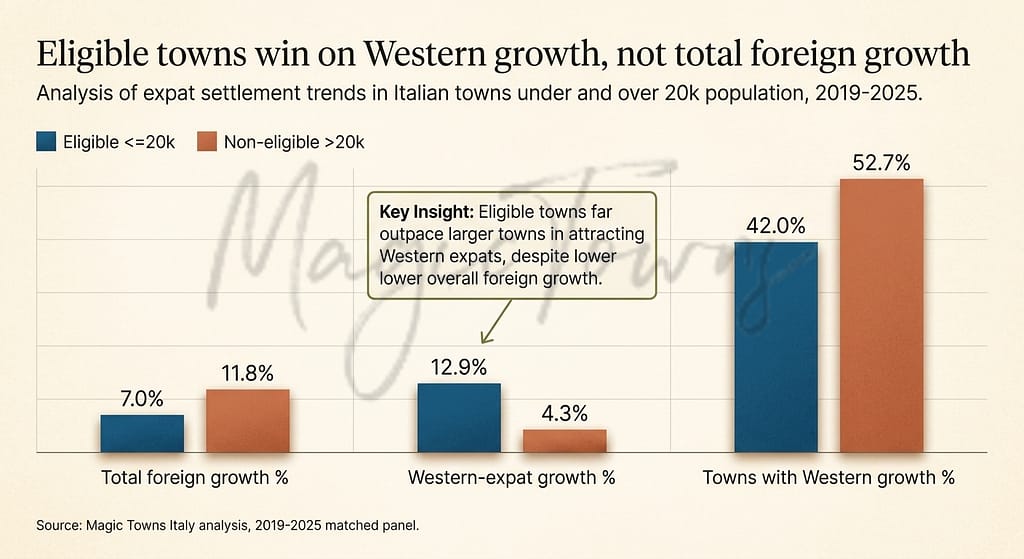
But that is not the whole picture, and it would be lazy to stop there. Eligible towns did better when we only consider Western expats: +12.9% between 2019 and 2025, against +4.3% in non-eligible southern towns. By 2025, eligible comuni accounted for 41.9% of all foreign residents in the comparison regions, but 52.9% of the western-proxy residents. That is the cleanest sign that the policy may be doing something. Eligible towns are not winning the total volumes game, but they are over-indexing for the kinds of residents the scheme was supposed to attract.
That makes the regime look less like a machine for demographic revival and more like a sorting device. It does not seem strong enough to transform the average eligible town. The scheme does seem capable of nudging more foreigners to places that already had some chance of working. A tax policy can open a door; it cannot, on its own, create a village scene, a housing market, an airport, or an established network of previous arrivals. As we discussed last week, expats tend to cluster together.
Where is the 7% Tax Scheme Working?
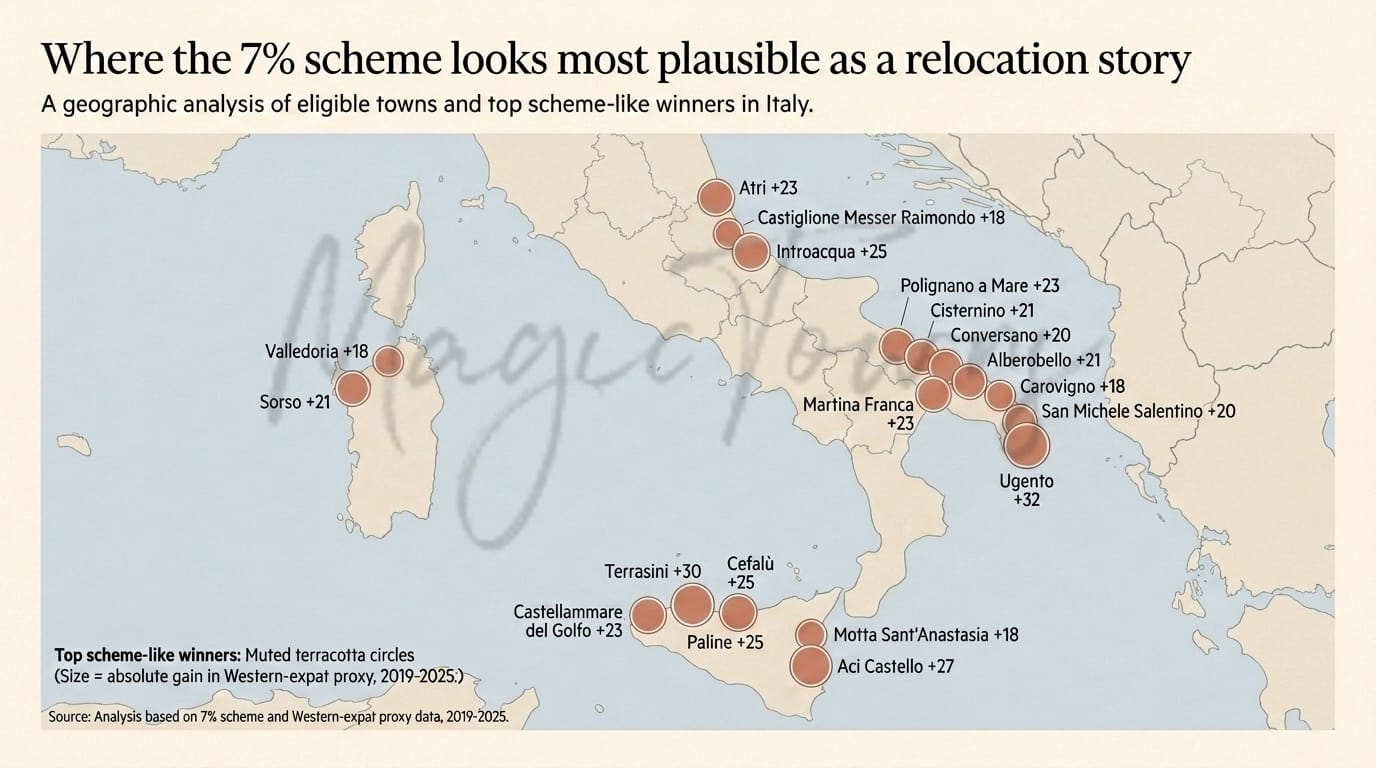
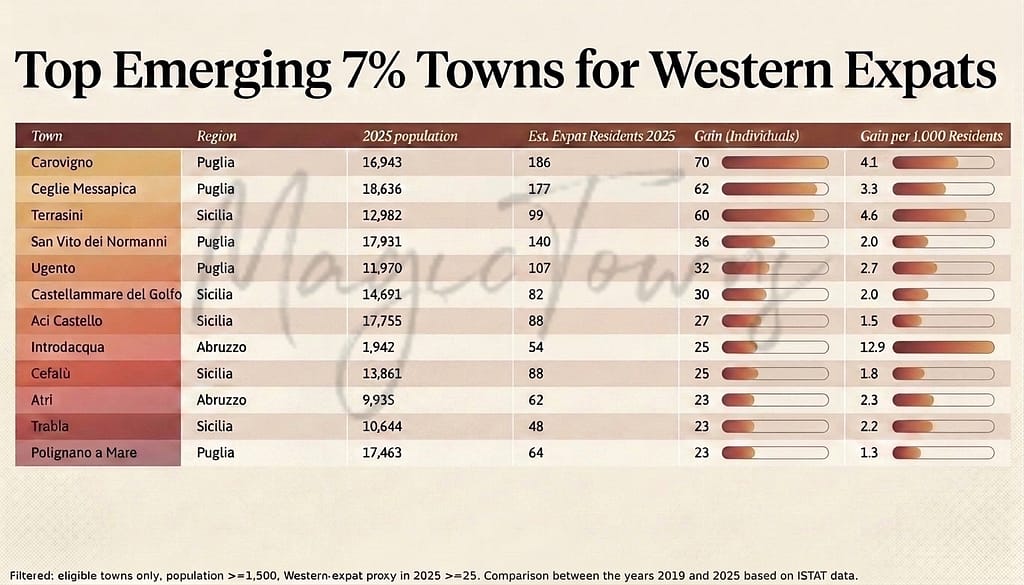
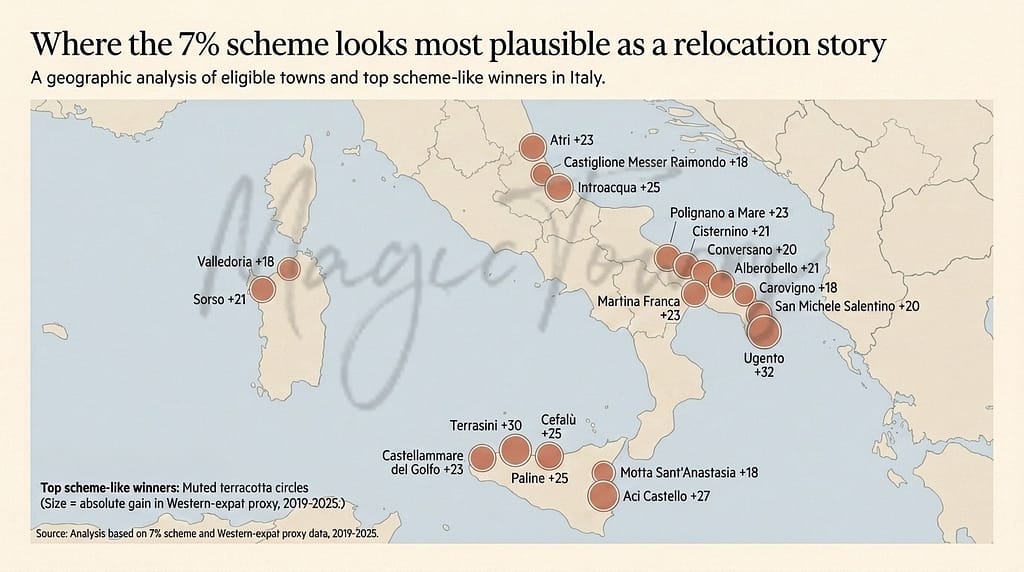
The scheme does work, locally. The clearest success story in the data is southern Puglia, especially Brindisi province. Carovigno added 70 western residents and 184 foreign residents overall between 2019 and 2025. Ceglie Messapica added 62 and 160. San Vito dei Normanni added 36 and 112. The report’s broader regional cut is equally telling: Puglia, Sicily and Abruzzo together accounted for 91.9% of net western growth across eligible towns, while province-level gains clustered above all in Lecce, Palermo, Brindisi, Chieti and Teramo. This is not a policy spreading evenly across the South. It is a policy hitching a ride on recognisable local hotspots.
The Puglia cases make intuitive sense even before you get to the tax rule. For a budget-conscious foreign crowd, it matters that real estate trades on average in Ceglie Messapica at €1,098 per square metre, versus Ostuni’s price point of €2,330 (it will be interesting to see if newly-qualifying Ostuni will get a further population boost after the April 2026 reform). That is not a minor discount; it is a completely different entry point into the same broader lifestyle geography.
Brindisi airport’s current destination list includes Amsterdam, Brussels, London, Rotterdam and Zurich among many others. If you were designing a map for cautious but curious foreign retirees, you would probably end up with something suspiciously close to this corridor: close enough to better-known hubs to borrow their appeal, cheap enough to feel like value, and connected enough not to feel like exile.
Sicily’s winners are real too, though they look more like a set of pockets. Terrasini is the standout, adding 60 western-proxy residents and showing particularly strong American momentum. Other convincing cases include Castellammare del Golfo, Cefalù, Trabia, Aci Castello and Balestrate. In Sicily, the scheme seems to favour towns that combine recognisable beauty with enough practical viability.
Abruzzo, meanwhile, offers the most revealing counter-stereotype. Its stronger cases are often inland, smaller and quieter. Introdacqua added 25 western residents even while its total foreign-resident count fell, which pushed the western share of its foreign population up by nearly 24 percentage points. Palombaro, Cellino Attanasio and Castiglione Messer Raimondo also stand out for the sheer weight of western residents relative to local size.
And again, the logic is not terribly mysterious. Aside from being a long-time British favourite, Abruzzo airport currently connects regularly to Brussels Charleroi, London Stansted, Luxembourg, Düsseldorf and Prague, with property prices comfortably under the €1,000 per square metre mark. Without over-romanticising Abruzzo, for a foreign retiree or pre-retiree, that is a compelling combination of affordability and access.
Plenty of Eligible Towns Are Going Nowhere
If we want to be serious, we must also consider the disappointments. Campania is the clearest warning sign. In aggregate, eligible Campania towns posted a 6.6% decline in western expat residents, making it the weakest regional story in the analysis. Calabria was not as visibly poor as Campania, but it was still close to flat and nowhere near Puglia or Sicily.
The more awkward result is that some of the underperformers are places an outsider might have assumed would be automatic winners. Sorrento, Lipari and Taormina all lost western residents between 2019 and 2025. Giardini-Naxos also lost western-proxy residents despite growing in total foreign residents. Policoro, Siniscola, Bosa, Guardiagrele, Ascea, Anacapri and Procida also appear in the report’s weaker set. So the tax break is clearly not enough to turn every attractive or scenic town into an expat growth story.
There is a second category of town that matters just as much: places that are attracting foreigners, but probably not because of the 7% regime. Ordona, Capua, Carapelle, Villa Literno, San Ferdinando di Puglia and Rosarno all posted very strong total foreign-resident gains, yet their western shifts were modest. That is a useful corrective for expats reading headline numbers too quickly. A town can gain foreigners without gaining the “Western expat” sort of foreigners. Not every foreign-resident boom is an expat or retiree story.
The Nationality Map is Not One Story
Nationality is one of the more persuasive parts of the case for a partial policy effect. Eligible towns added 301 Americans between 2019 and 2025, while larger southern towns added only 49. They added 165 Britons, while larger southern towns lost 132. Dutch presence also spread more widely through eligible towns: the number of eligible comuni with at least one Dutch resident rose by 62, compared with only three in the non-eligible group. If one were looking for the simplest sign that the regime is attracting the kind of movers it was pitched toward, this would be it.
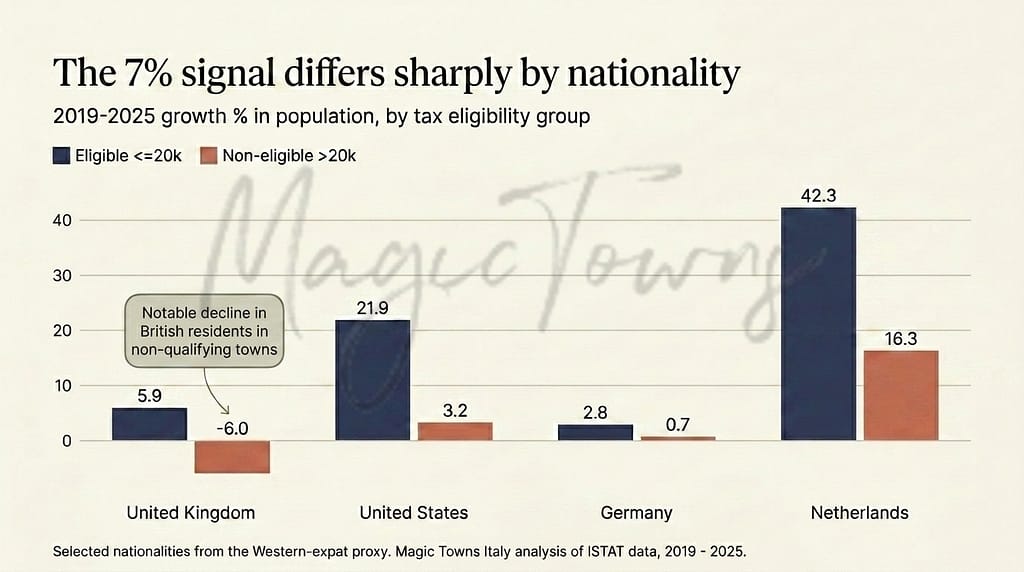
The British map is especially revealing because it does not simply reproduce the obvious postcard destinations. We see stronger British increases in places such as Casoli, Roccaspinalveti, Casalanguida, Palmoli and Castiglione Messer Raimondo in Abruzzo, as well as San Michele Salentino and Ceglie Messapica in Puglia. This confirms our “expat clusters” theory:: it suggests British settlement is following networks rather than prestige: the place where somebody already moved, renovated a house, joined the local Facebook group and told friends it was possible.
Americans seem to be behaving differently. Terrasini is a particularly notable case in this pattern: fewer towns, but clearer jumps where access, services and a recognisable lifestyle proposition line up. In other words, not quite the old British-Abruzzo model of many small footholds, but a more concentrated search for places that still feel Italian without feeling impossible to live in day to day.
Germans are part of the broader western mix, of course, but the clearest gains exist among Americans, Britons, Belgians and Dutch residents. That is worth noticing because popular expat lore often assumes northern Europeans move as one bloc. They do not.
The 20,000 Residents Line Has Little Impact
The most important result may be the one policymakers would least enjoy. Once we look at the tight line near the legal cut-off of 20,000 residents, we see that it is not a magic line. In the 15,000–20,000 eligible band, total foreign-resident growth was 11.4%; in the 20,000–30,000 non-eligible band, it was 11.5%. Western-proxy growth was 10.4% versus 10.5%. That is about as close to a statistical shrug as data will ever show you. The threshold may matter administratively. In behavioural terms, it does not appear to create a dramatic break in settlement patterns.
That result is crucial for expats because it changes the practical question. The right question is not “is this town eligible?” The right question is “is this town part of a place people like me are already choosing?” We already see spillovers from non-eligible anchors such as Ostuni, Noto and Sulmona (all of which are now eligible) into nearby eligible towns. That is exactly what one would expect if the true engine is imitation rather than legislation.
Put differently, the scheme is working best where it is least solitary. Expats, rather sensibly, seem to follow each other before they follow tax policy.
Is The 7% Tax Scheme Working? The Verdict For Expats
So, does Italy’s 7% pensioner regime work? Yes, if by “work” you mean that it appears to help certain already-promising towns deepen a western expat foothold. No, if by “work” you mean that it has broadly redirected foreign settlement across southern Italy or transformed the average eligible comune into an expat success story.
For anyone actually considering a move, the practical lesson very un-romantic. Start with clusters, not isolated bargains. Compare the eligible town with the larger hub next door. Look at whether the western share is rising, not merely whether the town has foreigners on paper. Pay attention to asking prices and airport links. And be wary of places whose reputation for beauty outruns their recent settlement numbers. The policy may open the door. But the people still choose the place.
With all the due caveats as regards our methodology (we look at residents, not pensioners and not tax claimants), the pattern it reveals is coherent enough to be useful. Italy’s 7% regime is not remaking the map. It is sharpening a few parts of it. And in expat geography, that may be the more realistic kind of success anyway.
Sources
This analysis is based on Magic Towns Italy’s own matched comune-level panel of foreign residents from 2019 to 2025, covering towns in Abruzzo, Basilicata, Calabria, Campania, Molise, Puglia, Sardinia and Sicily. We classified towns according to the 7% regime’s pre-2026 eligibility threshold of 20,000 residents, then compared eligible towns with larger non-eligible towns in the same regions. The analysis uses total foreign residents and a narrower “Western-proxy” group of nationalities associated with lifestyle and retirement migration; it does not identify actual 7% tax claimants, pensioners or individual tax residents.
Legal and policy context comes from Article 24-ter of Italy’s TUIR, Agenzia delle Entrate materials on the substitute tax for foreign pensioners, and the 2026 SME Law, which raised the southern-town population threshold from 20,000 to 30,000 residents from 7 April 2026.
Population and foreign-resident context is based on ISTAT demographic data and comune-level resident-population releases, including 2025 demographic updates.









 English
 French
 German
 Italian
 Danish