


Luca : Joyeux samedi à tous. Bienvenue dans le podcast de Magic Towns Italie.
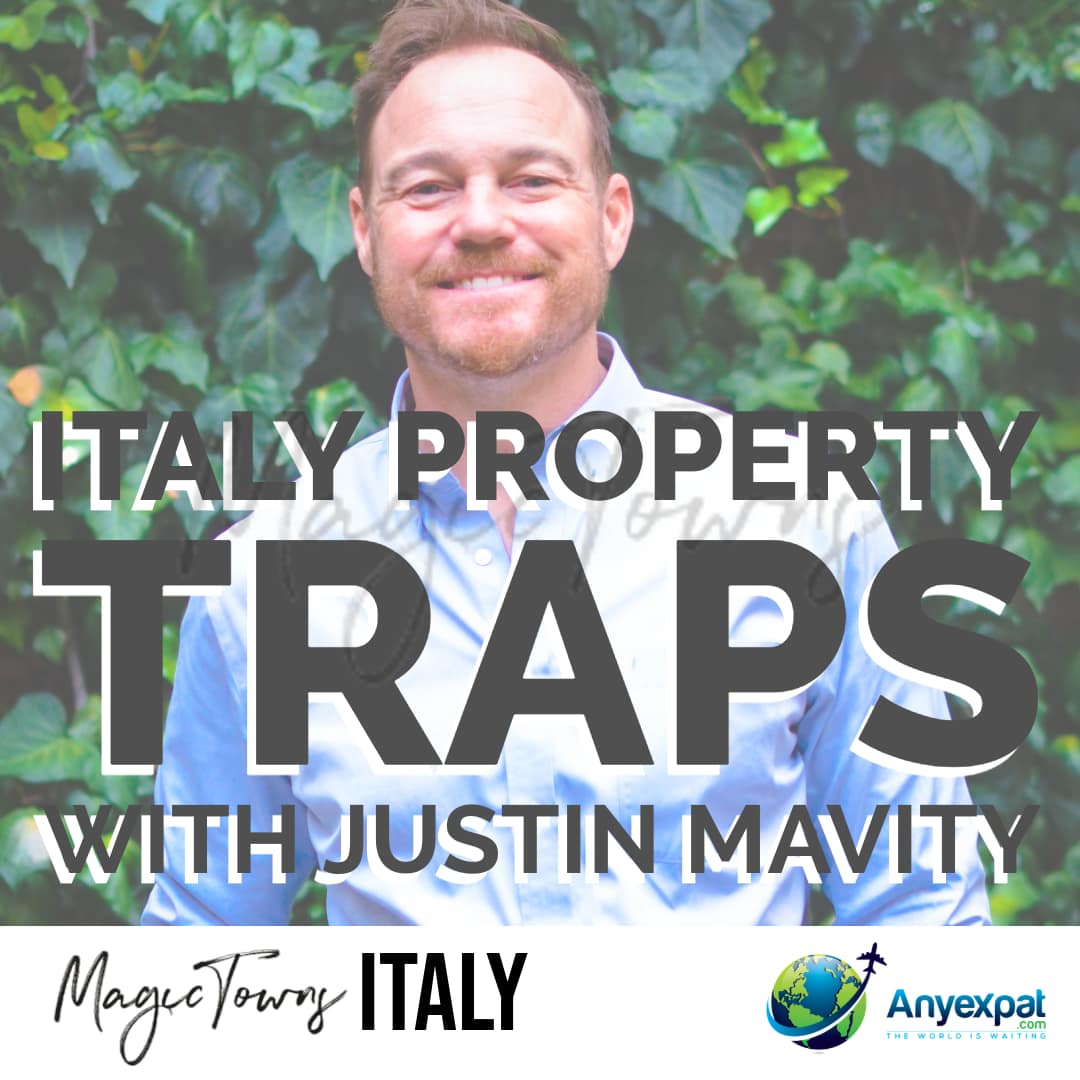
This week we have a special guest. Justin Curtis Mavity. He’s been a real estate agent, one of the very few qualified, licensed, real estate agents from America in Italy.
Après 10 ans passés dans le pays, il a beaucoup à dire sur l'achat d'une propriété, les quartiers à privilégier et ceux à éviter. Vous pouvez l'entendre directement dans ses mots.
Enchanté de vous rencontrer, Justin.
Justin : Vous aussi. Luca.
Luca : Je pense qu'il serait intéressant de commencer par la façon dont vous êtes arrivés en Italie.
Justin : In 2017. I had been a teacher for about 15 years. I was a music teacher, in a public middle school in a suburb of Denver. And I’d always had this love of Italy. I’d been on several vacations before, and in fact, that’s how I discovered Bologne. Nous nous sommes [00:01:00] arrêtés à Bologne et je me suis dit que cet endroit était magique.
J'ai étudié l'italien pendant un an, une année entière, et avant de commencer à mettre les pieds dans le plat et d'être, vous savez, fonctionnel.
En Italie,
Luca : Aviez-vous un réseau ou avez-vous choisi Bologne parce que vous l'avez aimée lors de votre visite ? Euh..,
Justin : À Denver, nous avons une amie italienne, Lucia, qui vient de Bologne. Et donc c'était, euh, c'était la connexion. Au moins, il y avait quelqu'un, euh, que je pouvais contacter en cas d'urgence.
Luca : So you’ve been there for the best part of 10 years?
Justin : Yeah. For the best part of 10 years. It’s changed quite a lot, honestly. I mean, when I first came to Bologna, it was. It was a touristy city in the summer, of course, but not as much as Florence or Rome or Milan in the last few years, especially after COVID tourism here has exploded.
It’s, it’s noticeable. And then of course, you know, May and July are just, just chaos if you’re in Piazza Maggiore at this point. Yeah,
Luca : That still doesn’t explain how you got into real estate here, right?
Justin : So, real estate in the United States was always going to be my backup plan, my, my second career, I started so [00:02:00] young, I could have retired at 52. Uh, I’m gonna be 45 this year.
Luca : Aller au 81.
Justin : Oui, allez à 81. Exactement. Une fois que j'ai eu les pieds sur terre, j'ai bien sûr dû enseigner l'anglais, comme beaucoup d'entre nous, pour survivre, se nourrir et payer le loyer.
That was a several years long process just to even get into the real estate course here and get started. It was already something that was in my mind to do. And so when I came here, I thought, gosh, this is a supernatural fit. I mean, I’m an American. This is something I wanted to do. There is nobody basically doing this here that I know of.
Luca : Un fossé énorme.
Justin : Oui, absolument.
I got my real estate license in the spring in May of 2023. And I’m sure you guys are a bit familiar with this process, that you have to do the, the written multiple choice exam and if you pass that, then you need to go onto this oral exam in front of a panel of experts and a live audience.
I passed that and I thought, gosh, I’m gonna get picked up by, by anybody. So I went to all the big agencies in town and they’re like, you can answer phones and do translations.
Luca : Vraiment ? [00:03:00]
Justin : Wow. That’s all. That’s all we can do with you. And then you can work.
But I did find a small local agency. They didn’t quite know what to do with me either, but at least they trained me and supported me with what I wanted to do. I kind of felt ready to go out on my own at that point.
Luca : Mais vous avez survécu.
Justin : J'ai survécu.
I know, but there’s, as far as I know, here in Bologna, there’s no one else that has a license that’s doing what I’m doing.
Luca : Il y a beaucoup de gens qui n'ont pas de permis.
Oui, bien sûr. Bien sûr. Surtout les expatriés.
Justin : Oh oui, exactement.
Luca : Que pensez-vous de cela ?
Justin : Si vous êtes pris en flagrant délit, vous pouvez être condamné à une amende pour avoir agi illégalement. Et en théorie, après la troisième fois, vous pouvez aller en prison. Personne ne va en prison. Le danger pour un client qui travaille avec l'une de ces personnes, c'est que ma licence et mon assurance sont une garantie pour vous, n'est-ce pas ?
Ainsi, si je fais quelque chose de mal qui nuit à votre transaction, vous avez un recours contre moi.
You chose to work with somebody who’s unlicensed. You have no recourse. You have no way to protect yourself.
Luca : I was curious if you still [00:04:00] specialize in Bologna itself, or you’ve kind of gone countrywide,
Justin : I’ll go all the way down to Puglia and I will work throughout the country. There are areas that I tend to avoid.
I’m not a huge fan of going to Sicily, Rome is its own particular animal when it comes to real estate as well.
Luca : Quel type de clients avez-vous et ces personnes connaissent-elles généralement l'Italie avant de vous dire qu'elles veulent trouver une maison au bord du lac ?
Justin : So I’m really clear with clients and say, you know, what are you looking for and where do you want it to be? And it’s really critical first that they have that where identified. Because Italy is very big and vastly different from city to city to region. I mean, nothing is the same.
And so if they don’t have that in their head and they say, well, Justin, I want a house by a lake. Well, there’s a lot of lakes in Italy that are, one is quite different from the other. And the other thing I tell them is you need to have been there first. If I’m going to work with you, if you are going to be looking in Côme. Have you been to Como? Do you think you’re going to like Como? Or are you just [00:05:00] buying Como? Because that happens
Luca : beaucoup cependant.
Justin : Oui, c'est vrai. Cela arrive souvent.
Luca : C'est alors que vous commencez à leur tenir la main. Ils sont allés à la Villa George Clooney, ils l'ont vue, et ils veulent celle d'à côté.
Justin : I work very collaboratively with my clients where I put together a spreadsheet and we all add things to it, you know, so they’re adding things, I’m adding things to it.
It’s a big process of elimination. I want them to feel like what they’re seeing is worth their time to see and not just something that I’ve put together for them.
Gillian : I think we’ve been on the tail end of that where you are with an agent who wants to show the seller that they’ve done the work. So they’re taking you to completely inappropriate properties just to put someone through the front door for the sellers.
Luca : Hey, I’m doing my job. I brought you two buyers.
Justin : Yeah, exactly. Yeah. Look, and they’re foreigners too. I told you I’d bring foreigners to your property. I promised you that right?.
Luca : Quelles sont, selon vous, les principales différences entre le système américain et le système italien ?
Justin : Par où commencer ?
Luca : Nous avons trois [00:06:00] heures. Juste du côté de la propriété
Justin : Everybody comments on the fact that a property inspection, like we have the United States, doesn’t exist. You can have an electrician come out, you can have a plumber come out, you can have a roofer come out, and you can get a general sense of the house in that way. But there’s no, I’m selling my property and I’m going to have the whole property inspected.
That doesn’t work here. If we want that kind of service, we really are gonna have to provide for that generally on our own.
Another big thing, people find it really strange that they’re required to make an offer and give earnest money immediately and often, uh, you know, people expect that as a seller, they expect that in their hands, but a good agent’s not going to let let that happen.
They’re gonna make that money go to the notary anyhow, which is what I do for my clients.
It’s always going to the notary, even if it costs you a little bit of money to hold it in there with the notary, well worth the protection if the deal falls apart.
Gillian : Par exemple, en Angleterre, lorsque vous achetez un bien immobilier, vous devez procéder à toutes les vérifications préalables avant l'échange, ce qui peut prendre jusqu'à quatre mois et [00:07:00] vous pouvez le perdre à la dernière minute ou quelque chose peut mal se passer.
Whereas I, Italy, it’s, it’s much quicker.
Justin : It’s funny that you say that, Gillian, because again I worked with in, uh, Assise in December with clients from the UK and they explained that to me that the deal can fall through. Even the day that you’re supposed to close, that the sellers can just walk away and say, no, I wanna sell it to somebody else.
Gillian : Correct.
Justin : That’s wild to me. One thing I I disagree with you on though, is the speed. Many of my clients are from the United States, not all but many are, and they’re surprised by how slow it is. Here. So they’re on the opposite side of that and they’re saying, wait, you know, I’m a cash buyer. What do you mean it’s gonna take four months to close? Five months to close.
Luca : It depends a lot on the property itself. I’ve seen properties close in days. And I’ve seen, I mean, we’re on, we’re on a contract now for a property for, what, two years, and it has been extended for another two years.
But it’s the beauty Italian system, I think.
Justin : Oui, c'est vrai.
Luca : Oui. Parce que le notaire ne le fera pas, le notaire est un très bon ami de l'acheteur.
Justin : [00:08:00] The notary works for you as the buyer. That’s the key thing.
Luca : En fait, vous pouvez faire en sorte que l'offre soit acceptée. En sachant qu'à ce moment-là, le notaire mettra tous les bâtons dans les roues possibles pour que tout se passe bien.
Justin : But this is another thing that’s different from, you know, in, in Italy than in other countries. A lot of other countries, the settlers already going to have done. All of this work before putting the property on the market, or at least be really aware of what’s coming up in many, many other countries. I feel like sellers are generally much more prepared to sell the property than they are here.
Gillian : Vous avez peut-être une expérience différente, mais j'ai aussi trouvé que les vendeurs, les vacants, et vous savez, ils ont littéralement laissé des vêtements dans l'armoire, comme si c'était le cas.
Justin : One key element of of that of course, is to insert that there’s going to be an inspection walkthrough the day of or the day before the closing. With everybody present.
But that property in Assisi that happened, we had stipulated everything’s gonna be empty, everything’s gonna be cleaned out, ready to go. And we got there and all the store rooms were just full of junk still, you know, garbage broken [00:09:00] exercise bikes. And so the notary withheld, you know, 10,000 euros and said, I’m holding this money until you fulfill the obligations in the contract here.
Vous m'avez posé une question sur laquelle j'aimerais revenir. Vous m'avez demandé si j'étais toujours un spécialiste à Bologne ?
I work less in Bologna than I do outside of Bologna by far. I think that renting and buying here in Bologna have become so expensive in the last few years, and that’s really chasing people away.
Luca : I’m very keen to understand from you where you see, areas of opportunity.
Justin : Je pense au nord de la Toscane. est une région très peu connue, à l'exception de Lucques. J'ai l'impression que Lucques, c'est un peu comme aller à Disneyland. J'y vais et il y a des familles américaines qui poussent des enfants dans des poussettes. Je n'entends parler que l'anglais dans la rue.
Luca : But the Lunigiana, I think is what you’re referring to.
Justin : Exactement. C'est vraiment magnifique. On peut acheter de magnifiques maisons en pierre dans ces petits villages qui ne sont accessibles qu'au prix de 30 000 ou 40 000 euros.
Luca : Has an interesting history because it, it used to be a very poor area [00:10:00] and it is also may surprise you the rainiest area of Italy. So you’re not going there for the sun necessarily? No. But with the global warming. I don’t think that’s necessarily a bad idea. When you go there in the summer, it’s like, oh, this is actually nice
Justin : it’s really pleasant. Another area, and I have to, you know, put a shout out to my home area here. Bologna is its own thing, but the Bolognese Appennines and Modenese Appenines and that area, you can still buy again, really gorgeous properties, stone villas, farmhouses, whatever you want for really reasonable prices.
The hills are a little different than, you know, Sienna. We’re not talking about that rolling, undulating, uh, lovely greenery, but it’s still absolutely stunning. Opportunities left and right. No one knows about that area yet.
Luca : No, of course not. And they are areas where the depopulation has been massive, uh, in the past 30, 40 years, and therefore people are desperate to get rid of the [00:11:00] grandparents’ house.
Yeah. But that doesn’t mean that they’re not beautiful. In fact, as you say. Maybe if you got some of the Tuscan crowd over there, they might struggle to see the difference. I often say to people that if you blindfold them, you take them around Italy and you say, this is Tuscany, they’ll be like, yeah, I can see that.
That’s Tuscany. Yeah, that’s not Tuscany.
Justin : It’s not Tuscany. Yeah, exactly.
Luca : Oui, c'est vrai. Sauf que si l'on enlève un zéro au prix de vente, on se rend compte que la réalité est différente.
Justin : The other thing about this area too, over here near Bologna is that of course we’re really well connected. You know, we have, uh, the airport in Bologna, which has a zillion flights coming in, out, in and out every day. The train station in Bologna, of course, is a major hub, uh, for trains all throughout Italy that are going north and south. So, I mean, for anybody arriving. It’s a great place to start out.
Luca : It is for the taking for the people that take the time to get out of the beaten track. I hope that we get more and more of the, you know, the foreign crowd to go and explore and, uh, try to revitalize these places, which frankly need it. We don’t need as [00:12:00] many 2 million euro sold in Tuscany. We need more of the a hundred thousand farmhouses in Emilia Romagna sold,
Justin : Exactly. We wanna re revitalize and maintain, you know, the culture in these areas. That’s really, really important.
Anna : I just have a question, I’m talking about people that have never been to Italy, and then just have the idea in their mind and realize later that that’s not like the right place for them.
Justin : Well, I think it’s kind of wherever the “in” place is at the moment.
You’re probably following these trends on social media. I mean, I feel like Puglia, these last couple years has really been all over social media, but people get in to Puglia and it’s, yeah, it’s gorgeous. It is really a wonderful place.
But if you’re moving down there to live full-time, you really have to be knowing what you’re getting into and the area you’re buying into. One of my colleagues was recently talking to a family, an American family who fell into this trap in Puglia, bought in some little village, a really gorgeous house, you know, of course made of stone and wonderful. And they [00:13:00] paid nothing but. They said, we have to get out of here. It’s, it is wonderful if you’re vacationing perhaps, but to live here full time, in the winter there’s nothing going on. We find the people kind of closed off. It doesn’t have all the services that we want. And so, they, to go back to your question, they kind of get sucked into whatever this social media trap is at the moment or whatever the big publicity is at the moment, so now it’s Puglia, the last couple previously, of course it was Tuscany and Umbria. And of course the, they still kind of also dominate. Who knows what will be next. I see Sardinia popping up a lot, uh, recently, and you know, people are gonna get sucked into that trap as well, you know. Yes. Living in Sardinia would be wonderful. I mean, we just, we spent, several weeks in, in Sardinia last summer. It was great. Would I have wanted to live there all year round in December, January, February, with nobody around, no services?
These stereotypes only show the positives. You know, that’s all that people are getting is they don’t get the reality of these places.
Luca : We talked a lot about buying. But a lot of people come here wanting to rent [00:14:00] and they know from experience what a cultural shock that is. Can you tell us a little bit about the foreign perspective of what it’s like to actually find someone to rent?
Justin : Yeah. Boy, that was a challenge for me 10 years ago, and now it’s gotten even more challenging. It’s not like in the, in many countries where if I go into a rental agency or even meet a landlord for a property and I have a wad of cash, I can just kind of throw that wad of cash at them and I’m probably going to get the apartment, this happens a lot in the United States.
Of course they’re gonna let me sign a rental contract and pay money up front. Italy doesn’t work like that because of course we have a lot of tenants protections, tenants rights. You put somebody in that property with a registered contract and it is really hard, as we all know.
It’s easier to divorce, it’s easier to divorce than it is to get the tenants out of your property. And so property owners are really leery about this. And then of course, we have this mafia history. So you show up with this giant bag of cash. You say, I can pay you 10,000 euros [00:15:00] today. What are these landlords supposed to be thinking?
Italy doesn’t work like that. You really have to demonstrate your value as a tenant.
Là encore, vous devez avoir un emploi et des revenus. Vous devriez avoir une lettre de présentation de l'entreprise qui explique ce que vous faites et combien d'argent vous gagnez.
You have to show a tax return. They need to see that you have consistent income coming in. Wherever it’s from, it’s not what you have some value to offer to the landlord. You have to present yourself in the best, most secure way possible.
Luca : It’s like a job interview in
Justin : d'une manière ou d'une autre.
Luca : Oui.
Justin : Landlords will let their property sit vacant rather than put the wrong tenant in a property, right? Because they don’t wanna risk putting the wrong person in there who stops paying.
Luca : Changer, c'est un peu ce que je ressens avec ces, euh, contrats transitoires, comme, vous savez, les contrats d'un an.
So there seems to be a little bit more flexibility because people feel like, uh, if they put a tenant down as a tourist, that the tenant loses a lot of the protections under the law, whether they that is actually [00:16:00] enforceable or not. Yeah. Well that’s,
Justin : Oui.
Luca : There’s still the issue of the furniture.
En d'autres termes, si vous finissez par trouver un appartement, vous devez apporter non seulement tous les meubles, mais aussi très souvent la cuisine. C'est choquant.
Justin : That’s not, not so much the case anymore. I’ve found, and again, I, and I, I mentioned this to everybody. That’s very uncommon anymore that you find an apartment with, nothing.
I think that here in this area, it’s more common to find in furnishings included of some kind, at least a kitchen, you know, maybe also a washing machine, maybe also some general furniture of the house. Um, but that is surprising when people see that they say, wait a second, it says fully furnished, but maybe it doesn’t literally have every single thing. That you can think of, you know, maybe it’s fully furnished and it has a, you know, kitchen table and chairs or dining room table chairs and a bed in each room and a wardrobe in each room. And that’s really about it.
Other thing about security that landlords want is they want somebody who’s going to be in there paying rent on time, and they want somebody who’s gonna be in there paying rent on time for a long time, right?
They want that income [00:17:00] year after year. So here, at least in my area, they’re looking for, you know, traditional four plus four or three plus two contracts, uh, with tenants. Do
Luca : you find that people are surprised that when they come to Italy and they find that renting generally means, uh, hey, I’m signing a contract for three or four years?
Justin : Yes, I do my best to explain this to ’em, of course, upfront and say, you know, generally there’s going to be a, an escape clause of three months, you know, for whatever reason for you, you know, we’re gonna try on our best to make sure that happens. And there, and as you know, there has to be an escape clause anyhow in the contract.
So you have to do a little preparation and understand. Yeah, it seems scary. I could be locked into this thing for eight years, but yeah, that’s an eight year contract that I can break anytime with three months notice, so that becomes way less scary.
Luca : Je suppose que vous devez courir.
Justin : Yes. I should probably go even though I’m really enjoying myself and I could keep talking for hours.
Luca : We’d happy to do a follow up.
Justin : I always see these articles on CNN about how wonderful it is to move to Italy and buy your one euro home and renovate it and look how, you know, how happy this 75-year-old [00:18:00] couple is that, you know, it’s just what
Luca : C'est une belle histoire parce que nous parlions la semaine dernière de cette femme que nous avons rencontrée dans une ville d'un euro. Elle était comme celle que vous avez mentionnée dans les Pouilles. Sortez-moi de là. Sortez-moi de là.
Justin : Que peut-on y faire ?
Luca : There’s a reason why they can’t sell the homes, but then again, if they sell enough of those homes, they
Anna : réparer cela
Luca : si cela résout le problème. Ainsi, il est possible d'obtenir des informations sur l'état d'avancement de la mise en œuvre.
Justin : it does, it does. It really depends on the village though, doesn’t it?
It has to be just the right village and just the right place. With just enough level of services. I, it’s one in a
Luca : mille.
Justin : Yeah. A lot of these villages really have nothing. They have nothing. It’s just a glob of houses, a collection of houses, ruined houses. It doesn’t even have the post office. Right. What attraction is there?
Luca : Nous espérons avoir l'occasion de vous revoir bientôt.
Luca : Thanks to Justin. It was great fun to have him. We’ll be back for part two with him. What do you think, Gill? You’ve spoken to him a couple times.
Gillian : Je l'ai trouvé fantastique. Les gens ont des vies et des besoins variés, ils veulent des choses différentes et il [00:19:00] semble le comprendre.
Luca : Yeah. And we certainly understand that. After all, that’s what we do. Try to highlight a huge country in all its multifaceted variety.
Gillian : Une chose que j'ai trouvée très intéressante dans ce que vous avez dit, c'est qu'il faut faire ses recherches et ses devoirs avant de dire, à l'improviste, que l'on veut une maison dans la région.
Luca : Toscane.
Gillian : Oui. La Toscane.
Luca : Yeah. Don’t call from Antarctica and say you wanna move to Tuscany if you haven’t been there because, uh, well at least don’t call Justin because he might not like that. I hope you have a fantastic weekend.
Gillian : Je vous remercie.
 English
 French
 German
 Italian
 Danish