


If you’ve been in Italy for a while and tried to do anything official online, you’ve probably already hit a wall asking for “SPID” or “CIE” before letting you go any further. They get lumped together, but they’re not the same thing, and getting SPID as an expatrié isn’t quite the same process as getting CIE. The confusing part isn’t really what they do – it’s figuring out which one you actually need, whether you can even get one yet, and what changes if you’re not a resident. So let’s go through it properly, starting with where this whole digital identity question actually comes up.
Where digital identity actually comes up, and your two ways in
As much as people complain about how slow and complicated La bureaucratie italienne can be, Italy is actually pouring a ton of investment into digitalizing public services right now – enough to be ahead of the European average. Which is exactly why it’s worth getting your head around two things that trip up a lot of expats: SPID, CIE, and how you actually use them.
These days there’s no shortage of situations where you’ll be asked for one or the other, from logging into your INPS account for anything to do with pensions, family allowances or unemployment benefits, to filing or checking things with the Agenzia delle Entrate (the tax office), to activating and viewing your Fascicolo Sanitario Elettronico – your electronic health record, where your GP, prescriptions and test results eventually live – and using the IO app, which the government relies on for everything from paying local taxes to claiming the odd bonus that comes along. Universities and some school portals ask for it too, and INAIL (workplace accident insurance) requires it as well.
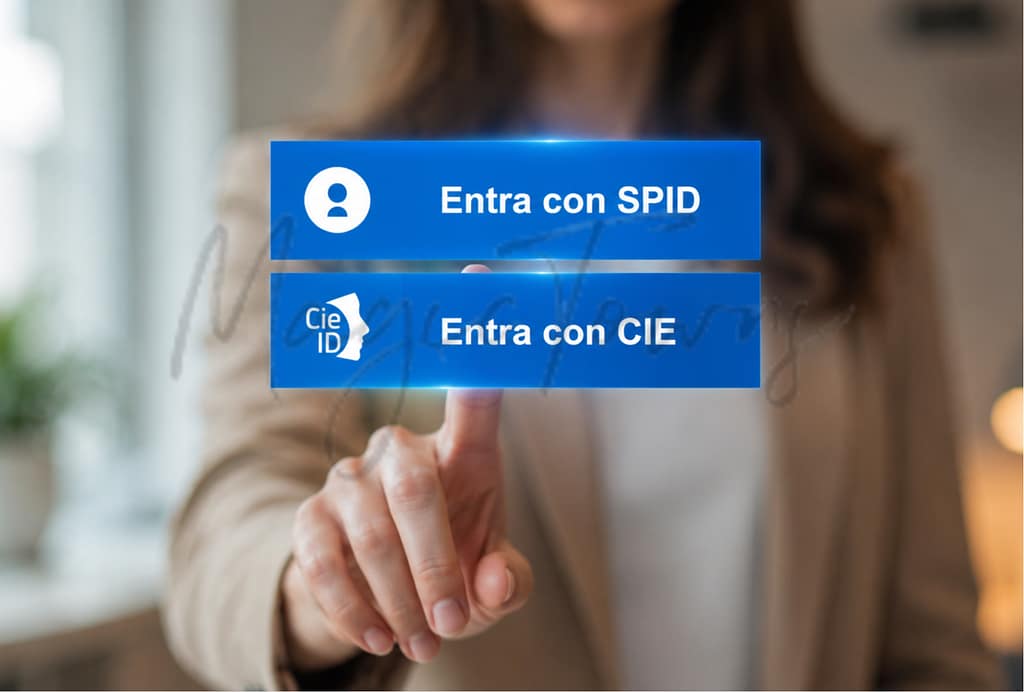
Whenever it comes up, you’ll almost always see two doors in: an “Entra con SPID” button, and increasingly, right next to it, the option to log in with your CIE instead. Which one you end up relying on has less to do with any fixed rule and more to do with which one you happen to have sorted first – and, as it turns out, you don’t strictly need both. Since practically every resident of Italy ends up with a CIE regardless of whether they ever think about digital identity, it makes sense to start there.
What CIE actually is
CIE stands for Carta d’Identità Elettronica, the electronic ID card, issued by your comune through the Ministero dell’Interno. Before it’s anything digital, it’s simply the physical ID you need for everyday life here – the thing you show a police officer, or use to pick up a package, or hand over whenever something asks for proof of who you are. Every resident of Italy, citizen or not, ends up needing one eventually, since comuni have largely stopped issuing the old paper cards altogether. In practice, that means once your residency is sorted and you go to request your first Italian ID document, what the clerk actually hands you will be a CIE, not paper – so you arrive at this point regardless of whether digital identity was ever part of your plan.
What makes it more than a normal ID card is the chip inside, which lets it double as a digital identity, with the same three security levels as SPID: level 1 for basic login, level 2 with a one-time code, level 3 with an extra physical device. To actually use it that way, you install the government’s CieID app on your phone and pair it with two separate PIN codes – one handed to you at the comune when the card is issued, the other mailed to you separately afterwards – plus a phone that can read the card’s chip over NFC, or a card reader if you’re on a computer.
Because CIE is officially recognised for the same identification purposes as SPID, most of the services that ask for one will just as happily accept the other. So technically, once your CIE is set up for digital use, you don’t have to bother getting SPID separately at all. CIE alone will get you through nearly tout.
For an expat, validity doesn’t work quite the way it does for Italian citizens, who get a straightforward ten-year card once they’re adults (five years for minors aged 3 to 18, three years under 3). As a foreign resident, you can only apply once you’re properly registered as a résident (iscrizione anagrafica), and if you’re a non-EU citizen, you’ll also need a valid autorisation de séjour in hand first. Once you have the card, its validity is anchored to your permesso di soggiorno rather than the standard ten-year cycle Italians get, and it only proves who you are inside Italy – it’s not a substitute for your passport if you’re crossing a border.

What SPID actually is, and whether it’s still worth getting
If CIE alone can get you through nearly everything, it’s fair to ask why SPID gets talked about so much. The short answer is convenience.
SPID stands for Sistema Pubblico di Identità Digitale, and it isn’t issued by the government directly. AgID, the government agency in charge of the whole system, accredits private companies to hand it out instead – nine of them at the moment, Poste Italiane et InfoCert being two of the more familiar names. Whichever one you pick, the SPID you end up with is identical and works everywhere the others do, so there’s genuinely no advantage to shopping around for a “better” SPID. What differs is how painless each provider makes the identity check, and whether they charge you for it.
That identity check is really the whole process. Once you’ve got your Italian ID document, codice fiscale (or tessera sanitaria), and a mobile number and email address that belong to you personally, you register with a provider and prove you are who you say you are. Depending on the provider, that can mean showing up in person, hopping on a webcam call with an operator, doing a video selfie paired with a small bank transfer as verification, or, if you already hold a CIE, a Carta Nazionale dei Servizi or a digital signature, just using one of those instead of starting from scratch. Some of these routes are free, some aren’t, and it’s worth comparing before you pick a provider.
SPID has the same three security levels as CIE, and level 2 – SPID credentials plus a one-time code – is the one most public services actually require: INPS, Agenzia delle Entrate and university portals all typically ask for it. Using SPID once you have it costs nothing, except in some cases – PosteID being the main one – a small annual fee of around €6.
So, is it worth getting if you already have a working CIE? For most people, yes, but for a fairly unglamorous reason: it’s simply less fiddly to use day to day. Logging in with SPID means a username, a password and a code from an app – no NFC tap, no separate card reader, no waiting on a second PIN to arrive in the post. It’s also worth being clear that SPID isn’t a shortcut around CIE: since you need an Italian ID document to apply for it in the first place, CIE (or at least a paper carta d’identità, where those still exist) always comes first. SPID is best thought of as an optional convenience layer on top, not a faster route in.

Can you get SPID before you have Italian residency?
Short answer: no. SPID requires a valid Italian identification document – a CIE, an Italian passport, or an Italian driving licence. And to get a CIE, you’ll have to be a registered resident.
So if you’re relocating to Italy and are an EU citizen, you’ll have to register your residency at the comune, get your carta d’identità or CIE, then request SPID. If you’re a non-EU citizen, you’ll have one extra stage first – codice fiscale (often arranged before you land, at an Italian consulate, or once you’re here through the Questura or the Sportello Unico per l’Immigrazione), then autorisation de séjour, then residency registration, then carta d’identità or CIE and, if you want, SPID.
If you’re not relocating – a second home, a few weeks or months a year – a codice fiscale, an Italian bank account or a property in your name won’t get you there. If you’re not registered with a comune, SPID and CIE are both off the table. The one exception: Italian citizens living abroad and enrolled with AIRE can get an actual SPID, through recognition methods built specifically for applying from outside Italy.
Rules around Italian bureaucracy do get tweaked from time to time, so if something here feels off by the time you’re reading it, it’s worth double-checking directly with spid.gov.it, cartaidentita.interno.gov.it, or your comune’s anagrafe office before you go in for an appointment.
Useful Sources
- Spid — Frequently Asked Questions
- Spid — How to activate SPID
- Spid — Where to use SPID
- Carta di Identità Elettronica — About CIE
- Carta di Identità Elettronica — Request CIE
- Carta di Identità Elettronica — Release and renew in Italy
- Agenzia delle Entrate — Tax identification number for foreign citizens








 English
 French
 German
 Italian
 Danish