
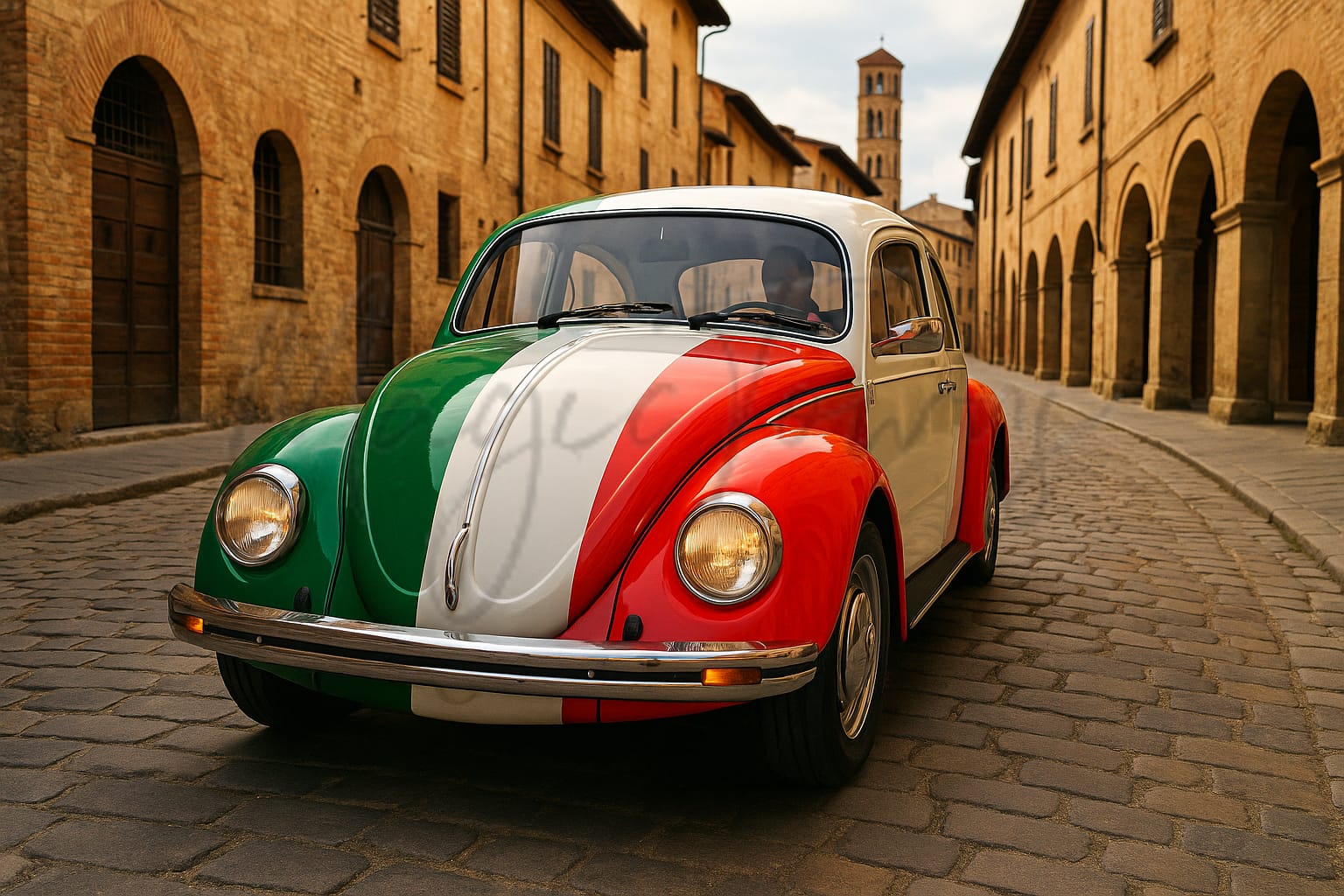
Moving to Italy offers dreamlike scenery, cuisine, and culture, but a recent Magic Towns survey of over 1,000 third-country national (TCN, meaning non-EU/EEA citizens) expats found that the single most cited difficulty in the relocation process (after getting a visa) was obtaining an Italian driving licence. This may come as no surprise, since being able to drive is often a necessity outside the major cities. Italy is Europe’s most car-dependent country (with around 684 cars per 1,000 inhabitants, the highest rate in the EU) and public transport remains limited, especially in rural and small-town areas.
Though places do exist where owning a car is not necessary (we call them “Walker’s Paradise“) in many picturesque Italian towns, life is virtually unlivable without a car: local buses are infrequent, and outside of major cities, taxis are scarce and prohibitively expensive. In this article, we’ll explain why getting an Italian driving licence is so challenging for non-EU expats and guide you through the process, including recent rule changes, workarounds, and potential improvements.
Driving in Italy on a Foriegn License
In Italy, a non-EU driving licence is only valid for a short period once you become a resident. Tourists or short-term visitors can drive with their foreign licence (often alongside an International Driving Permit for translations) for up to 6–12 months, but the clock starts once you officially register as an Italian resident. Exactly 12 months from the date you obtain residency is generally the maximum period you can legally drive on your non-EU licence in Italy. After 12 months of residency, your foreign licence is no longer recognized, and continuing to drive on it could leave you uninsured and facing fines.
For licence holders from EU/EEA countries, the situation is simpler: an EU licence is recognized in Italy until it expires. EU licence holders residing in Italy do not need to exchange their licence at all, though many choose to exchange it for an Italian one after a while for convenience. But for non-EU citizens (also known in EU terms as third-country nationals), Italian law requires you to convert to an Italian driving licence within one year of residency if you wish to keep drivingreddit.com.
It’s important to note that merely having a valid licence from your home country is not enough after that first year. Italy does not allow you to keep driving indefinitely on a foreign licence once you live there. The onus is on the expat to obtain an Italian patente di guida (driving licence) or stop driving after the grace period. The only exceptions to this strict rule are if your foreign licence is from a country that has a reciprocal conversion agreement with Italy (more on that below) or if you fall under a special status (e.g. military/diplomatic personnel). For most non-EU expats – including Americans, Canadians, Australians, Indians, etc. – the foreign licence cannot be directly converted, meaning you’ll eventually need to go through the Italian licensing process from scratch.
Bottom line: You can drive in Italy on a valid foreign licence for your first 12 months of legal residency. After that, if you haven’t obtained an Italian driving licence, you must hang up the keys. Many expats are caught off guard by how quickly that first year passes – and by how lengthy the Italian licensing process can be – so it’s wise to start planning your licence conversion or exams well before the deadline.
How to get an Italian driving licence if your foreign one isn’t convertible (e.g. Americans, Canadians)
If you’re from a country whose driving licence is not “convertible” in Italy – for example, the United States or Canada – be prepared for a challenging road ahead. Italy has bilateral licence exchange agreements with only a limited list of countries (mostly in Europe or with historic ties). For all other nationalities, there is no shortcut: you will need to obtain an Italian driving licence the same way a new driver in Italy would, including passing Italy’s theory and practical driving exams. That’s one way to feel like you’re a teenager all over again, at least!
Here’s an overview of the process:
- Enrollment (Iscrizione): You may choose to enroll at a local autoscuola (driving school) or study on your own as a privatista (private candidate). The school isn’t legally required, but it can help immensely with paperwork and preparationcollineallemontagne.com – especially given the language barrier. If you go as a private candidate, you’ll handle forms and exam bookings at the provincial Motorizzazione (DMV-equivalent) yourself.
- Medical check: You’ll need a medical certificate proving you are fit to drive, from an authorised doctor (often arranged via the autoscuola or the Motorizzazione). Basic vision and health checks are done, and a fee is paid.
- Theory test (esame di teoria): This is often the hardest part, notorious among expats. The Italian theory exam consists of 30 multiple-choice questions (formerly true/false statements), and you can only miss 3 to pass. The catch? The test is not offered in English. By law, it’s available only in Italian (and in German or French on request, due to linguistic minorities). So unless you’re fluent in one of those languages, you must learn the Italian road rules vocabulary. Many expats take intensive language classes or find unofficial English translations of the question bank to practice, but during the actual exam you’ll be reading Italian. Moreover, the questions are famously tricky – even Italian teenagers struggle with them. As one American expat lamented, “the questions are tricky even for young Italians… it’s been stressful to say the least”. Nonetheless, with serious study (and often help from a driving school’s preparatory classes), expats do pass this exam every year – so it’s tough but not impossible. Budget for exam fees (around €100 in total) and keep in mind you get two attempts per application. If you fail twice, you must restart the application from the beginning (and pay again).
- Learner’s permit (Foglio Rosa): Once you pass the theory test, you obtain the foglio rosa, a learner’s permit valid for 6 months. This allows you to practice driving on the road, but only with certain conditions: you must be accompanied by a licensed driver (Italian or EU licence) over 10 years’ experience and under 65 years old, and you cannot drive on autostrade (highways) or exceed 90 km/h. During this time, many expats take practical driving lessons through an autoscuola. While not mandatory for those who already know how to drive, lessons are highly recommended to learn Italian driving norms and ensure you don’t pick up infractions during the test. Note: Very often, the instructors know the general routes taken by examiners and where they like to test certain types of maneuver. In other words, a few driving lessons will give you helpful tricks to pass the test, even if you’re the most experienced driver in the world already.
- Practical driving test (Esame di guida): After at least one month from obtaining the foglio rosa, you can take the road test. You’ll typically use the autoscuola’s dual-control car for this exam (or your own car if you can insure it for the test and have the supervisor). The test involves driving on real roads with an examiner, performing maneuvers like parking, U-turns, and showing overall safe handling of the vehicle. The test is usually around 20–30 minutes. If you fail, you can retry (you get a couple of attempts per foglio rosa). Pass it, and congratulations, you’ll be issued an Italian driving licence!
Important: The entire process can easily take 6+ months (sometimes up to a year) from start to finish. Delays in getting exam dates are common, especially in larger cities. Theory prep can take a few months on its own. So if your home licence isn’t convertible, plan accordingly. Ideally, start the process soon after arriving, rather than waiting until month 11 of your stay. You’ll end up having to walk to your driving lessons.
For Americans, Canadians, Australians and others in this boat, the requirements above are the same as those for a local 18-year-old Italian getting their first licence. And unfortunately, there are no significant shortcuts for experienced foreign drivers: you’ll still be treated as if you’re a brand-new driver in terms of testing. That also means after you do obtain your Italian driving licence, you’ll be considered a neopatentato (newly-licensed driver) with certain restrictions (see below) as if you just passed your test, regardless of having driven for 20 years elsewhere.
One more consideration: language support. While the official theory test is in Italian, some (few) driving schools offer textbooks and courses in English to help you prepare. Few schools have instructors who speak English and can explain the rules, even though the exam won’t be in English. There are also online resources and communities of expats sharing unofficial translations of practice questions. We covered one during our interview with the Mangiaparole school. Make use of these to overcome the language hurdle. For the practical exam, language is less of an issue. The examiner may speak Italian, but the instructions are usually straightforward (and your instructor can teach you the common phrases in advance, like “turn right”, “slow down”, “park here” etc.) and nothing prevents you from asking“Può ripetere, per favore?”.
Are there any exceptions to getting an Italian driving licence? (e.g. for US military, diplomats)
If you’re in the list below, it’s your lucky day. A few special categories of foreigners can bypass the usual Italian licensing grind:
- US/NATO Military Personnel and Dependents: If you are a member of the US Forces stationed in Italy (or a dependent), you typically do not need to get an Italian civil licence. Under the NATO Status of Forces Agreement, US military and DOD civilians can obtain a “AFI” driver’s licence (Allied Forces Italy licence) without taking Italian exams. This is a special licence valid only in Italy (and only while your SOFA status is active). Essentially, the military base will issue you an AFI licence upon showing your US licence and passing a brief orientation/course. Italian authorities accept this in lieu of an Italian driving licence for driving in Italy as a service member. Be aware though: the AFI licence is tied to your status. It’s not a general Italian driving licence you can keep if you leave the military or Italy, and are also supposed to carry an International Driving Permit if you drive outside Italy.
- Diplomats and Consular Officials: Diplomats (and in some cases their families) posted to Italy often enjoy licence reciprocity as part of diplomatic agreements. In practice, many foreign diplomats in Italy can continue using their home country licence or are facilitated in exchanging it without tests. Some may be issued a local diplomatic mission driving permit. The rules can vary by country and specific agreements, but essentially, diplomats are exempt from the standard conversion requirements faced by other expats.
- Countries with Bilateral Licence Exchange Agreements: This isn’t exactly an exception to needing an Italian driving licence. Rather, it’s a shortcut to getting one. Italy has agreements with a number of countries (mostly outside the EU) to allow a direct exchange of licences. If you have a licence from one of these countries, you can swap it for an Italian one without exams, within your first year of residency. As of 2025, the list includes countries like Switzerland, UK, Israel, Turkey, and a handful of others, often with conditions.
For example, since Brexit the UK is now on this list – Brits can exchange their UK licence for an Italian driving licence within 6 years of becoming resident (or within 1 year for those who moved after 2021) without taking a test. Other countries like Argentina, Japan, South Korea, and Morocco also have agreements. Always check the latest list on the official MIT (Ministry of Infrastructure and Transport) website, because new agreements do get signed occasionally. If you’re lucky enough to hail from one of these countries, the process is much simpler: you submit an application to convert your licence (usually through an agency or the DMV), pay the fee, and you’ll get an Italian driving licence in exchange (and your original licence is often returned to your home authority). No tests required. Unfortunately, the United States, Canada, Australia, and many others are not on Italy’s exchange list – which is why their citizens must re-test as described above.
Outside of those scenarios, there really aren’t other shortcuts. Students and other short-term visa holders often ask if they can keep driving on their foreign licence longer, but unless you avoid becoming a resident officially (which has other downsides), the 12-month rule stands. International Driving Permits (IDPs) are only a translation document; they do not extend the validity beyond what Italian law permits.
One thing not to do is rely on an EU driver’s licence that wasn’t genuinely obtained. Italian law (and EU law) has provisions to prevent “licence shopping”. For instance, you cannot simply circumvent Italy’s rules by quickly getting a licence in another EU country where it might be easier and then swap it, unless you actually lived there and the licence is legitimate.
Also note: if your EU licence was originally converted from a foreign licence (say, you converted your US licence into a Danish licence), you can generally keep driving until the EU licence expires. However, you won’t be able to renew it or exchange it in Italy: your US-turned-Danish licence carries a note stating that it was converted, and Italian authorities will reject it for conversion. Essentially, you’ll have kicked the can down the road, and will still need to test for an Italian driving licence.
What car can you drive in Italy as a neopatentato?
The road to driving in Italy is seemingly full of potholes. You had to get a licence from scratch and learn the language enough to do so. Once you obtain that coveted Italian driving licence, you might think you’re free to drive any car you please. Not so fast. Italy imposes special restrictions on neopatentati, meaning new licence holders. As a new driver (defined as within 3 years of getting your first licence), you are subject to limits on the type of car you can drive and certain driving rules:
- Power and weight limits: For the first three years of your Italian Category B licence, you cannot drive vehicles exceeding 75 kW per tonne (power-to-weight ratio), and in any case no car with more than 105 kW of engine power (equivalent to 142 horsepower). This is a recent update (as of late 2024) as previously the limits were even stricter (55 kW/ton and 70 kW total, but only for the first year). Now the law has been liberalised slightly but extended to 3 years. If the kilowatt numbers sound like mumbo-jumbo to you, you’re not the only one. Realistically, you’ll have to check what vehicles fit the bill. Helpfully, we provide you with a list of suitable neopatentati vehicles in this article.
The idea behind the restrictions is to keep novice drivers out of very high-performance cars. Practically, this means many large-engine or sports models are off-limits to you initially. No driving daddy’s Porsche if you’re an Italian teen, and you can’t drive your old Porsche you imported from the UK, either! - Speed limits: Neopatentati also face lower speed limits. For the first 3 years, you may not exceed 100 km/h on autostrade (highways) and 90 km/h on major non-highway roads, even if the posted limit is higher. So even on a 130 km/h autostrada, you must max out at 100 until you’re more experienced.
- Zero alcohol tolerance: Another rule for new drivers (as well as professional drivers) in Italy – your blood alcohol must be 0.0 when driving. No celebratory prosecco and drive home for you! Italy forbids any alcohol in the blood for drivers with less than 3 years’ experience (the normal legal limit for others is 0.5 g/L). If caught even with 0.1 as a neopatentato, the penalties are severe.
Given the power limits, what kind of car can you drive as a newcomer? Fortunately, the recent increase to a 105 kW cap means there are many options – from city cars and family hatchbacks to even some small SUVs. Here’s a list of 15 vehicles (among many) that meet the neopatentato criteria in 2025, along with their basic specs:
Compliant Cars for Neopatentati (2025) – Examples of cars under 105 kW & 75 kW/tonne
(Power figures are approximate; always double-check a specific model’s kW and weight. EVs and hybrids have special considerations for power/weight but many are allowed under the new law.)
As you can see, new drivers aren’t stuck only with tiny 50 hp cars – the 105 kW rule now allows up to roughly 140 hp, which includes a wide range of family cars and SUVs, as long as they aren’t extremely lightweight. Popular models like the Fiat Tipo sedan, Volkswagen Golf 1.5 TSI (96 kW) or even a Jeep Renegade 1.6 diesel (88 kW) are now just within reach for new drivers thanks to the updated limits – whereas previously those would have been banned for a year.
Do note that if you’re driving with the foglio rosa (learner’s permit before you get your licence), you must display a large orange “P” sticker (for Principiante, beginner) on the car. After you pass and get the licence, that “P” is no longer required – but the above restrictions remain in effect for 3 years. Breaking the neopatentato rules (e.g. driving a too-powerful car or speeding beyond 100) can result in heavy fines and even licence suspension. So choose your vehicle accordingly and drive cautiously those first years.
Will Italian insurance recognize your foreign driving history?
After jumping through hoops to get an Italian driving licence, many expats face (another) nasty surprise when insuring a car in Italy: Italian insurers will likely treat you as a brand-new driver, regardless of decades of accident-free driving abroad. Italy has a claims class system for car insurance (class 1 to 18, where new drivers typically start at class 14, paying high premia). Unfortunately, most Italian insurance companies do not recognise a no-claims bonus or driving history from non-EU countries.
What does this mean in practice? If you’re an American or other non-EU licence-holder who just got an Italian licence, you will usually be rated as having zero Italian driving history – essentially equivalent to a teenager who just passed their test. Premiums for new drivers in Italy can be very high, often €1,500+ per year for basic coverage on an economy car. This can come as a shock if you were used to cheap insurance back home due to a long safe driving record. (You’re in for another shock as you discover that premia can be vastly more expensive in “less safe” areas of Italy than in others. We provide you with this guidance in our Town Explorer profiles).
There are a few nuances and tips:
- Some insurers might consider your past if you transfer a no-claims bonus from an EU/EEA insurer. If you previously had car insurance in an EU country that provides a certification of your claim-free years, Italian companies can choose to uphold it. For example, if you lived in Germany and had 5 claim-free years before moving to Italy, look for an insurer that accepts that certificate – they might bump you up to class 9 instead of class 14, which could significantly cut costs. This is thanks to EU rules on recognising no-claims between member states.
- For non-EU insurance history, it’s tougher. Italian insurers are not obliged to accept a driving record or no-claims letter from, say, a US or Canadian insurance company. However, some international-oriented insurers or brokers might take it into account as a gesture (especially if they want your business). It’s worth asking. Bring any documentation you have – e.g. a letter from your previous insurer listing how many years you were claims-free, translated into Italian if possible. Just manage your expectations: many companies will politely file it away and still start you at class 13 or 14.
- Shop around and use brokers: Car insurance in Italy varies wildly. Some companies penalize new drivers brutally, others are a tad more lenient if you’re older (e.g. a 40-year-old who just got their licence may get a slightly better rate than an 18-year-old). Use comparison sites (like Facile.it) and consider talking to an insurance broker who deals with expats. They might know which insurers occasionally accept foreign no-claims bonuses or have niche policies for new residents.
- Family option (Legge Bersani): Italy has a law that allows you to inherit the insurance class of a family member in the same household for a new policy. If you have an Italian spouse or even a convivente (partner at the same residence) with a good insurance class, you might be able to start your policy at their class. This won’t apply for many newly arrived expats, but it’s worth mentioning.
In summary, don’t expect your 20 accident-free years in California or Sydney to automatically translate into a cheap Italian insurance rate. Prepare for possibly first-time driver insurance prices for at least the first year or two. Over time, as you accrue Italian no-claims years, your class will improve annually and premiums will (or should) drop, but the first year is the hardest hit.
One more note: if you do have an at-fault accident as a neopatentato, the penalties on both your licence and insurance can be steep. New drivers have only 20 points on their licence (versus 30 for experienced drivers), and violations in the first years often incur doubled fines. On insurance, a claim will typically knock you down 2 classes (e.g. from 14 to 16), making the already high premium shoot up further. Drive safe and defensively to protect both your record and wallet.
Is the EU planning to change this system?
Given the patchwork of rules across Europe for recognising foreign licences, the EU is indeed looking at ways to simplify life for expat drivers. In March 2023, the European Commission presented proposals to modernise EU driving licence rules, and one element explicitly aimed to make it easier for people from certain non-EU countries to exchange their licence for an EU one.
The idea is to allow direct exchanges without re-testing if the non-EU country’s road safety standards are deemed “comparable” to the EU’s. In other words, if you come from a country with a solid driving examination system and traffic safety record, the EU might compel all member states to honor your home licence by a simple swap.
As of 2025, these changes have not yet come into force. They are part of a broader EU driving licence directive update that includes other measures (like digital driving licences, revised testing for new drivers, etc.). The legislative process in the EU takes time – the Commission proposes, then the European Parliament and Council need to agree. There has been provisional agreement on some aspects of the new Driving Licence Directive, but member states may still negotiate details like which countries are considered equivalent for licence exchange.
It’s also worth noting that the EU has floated ideas like temporary one-year EU licences for newcomers or international students, and other flexible arrangements, but these are still speculative. For now, each country maintains its own list of recognized licences. The UK’s exit from the EU highlighted this issue, prompting many bilateral deals (as we saw with Italy and the UK exchanging licences). The EU-wide solution would streamline such arrangements for all member states together.
In short: Yes, change is on the horizon, but not here yet. If you’re moving to Italy in the next year or two, you should proceed under the current rules (i.e. plan to do the Italian test if required). Keep an eye on EU news, though. It’s possible that in a few years the process will be far easier for the expats of the future. Perhaps one day “bureaucracy” won’t top the list of expat complaints! And if that day ever comes, we’ll let you know.
How do other EU countries treat US, UK, Canadian and Australian licences?
Driving licence conversion rules vary widely across the EU. Some countries are more lenient than Italy, while others are just as strict. Here’s a quick comparison of how a few major EU countries treat licences from USA, UK, Canada, and Australia:
| Country you are moving to | US licence | UK licence | Canadian licence | Australian licence |
|---|---|---|---|---|
| France | Yes – exchange possible for 18 US states (if resident <1 year); other states must re-test | Yes – exchange within 1 year (no test) under UK–France deal post-Brexit | Yes – exchange possible for certain provinces (France has reciprocity with some Canadian provinces) | No – no direct exchange (full testing required) |
| Germany | Yes – exchange without test for licence holders from 27 approved US states; other states require testing | Yes – exchange within 6 months of moving (no test) under Germany–UK agreement | Yes – all Canadian provinces have reciprocity (no tests needed) | Yes – full reciprocity (no test) for Australian licences |
| Spain | No – no exchange agreement (US drivers must re-test in Spain) | Yes – exchange allowed (a bilateral deal in 2023 lets UK licence holders swap without tests) | No – no general exchange (must take Spanish test) | No – no direct exchange (must re-test) |
| Netherlands | No – not for ordinary residents (Americans must re-test) (*) | Yes – exchange without test (UK is treated like an EU licence currently) | Yes – exchange available (Netherlands recognises Canadian licences via agreements) | Yes – exchange available (Australia is on the approved list) (*) |
(*) Netherlands: The Netherlands makes an exception for highly skilled expat workers: if you qualify for the 30% tax ruling as a knowledge migrant, you can exchange any foreign licence for a Dutch one without tests. We’re not sure what the reasoning is here: perhaps you’re assumed to be too smart to have a road accident. If you don’t have that highly-paid expat status, the Netherlands only exchanges licences from certain countries (which include the UK, Canada, Australia, New Zealand, Japan, South Korea, etc., but notably not the US unless). Regular American licence holders moving to NL face the exams just like in Italy, whereas a Canadian or Aussie can swap thanks to reciprocity agreements.
As you can see, policies differ by country:
- Germany stands out as very welcoming – they honor licences from a large number of countries and even specific U.S. states. All Canadian provinces and Australian states are recognized for a straight swap. Germany essentially spares many expats the trouble of re-testing (though you still must apply for the exchange within the first six months of residence in most cases).
- France is mixed – they have state-by-state deals in the US (18 states as of 2024) and some Canadian province agreements. If you’re lucky to come from, say, Florida or Illinois, moving to France is easier (no test); from New York or California, you’re out of luck and must take the French exam. France does allow UK exchanges (with deadlines tied to Brexit implementation) and often Latin American countries due to historic ties (for example, French overseas territories or certain South American countries have agreements).
- Spain historically had no exchange for Americans or Canadians, and only recently sorted an agreement for Brits. Spain does have exchanges with many Latin American countries (sharing language and treaties) – e.g. if you’re from Argentina, you can swap in Spain, but if from the USA, you cannot. So it’s a bit asymmetric.
- Other EU countries: Many smaller countries align with one of these approaches. Some, like Belgium and Sweden, allow theory exams in English which at least eases the process for English-speaking expats (though they still require the tests if no reciprocity). Ireland interestingly has no automatic exchange for US/Canada either, despite the cultural ties. Americans in Ireland have to pass the Irish test (which is also quite involved, including mandatory driving lessons, not to mention they are driving on the “wrong” side of the road). However, Ireland and the US are reportedly discussing a reciprocity deal, so that could change. Malta, being English-speaking, is sometimes sought out by Brits or Australians for an easier experience, but Malta too requires tests for non-exchangeable licences (the exam can be taken in English there, which helps but, again, you will be driving on the left side).
In summary, if you have the flexibility and foresight, it can make sense to obtain your EU licence in a country with easier rules if you plan to move around. For instance, some expats first move to Germany or another accommodating country, swap their home licence for an EU licence, and then move to Italy, thereby avoiding the Italian exam entirely. (EU licences are mutually recognized, so once you have one, you can exchange it in another EU country without exams.) This kind of two-step manoeuvre must be done legitimately (you need legal residence in that first EU country), but it’s a hack that a few savvy expats have used. Of course, not everyone has the luxury to pick and choose countries just to get a licence.
The table above and examples show that Italy is not uniquely difficult – many EU nations make Americans and others re-test – but Italy’s combination of no reciprocity, no English testing, and strict new-driver rules certainly puts it on the tougher end of the spectrum. The ongoing discussions at the EU level, as mentioned, might eventually harmonize and relax these differences.
What you can do to make this easier
Facing the Italian driving licence ordeal can be daunting, but there are a few strategies and tips to smooth the path:
- Invest in Italian language lessons (or at least driving vocab): Since the theory exam is in Italian, improving your language skills is key. Even if you can’t become fluent, focus on studying the Italian driving handbook (Manuale di Teoria) and learning the specific terms (e.g. corsia = lane, incrocio = intersection, sorpasso = overtaking, etc.). Many expats swear by using online quiz apps (which you can find for both Android and Apple devices) daily. Some driving schools offer courses where an instructor explains the theory in English but then helps you practice in Italian. And we mentioned there are schools like Mangiaparole (this isn’t sponsored, just want to point that out) that focus on getting you to pass the test.
- Practice tests, practice tests, practice tests: There are free websites and mobile apps that replicate the official exam questions (which are drawn from a large question bank). Do hundreds of practice questions until you consistently score well. It not only teaches you the rules, but also the “gotcha” phrasing to watch for. By exam day, you want to recognize patterns (e.g. questions containing “non…unless…always” etc. which can trip you up).
- Consider taking the driving test in another EU country: If you have the possibility (work, study, or family reasons) to spend time in a country like Germany, the Netherlands, or Ireland and get a licence there, it might be easier. Germany allows the theory test in English and recognizes US licences from many states – so some Americans find it easier to get a German licence and later transfer to Italy. Ireland conducts the test in English (though it has mandatory lessons and a waiting period for road test). This is obviously a drastic measure and not feasible for everyone.
- Leverage any dual citizenship or exchange opportunities: If you happen to have dual citizenship or residency in a country that has an agreement with Italy, use it. For instance, some Latin American expats who also hold Spanish citizenship were able to first exchange their foreign licence in Spain (thanks to Spain’s agreements) and then bring the Spanish (EU) licence to Italy. Each person’s situation is unique – explore your connections.
- Get familiar with Italian driving early: While you have that one-year grace period on your foreign licence, use it to adapt to Italian roads. Drive often (legally, with your IDP if required) to get used to local driving styles, road signs (which are mostly pictograms and Italian text), and the quirks of Italian traffic. The practical test might include scenarios like navigating complex roundabouts or handling assertive traffic – things you can practice during your daily drives. Just remember that after month 12, you should stop driving.
- Prepare financially: Budget for the costs. The whole process (medical visit, theory test, school fees or books, practical test, etc.) can run several hundred euros – more if you take many driving lessons. Also, initial car insurance will be expensive as mentioned, so factor that into your relocation finances. Some expats decide to delay buying a car until they have the licence and maybe have had it for a year to avoid the absolute worst insurance class. In the meantime, they rely on public transport or car-sharing for a bit longer (tough in rural areas, but perhaps manageable if you live in a city initially).
- Patience and persistence: Many expats require more than one attempt to pass the theory or even the practical. If you fail, don’t be discouraged. Analyze what went wrong (many times it’s the language on theory, or a specific maneuver on the practical) and try again. As long as your permit is valid, you usually can retake the theory once (with the initial fee) and the practical twice. If you run out of attempts, yes, you must reapply, but you’ll be wiser the next time. It’s a hurdle, but countless expats before you have cleared it and are happily driving around la bella Italia now.
Finally, if you’re really struggling with not being able to drive, consider interim solutions like mopeds, micro-cars or e-bikes. These aren’t long-term solutions for most, but they could give you some mobility in a pinch while you work on the full licence. And with Amazon Prime and grocery deliveries in many semi-rural areas, it isn’t impossible to survive on a no-car diet for a few months.
What you can’t do without an Italian driving licence
It’s equally important to know the don’ts in this process to avoid legal troubles:
- Don’t keep driving indefinitely on a foreign licence: As stressed, after 12 months of residency your foreign licence is no longer valid in Italy. There’s no loophole to extend this (IDP is not an extension; it’s just a translation document). Some expats try to fly under the radar, but if you get pulled over or, worse, have an accident after that period, you could be charged with driving without a licence – a serious offense. It’s not worth the risk to “wait one more year.” Plan ahead to either stop driving or get the Italian driving licence in time.
- Don’t swap a licence in another EU country after you’re already resident in Italy: Once you are an Italian resident, you are expected to follow Italian rules. For example, if you hear that Germany would exchange your licence without a test, you can’t simply mail your licence to a German friend or somehow do a quick exchange trip because you won’t meet the residency requirement in Germany. Your official residence is Italy, so any exchange must happen under Italy’s system. If you actually moved to Germany first, do the exchange, then move to Italy, that’s fine. But Italy may reject an exchange from another EU country if you weren’t genuinely resident there.
- Don’t assume a previously converted licence is convertible again: We mentioned this earlier. Say you converted a foreign licence to a UK licence in 2020, and now try to convert the UK licence to Italian. Italy’s agreement with the UK allows exchange of UK-issued licences. In most cases, they will exchange it without question. But if your UK licence has a code on it indicating it was an exchange from country X, Italian authorities theoretically could say “we don’t have a deal with country X, so we won’t honor this exchange.”
- Don’t drive alone on a learner’s permit: With the foglio rosa, you must always have an experienced accompanying driver when practicing, and adhere to its limitations. If you drive unaccompanied or on highways when you’re not allowed, you will be fined just the same as if you were driving without a permit.
- Don’t overlook the new-driver restrictions: As a neopatentato, avoid the temptation to drive that high-powered rental car or a friend’s Maserati “just this once.” If you’re caught, the fines can be hefty (hundreds of euros), and it could lead to your shiny new licence being suspended. Likewise, absolutely do not drink and drive – not even one beer – during those first three years (really, one should never drink and drive, but new drivers have zero leeway). Italian police often do random alcohol checkpoints, and they will show no mercy if you’re a new driver over 0.0 BAC.
- Don’t lose hope or your temper: Dealing with Italian bureaucracy can be frustrating. Long lines at the Motorizzazione, examiners who might seem overly strict, multiple exam failures… this can all test anyone’s patience. But venting at an official or examiner will get you nowhere (in fact, it will get you in trouble). Keeping calm and carrying on is the only way through. Join expat forums and share your woes; it helps to know you’re not alone and others have eventually succeeded.
What Italy could do better
While this article mainly guides expats on how to navigate the system as it exists, it’s worth reflecting on how Italy could improve this experience (we write sections like this all the time, in the hope that someone “up there” in government will take note. And hope springs eternal):
- Offer the theory exam in English (and other major languages): Italy did away with English-language driving tests in 2011, but many EU countries still offer exams in multiple languages. Given how many foreign residents Italy has – not just from English-speaking countries but from Asia, Africa, etc. – providing an option to take the theory in English (or even allowing an official translator) would be a huge help. It would not undermine safety, as the content is the same; it would simply remove a language barrier. Even the Vatican, right next door, allows driving tests in several languages! It’s an achievable change that would instantly make Italy more expat-friendly.
- Expand reciprocal agreements: Italy could negotiate agreements with more countries or territories. For instance, some EU states allow exchanges with individual U.S. states or Canadian provinces. Italy currently doesn’t, but why not? If an American has a licence from a state known for rigorous tests, and a large population (say New York or California), Italy could reasonably allow a swap – perhaps still requiring a road test but waiving the theory, or something along those lines. The same goes for countries like India or South Africa – large expat populations in Italy who must all re-test currently. Crafting deals to at least partially recognize those licences (maybe require only the theory or only the practical) would reduce the burden on both expats and the licensing offices.
- Improve testing availability and transparency: Many Italian Motorizzazioni are backlogged, and booking a test can be slow. Increasing the number of exam sessions or examiners would help everyone (Italians and expats alike). Also, making the process clearer – for example, publishing the theory question bank in multiple languages officially – would make it less of a mystical challenge and more about actually learning the rules.
- Insurance considerations: While insurers are private companies, the government could encourage recognition of foreign no-claims history, perhaps through a standardized certificate. Right now it’s ad hoc. If Italy wants to attract skilled workers, addressing the exorbitant insurance costs (one of the side effects of the licence issue) would be wise. Some countries allow new residents to bring a letter and start at a better insurance class; Italy could promote this practice.
- Digitalization and support: The overall licence process could be more digital. Some countries let expats apply for exchanges or tests online, check progress, etc. In Italy, it’s often an old-fashioned shuffle of paper receipts and stamps. Moving more of it online (which the EU’s new directive would also push) could ease confusion and reduce trips to offices.
- Differentiation for experienced drivers: Perhaps a bold idea: Italy could introduce a special shorter course or just a road test for those who already have years of driving experience abroad, instead of treating them exactly like new teenagers. For instance, an accelerated programme in English that skips the classroom lectures and focuses on Italian road rules differences could be implemented. After all, this is what Italy has already agreed to do for American military personnel stationed in the country. It isn’t impossible.
In the end, these changes would not only help expats but could also benefit road safety – by making sure people actually go through the legal process rather than risk driving illegally out of frustration. A more accommodating system means more drivers on the road are properly licensed and informed about Italian rules, which is good for everyone.
Conclusion: Obtaining an Italian driving licence as a non-EU expat is undeniably a challenge – a blend of bureaucracy, language tests, and patience. From our survey and expat testimonies, it’s clear this is one of the toughest parts of integrating into life in Italy. However, with determination and the tips outlined above, it’s a challenge you can overcome. Once you do, you’ll have the freedom to explore every corner of Italy’s beautiful landscapes on your own terms (and perhaps a newfound appreciation for the accomplishment!).
Have you gone through this process, or are you in the middle of it? We’d love to hear your experiences. Feel free to share your story or ask questions on our social media outlets. And if you found this article helpful, consider subscribing to Magic Towns Italy for more expat guides and local insights. Buona fortuna with your licence journey – and see you on the road in Italy!









 English
 French
 German
 Italian
 Danish