
Very often, when traveling to Italy or even when moving here, it can be difficult to discover what we Italians would call “chicche“, in other worlds, hidden gems: small, lesser-known places where you can experience an authentic side of Italy, steeped in history and ancient traditions. We’ve compiled a list of our five favorite villages, each unique in its own way, yet all easily connected to other points of interest.
Arquà Petrarca (Padua, Veneto)
Arquà Petrarca is undoubtedly one of Italy’s most beautiful villages, tucked away in the Euganean Hills. Best known as the place where poet Francesco Petrarca spent his final years, it’s believed he chose this spot because the landscape reminded him of his beloved Tuscany. Indeed, it’s hard not to be captivated by the charm of this village, from the friendliness of its residents to the cozy little restaurants lining the streets.
Today, you can visit Petrarca’s historic home for just over 6 euros. The best times to visit are in spring or summer, or in early October during the Festa delle Giuggiole, a local celebration dedicated to the jujube fruit, which is widely cultivated in this area.
The most convenient way to reach it is by car, with several parking areas available nearby for just over 1 euro per hour. Considering the beautiful location, I suggest staying in the area and organizing some walks or bike rides along the various trails in the Euganean Hills Regional Park.
Otherwise, if you have extra time and are in the mood for something a little livelier, Padua is just over 35 minutes by car, while Vicenza, Verona and Venice are all within an hour’s drive.

Castelmezzano (Potenza, Basilicata)
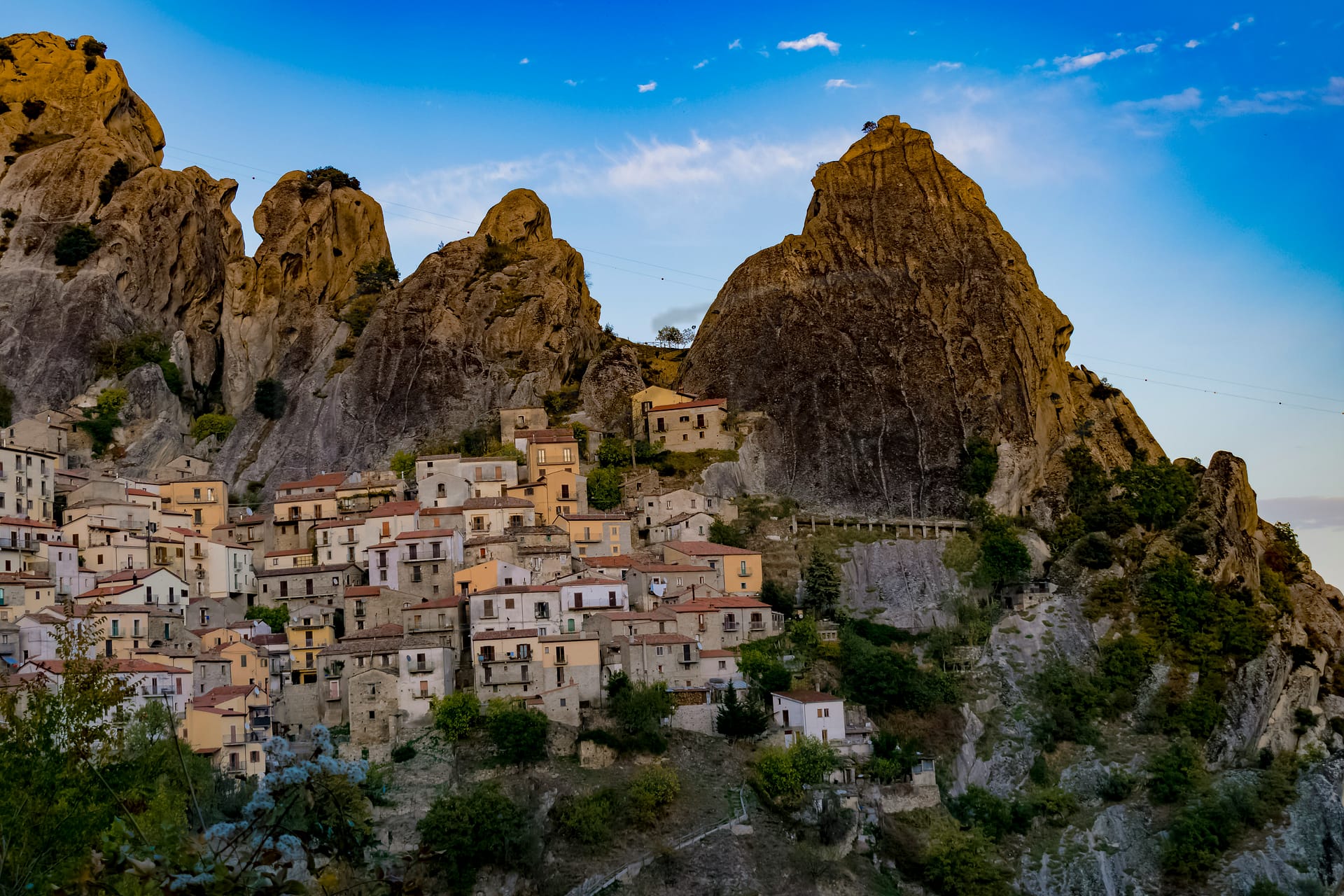
Castelmezzano is a great choice for those in search of a village set in a truly breathtaking landscape, nestled in the heart of the Piccole Dolomiti Lucane (Little Lucanian Dolomites). The houses here are carved into the rock itself and connected by a maze of narrow alleys, with the Church of Santa Maria dell’Olmo at its center.
Though small in size, it offers plenty of experiences for visitors, such as the Volo dell’Angelo (Angel’s Flight), a zipline that connects Castelmezzano to its twin village, Pietrapertosa. For adventure lovers, the Via Ferrata Salemm is a well-equipped climbing route allowing you to scale the Lucane Dolomites and fully immerse yourself in nature, complete with Nepalese bridges.
If you prefer something less extreme, the Percorso delle 7 Pietre (Path of the 7 Stones) offers a 2 km hike between the villages, once walked by local farmers and now enriched with mythological tales along the way. And starting April 25, a new mountain toboggan ride will open, providing a scenic and fun way to descend from the heights back to the village center.
The ideal time to visit is between summer and early October, when the weather is perfect for outdoor adventures.
For accommodations, you can stay right in Castelmezzano or opt for the nearby town of Satriano di Lucania, famous for its stunning murals that cover the walls of homes and buildings. If your schedule allows, don’t miss a visit to Matera, just over an hour away, known worldwide for its ancient cave dwellings.

Santo Stefano di Sessanio (L’Aquila, Abruzzo)
Abruzzo is a beautiful and still largely undiscovered region of Italy. If you’re planning a trip and find yourself near L’Aquila, you should know that you’re just 40 minutes away from Santo Stefano di Sessanio.
This tiny medieval village, home to just 105 residents, is nestled within the stunning Gran Sasso National Park. It’s the perfect destination for a quiet weekend escape, surrounded by untouched nature and centuries of history.
To make the most of your visit, pair it with a hike to Rocca Calascio, just 5 km away. This magical fortress is well worth the effort to reach, offering dramatic landscapes and one of the most breathtaking panoramic views in the region. If you’re visiting in winter, especially around Christmas, don’t miss the Stiffe Caves, because they’ll host one of the most beautiful nativity scenes in Italy.
As with many mountain villages, having a car is essential. Fortunately, there are several free parking areas just outside the village walls, including charging stations for electric vehicles.

Montemerano (Grosseto, Tuscany)
Tuscany is well-known for its beauty, but Montemerano stands out as one of its lesser-known treasures.
This medieval village lies in the hills of the Maremma, a region famed for its wild, unspoiled landscapes that alternate between beaches, mountains, and an endless countryside.
Situated in the province of Grosseto, Montemerano is just about an hour’s drive from the coast and conveniently close to the iconic Saturnia thermal baths – an absolute must-visit, especially in autumn or spring (preferably in May to avoiding the crowds).
The surrounding area is also dotted with other small villages worth exploring, such as Pitigliano, Sorano, and Sovana, each located roughly 30 minutes away.
For wine lovers, Villa Acquaviva nearby organizes wine tasting experiences with local product tastings, all for just 15 euros.

Borghetto sul Mincio (Verona, Veneto)
Back in Veneto, Borghetto sul Mincio is a beautiful village, perfect for history enthusiasts or anyone looking for quieter alternative to the more touristy towns around Lake Garda.
The best time to visit is in the early morning, when the streets are still quiet. You can walk through the narrow alleys, check out the historic watermills (some of which are open to the public) and cross both the Visconti Bridge and the wooden footbridge nearby.
A must-try local specialty is the Tortellini di Valeggio. According to local legend, this dish symbolize the love story of Silvia, a water nymph, and Captain Malco, who leapt into the river to protect their forbidden love.
Borghetto is quite small and easily explored in about an hour, making it an ideal day trip stop. For accommodations, we suggest staying in Sirmione, which is just 30 minutes away. It’s a lakeside spa town where you’ll find lots of hotels with wellness facilities like saunas and spas, which makes it perfect for unwinding after a day of exploring.
Thanks to its strategic location, it is also a great base for discovering other places like Peschiera del Garda (15 minutes away), or Verona and Mantua, both reachable in about 40 minutes by car.